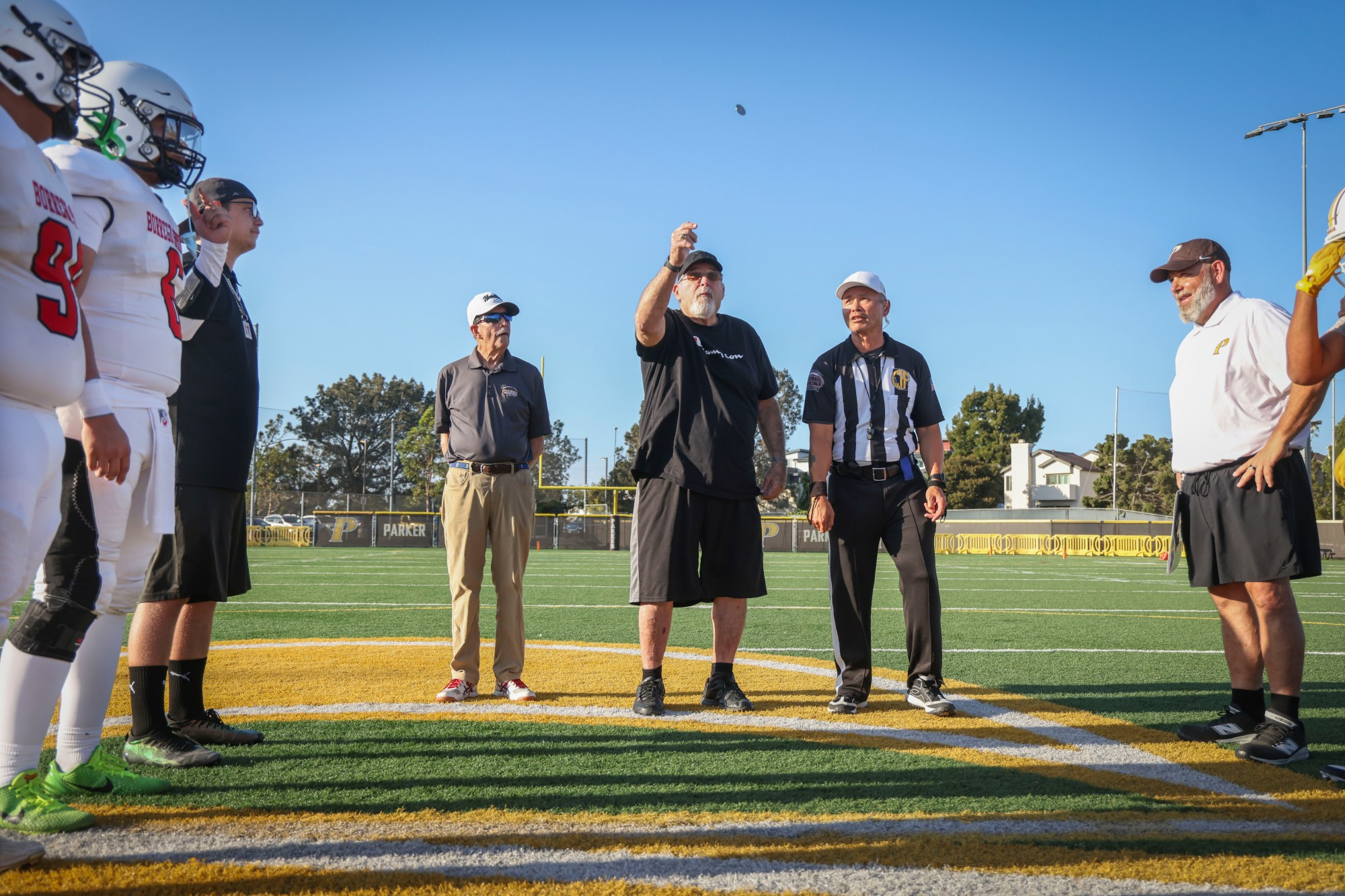
2026 Football Week 0: Six Teams in Max Preps’ State Preseason Top 25

Clear the decks! Football is Back.

A few late schedules have drifted in but most teams, with schools in session, have wrapped “training camp” modes after toiling under hot August skies and gearing for the 67th season of the San Diego Section, which started in 1960.

First games are this week, most on Aug. 21 or 22, although some teams won’t play before Aug. 28 or Sept. 4.

Notes to You:

—Cathedral (11th), Lincoln (14), La Costa (17), Carlsbad (18), Mission Hills (22), and Granite Hills (25) are in Max Preps’ preseason State top 25.

—Carlsbad is at home vs. Nevada preseason No. 4 Las Vegas Arbor View, which lost its opener, 20-14, to Salt Lake City West.  Arbor View won on road, 45-44, at Lincoln in 2024.

—Lincoln begins at home versus Los Angeles Carson, preseason No. 1 in the L.A. City Section.

—Cathedral’s opener is in Week 2 against Southern Section Trinity League power Orange Lutheran, Max Preps’ preseason No. 9.  Sean Doyle’s Cathedral Dons beat OLu, as it is known by insiders, 71-62, in the 2021 Southern California regional playoff before a 33-21 win over Folsom for the State Division 1 championship.

—El Capitan, seeking a bounce from 2025’s 4-7 season, opens at Hawaii’s Oahu Pearl City, 7-6 last season.  The Vaqueros have a hsratings.com grade of -14.6 to the purple-and-white-clad Chargers’ -32.7.

—Mira Mesa (-29.4) will play the same evening 17 miles east of El Capitan-Pearl City against Kaneohe James Castle (-35.7), a 44-20 loser in its opener to Honolulu Admiral Radford and a 67-0 loser to San Juan Capistrano San Juan Hills in Hawaii Week 2.

—Torrey Pines’ first game is Thursday, Aug., 20, at Radford.

—Army-Navy, 58-52 since 2015 under Nehemiah Brunson but 34-11 from 2022, opens at home against North Las Vegas Career and Collegiate.

The Warriors are ranked 32nd in the San Diego Section by Max Preps.  The Wolves, 73rd in Nevada ratings, were 2-6 in 2025, but opened the  season last week with a 26-0 win over Judge Memorial of Salt Lake City.

—Santa Fe Christian, 103-44 (.701) from 2013, when Jon Wallace became head coach, faces Army-Navy in a Coastal League opener in Week 5 Sept. 18.

Wallace is tied at 52nd with Chula Vista’s George Ohnesorgen in all-time wins after joining 54 other coaches with at least 100 career victories.  Sean Sovacool of La Costa Canyon (108-68, .614) is 47th following the Mavericks’ 9-2 season in 2025.

—Cathedral’s Sean Doyle (251-116-0, .684), whistling in his 31st season, sits No. 2 in all-time victories, with only Herb Meyer (339-148-15, .690) in front. Doyle can catch the late Oceanside and El Camino coach by averaging 11 wins for eight more seasons. Meyer coached 45 years, 1959-2004.

–After 68 years as Chieftains, Clairemont now is known as the Captains.

—At last count there were 20 coaching changes since the 2025 campaign, including a familial connection:

Tim White, after 10 seasons at Borrego Springs and earlier tenures at Julian and Westview, moved to Francis Parker, and Ty White, Tim’s son, takes over at Borrego Springs.  Watching closely is Big Ed White, the proud father and grandfather and should-be Hall of Famer who played 17 seasons in the NFL, the last nine as the right guard in the San Diego Chargers’ Air Coryell attack.

SCHOOL NEW FORMER FIRST GAME
Bonita Vista Diante Lee Jay Hernandez @Eastlake
Borrego Springs Ty White Tim White @St. Joseph
Brawley Rick Stewart Bert Esposito Palm Desert
Calipatria Rick Vandiver Rick Stewart @Foothills Christian
Coronado Joshua Dean Kurt Hines Hilltop
El Cajon Valley Syd Reed James Simon @Mar Vista
El Camino Stefan McClure Mike Hobbs @Mission Hills
Escondido Ian Kelly Stephen Dixon Fallbrook
Escondido Charter Erick Morales Jon Goodman Foothills Christian @El Cajon Valley
Francis Parker Tim White D.J. Walcott San Bernardino Public Safety
La Jolla Country Day Carmy Cesaire Tyler Hales @Canyon Hills
Mabel O’Farrell Corey Miller-Thompson Bruce Newland Coastal
Mission Hills Thomas Altieri Chris Hauser (4), DJ Zapata (7) El Camino
Mount Miguel James Simon Verlain Betofe @Montgomery
Orange Glen Neil Bonahoom, Jr. Santiago Rocha Maranatha
Poway Ryan Hernandez Brandon Harris Scripps Ranch
San Diego Stephen Cooper Syd Reed @Steele Canyon
San Pasqual Andrew Clark Tony Corlee Classical
Scripps Ranch John Taylor Marlon Gardinera @Poway
Valhalla Jason Carter Wayne Cherry San Jacinto Valley


1930 Football, Looking Back: They Don’t Like Their Vintage Mascot

Originally published Aug. 16, 2014.

Now wait just a grape-pickin’ minute!

Students at Escondido High were up in arms.

They did not cotton to the term Grape Pickers or its use to describe the school’s athletic teams, although the wine-making fruit held agricultural sway in the area and the city had hosted a Grape Day Festival since 1908.

The students wanted a tough, masculine mascot.

They voted to adopt the cougar, which had been known to prowl the mountain ranges near the valley community for centuries.

The school also made a request of sports writers to refrain forthwith  from referring to Grape Pickers in print.

Perhaps coincidentally, football at the second oldest football-playing school in the County finally was earning some respect.

The Cougars, paced by future major league baseballer Pete Coscarart; Tom Luscardi, and future NFL player Ed Goddard, posted a 9-2 record although defeated by El Centro Central in the CIF minor division championship game.

THREE-WAY TIE

Along the way, coach Harry Wexler’s North County squad tied with Coronado and Grossmont for the Southern Prep League championship.

Escondido defeated Grossmont, 31-0, and Grossmont topped Coronado, 12-7, but Coronado upset the Cougars, 20-6.

The teams were 3-1 in final standings and followed an interesting path from there.

A three-hour meeting of representatives from the three schools was held Monday, Nov. 12, at the Stanley Andrews store in downtown San Diego.

A league rule stipulated that a playoff would have to be played Tuesday, Nov. 13, or Friday, Nov. 15.

In the scrambling, seemingly haphazard manner in which the CIF Southern Section selected playoff teams, it appeared that two clubs from the Southern League were eligible for the postseason.

According to The San Diego Union, Coronado coach Amos Schaefer said he’d play only if Grossmont agreed to enter the playoffs.

Grossmont coach Jack Mashin bailed, citing a number of injuries that depleted his squad would preclude a game the next day.

Mashin and Schaefer, after a three-hour back and forth, finally conceded the championship to Escondido and its representative Martin Perry, and cited curious logic:

Ed Goddard attempts tackle on Coronado's Jimmy Blaisdell, who helped Islanders upset Escondido.
Ed Goddard attempts tackle on Coronado’s Jimmy Blaisdell, who helped Islanders upset Escondido, 20-6.

Grossmont had beaten Coronado the previous Friday and even if Coronado would defeat Escondido again, the Islanders’ loss to Grossmont would overshadow a win over Escondido.

That’s the way it was reported in The San Diego Sun.

ORANGE PEELED

The Cougars routed Orange County champion Orange, 52-0, that Friday in their final, regular-season  game. But a pregame story in The Sun declared that the matchup “may be considered as one of the Southern California interscholastic Federation, Unit B playoff contests.”

The disclaimer notwithstanding, the playoffs were scheduled to begin the following week, when Escondido was to play the inaugural City League champion, Point Loma.

It gets more confusing.

The story in The Sun added, “If pairings should so fall that Orange and Escondido would logically be paired up in second round playoffs the score of tomorrow’s game in all probability would be considered instead of (Escondido and Orange) playing another game.”

NEW DEAL

Always looking for possible revenue streams, the struggling federation this season had divided its members by leagues into Major Division and geographic Northern Minor and Southern Minor.

Teams from the Coast, Cirtrus Belt, Foothill, Orange, Ventura, Bay, and San Luis Obispo leagues were placed in the Major Division.

Teams from the San Diego City League, Southern Prep, and Imperial Valley circuits would align in the Southern group.  Teams from the Riverside, San Gabriel Valley, Ventura Minor, and Tri-County loops would comprise the Northern group.

The increased playoffs and more numerous pairings didn’t “fall” to a Cougars-Orange showdown.

Escondido met Point Loma and moved on with a 13-6 victory. Next up was Banning, the Riverside County champion, and the Cougars sent the Broncos home, 46-0.

The win over Banning set up a second match with El Centro Central, beaten, 6-0, by the Cougars early in the season.

Maybe it was the long postseason, but even a partisan home crowd couldn’t help the Cougars, who dropped a 20-6, championship game decision to the team from Imperial Valley.

Point Loma’s City League champion, coached by Lawrence Purdy (top). Hoover, with former San Diego coach John Perry, fielded its first team.

THE WEXLER WAY

Coach Harry Wexler brought the Escondido program out of the depths in which it resided for most of the previous 30 years. His teams posted a 57-32-11 record over 10 seasons from 1928-37.

Escondido’s record under five coaches from 1920 until Wexler was hired was 10-41-5.

Wexler’s .624 winning percentage  is bettered at Escondido only by the standard of the legendary Bob (Chick) Embrey, who was 144-66-4 (.682) from 1956-77.  Paul Gomes was 59-37-7 (.607) from 2001-09.

Local merchants, so taken with the Cougars’ success, closed their stores in order to see the game with rival Oceanside.

NO, NOT ME

Did Wexler, a Washington State Cougar in his undergraduate days, have something to say about the change in nicknames?

School officials said Wexler did not suggest or have anything to do with the switch.

Wexler undoubtedly had something to say about Goddard’s future.

The sophomore fullback went on to an all-America career at Washington State and was the second player  selected in the 1937 NFL draft.

A Los Angeles Times reporter was so taken with Goddard’s running in a victory over USC that he coined Goddard the “Escondido Express.”

GODDARD GOES FIRST

There had been a handful of San Diego-area preps who had played professionally, notably Russ Saunders of San Diego High with the 1931 Green Bay Packers, but Goddard was the first to be drafted in the NFL.

Goddard played two seasons, 1937 and, ’38,  with the Brooklyn Dodgers and Cleveland Rams and then went into teaching and coaching. He was an assistant coach on the 1950 Fullerton High staff. The Indians upset San Diego, 20-19, in the playoffs.

Hilltoppers coach Hobbs Adams relied on Ted Wilson (left and upper left)) and Wilson teammates teammates (from upper left) Irvine (Cotton) Warburton, Don Giddings, Gerard Burchard, and Orin Whitley.

THEY ALL REMEMBERED

Before they passed, many retired San Diego High coaches and staff shook their heads when they spoke, often, of the game coach Hobbs Adams’ Hilltoppers lost at Long Beach Poly in 1930.

Estimated attendance at  Burcham Field was 15,000 persons for the game that decided the Coast League championship and the league’s playoff representative.

Another 4,000 was said to have been turned away.

Hundreds of Hilltoppers boosters were there. Radio station KSUN in San Diego offered a play-by-play of the contest. San Diegans also were able to pick up a Long Beach radio station broadcast on San Diego station KGER 1350.

The Fox Theater commissioned a special cameraman to take film of the game and begin a one-week showing the day after the Thanksgiving tussle.

LUCK O’ THE JACKRABBITS!

The Jackrabbits won, 14-8, and breezed to the Southern California upper division championship.

–San Diego had 15 first downs, Poly 1.

–Long Beach’s longest gain on a running play was 4 yards.

WRITER’S LAMENT

The game story lede, in part, as sent by The San Diego Union reporter Charles Byrne:

“Although outclassed—and outclassed badly—Long Beach Poly capitalized on the ‘breaks’ of the game to capture the Coast League championship in one of the weirdest prep school battles ever witnessed in Southern California.”

Poly’s one first down was on a pass play that turned into a 50-yard touchdown.

A Cotton Warburton punt from the end zone was blocked and Warburton recovered for a Poly safety.  Long Beach led, 8-0.

The Jackrabbits went up 14-0 after a lateral from Warburton to Ted Wilson was knocked in the air and strayed into the hands of another Poly defender, who ran 85 yards.

San Diego got on the board in the fourth quarter.  Cecil McElvain intercepted a Poly fumble and raced 20 yards to make the score 14-6.

King Hall blocked a Poly punt out of the end zone for another safety.

Poly went on to defeat Redondo Beach Redondo Union, 20-3, for the championship.

ROAD WARRIORS

Ted Wilson's two touchdowns were not enough in loss at Phoenix.
Ted Wilson’s two touchdowns were not enough in loss at Phoenix.

Thirty-three of the 40-man San Diego squad boarded a 5:15 p.m. train on Thursday for an all night ride to Phoenix.

After “resting up” the Cavers dropped a 22-20 decision to Phoenix Union and hustled to the depot to catch the last train at 10:30 Friday night.

The team arrived back in San Diego Saturday morning.

The sluggish Hilltoppers trailed, 15-0, at halftime but rallied as Ted Wilson scored two touchdowns and Cotton Warburton added another.

SOUTHERN GOES ALL COUNTY

The fledgling City League, numbering Point Loma, La Jolla, San Diego High’s Reserves, and the new Hoover High, meant that the Southern Prep, originally known as the County League, would become just that, a league of County squads.

The Southern Prep now listed Coronado, Sweetwater, Oceanside, Escondido, Mountain Empire, and Julian.  The last two did not field football teams but competed in other sports.

HILLTOPPERS’ BIG THREE

At one point in the preseason, San Diego coach Hobbs Adams had five, 11-man squads practicing daily.

Adams decided that assistant coach Mike Morrow would handle a group called the “Reserves”, sometimes referred to as the “Seconds”,  and Glenn Broderick would continue as coach of the B’s.

Broderick’s B team was the defending Southern California champion, but the Coast League dropped its B playoffs this season

The Little Hilltoppers forged a free-lance schedule and again prevailed in Southern California.

The B team defeated Santa Monica, 25-6, in the preliminary game to Long Beach Poly’s 20-3 victory over Redondo at the Los Angeles Coliseum.

As was the practice in track and field and other sports, with A, B, and C squads based on “exponents,” B footballers’ eligibility was determined by their height, weight, grade, and age.

The Reserves served as sort of a varsity minor league.   Players shuttled back and forth between the teams.

LIGHTS…ACTION….

The date was Sept. 27, 1930, when St. Augustine and Grossmont took the field in the first high school night football game under lights in San Diego County.

One day after San Diego State had played the Marine Corps Recruit Depot on the tanbark Navy Field, St. Augustine defeated the Foothillers, 25-0.

San Diego coach Hobbs Adams took his team to Navy Field for a workout later in the season before the Hilltoppers boarded a train for a game in the north.

The Navy Field site at the foot of Broadway and adjacent  to Pacific Highway and Harbor Drive would be renamed Lane Field as home of the Pacific Coast League San Diego Padres later in the decade. The Padres’ franchise was moved from Hollywood in 1936.  The owner of the team was Bill Lane.

San Diego High’s Class B team represented the school in its first night-time venture when the Little Hilltoppers traveled to Brawley.

Coach Vance Clymer (third row, right) guided his second Sweetwater team to 2-5 record after 0-6 in 1929.

HOOVER, THE SCHOOL, ASCENDS

September was a historic month.

On Sept. 3, Herbert Hoover High, 4474 El Cajon Blvd., in East San Diego, opened its doors to almost 1,000 sophomore and junior students.  There was no senior class.

Known as the Engineers or Presidents, students opted for school colors of Red and White.

Their teams eventually became the Cardinals.

Coach John Perry, who had posted a 52-14-5 record at San Diego from 1920-26 but had left coaching to pursue additional educational credentials, came out of retirement to lead the Eastsiders.

Perry’s first call resulted in 88 candidates, a remarkable turnout, said The San Diego Union, in that there were less than 500 boys in the school.

A total of 130 were out at  San Diego High, 50 at Grossmont, 75 at Army-Navy, and 35 at St. Augustine.

ALSO DEBUTING

San Diego had a new practice field north of the City Stadium but the rough, dirt layout prohibited intrasquad scrimmages until the team moved into the stadium and its turf playing surface.

The football team and student gym classes soon would access the stadium on a daily basis throughout the school year after an agreement was reached during a meeting of the Balboa Park Board and City Schools big shots.

For the next 30-odd years, it was easy to identify the practice field site.  Whenever news media photos were taken of the San Diego High players, the Balboa Naval Hospital would loom in the background.

The new, Crosstown Freeway of Interstate 5 opened in 1963 and changed the practice landscape, as the baseball field was reconfigured.  Cavers teams continued to practice football there.

SIGNS OF THE TIME

Eddie Dowling and Cinema signs of the time featured Eddie Dowling and Betty Compson fanning the flames in new release at Spreckels Theater.
Spreckels Theater Cinema signs of the time, star Eddie Dowling  is acquitted of murder of wife Betty Compson’s lover.

La Mesa was approved for daily mail delivery after the community’s Chamber of Commerce voted to increase the number of sidewalks and paving as required by the U.S. Postal Service.

The government agency also had required La Mesa to improve street lighting and provide a modern numbering system for residential and business addresses.

AGGRAVATED BATTERY

Interscholastic athletics at Fresno Edison Technical were suspended until the end of the school year June 1, 1931.

Two Technical students were charged with assaulting game referee H.L. Rowe, a resident of Madera who ruled a touchdown in favor of Kingsburg with two minutes left in the game that gave Kingsburg a 6-0 victory and setting off a riot.

About 30 Technical students were involved in the beef at the game and for creating another disturbance that night.

FOOTBALL HUB

Thirty-one former San Diego-area gridders were listed on the rosters of 12 universities.

Twelve players each were from San Diego High and St. Augustine.  Coronado had four.

The schools included USC, Stanford, California, and Oregon of the Pacific Coast Conference, plus Idaho, Tulane, Kansas, Tulsa, St. Mary’s, Santa Clara, Regis of Denver, and Columbia of Seattle.

TRUE GRID

Hobbs Adams closed practices and locked gates at City Stadium as his team prepared for visiting Long Beach Wilson and Santa Ana…the Bruins were coached by former San Diego High star Rockwell  (Rocky) Kemp, Santa Ana by former Memorial Junior High and San Diego High coach Gerald (Tex) Oliver…heavy rain forced the Hilltoppers indoors to their new gymnasium the Thursday before the Alhambra game…Grossmont had turf for the first time…”We’ve been working for a turf field for about six years, and now that we have one, it’s probably the best in the County,” said Foothillers coach Jack Mashin…Ramona, which opened in 1893, continued the idea fielding a  football team… coach Harold Roberts was in place, but the Bulldogs wouldn’t be on the field until 1938…Gene Miller got San Diego on the scoreboard against San Bernardino by drop-kicking a 38-yard field goal…Oceanside was constructing an  athletic facility that could hold three full-size football fields, four tennis courts, and a quarter-mile oval for track and field meets…one local writer described Grossmont as “the back country school.”…flags flew in St. Augustine’s 64-0 win over Brawley…the Saints were penalized 165 yards and the Wildcats 105…the same Brawley squad dropped a 26-0 decision to the San Diego B team the next week…Cotton Warburton was the only athlete from the area to earn all-Southern California honors…Warburton was on the first team for the second year in a row.


1978 Football, Looking Back: Where Did That Tackle Come From?

Originally published Jan. 10, 2016.

John Saleamua took the handoff, cleared the first line of defense, and cut to the outside.

The Sweetwater running back was running free along the Montgomery sideline when he suddenly went down.

Jack Jackson, a Montgomery player, had left his bench area, came onto the field, and tackled Saleamua, short-circuiting a 79-yard touchdown run.

“I couldn’t believe it,” said the shocked Saleamua.

“I was on my head phones talking to one of our spotters upstairs in the press box, when he yelled in my ear,”  Red Devils coach Al Jacobus told Jerry (Sigmund) Froide of the Evening Tribune.

Game officials huddled briefly at midfield and then signaled touchdown, one of many in Sweetwater’s 44-7, first-round playoff victory.

“It was a weird play,” understated Jacobus.  “I guess they were frustrated over there.”

“I thought I had a touchdown for sure,” Saleamua said.  “I would have been really mad if the refs hadn’t given me the touchdown.”

Longtime observers remembered the nationally televised Cotton Bowl in 1954.  An Alabama player left the bench and brought down Rice’s Dickie Moegel, who was running free for a touchdown.

Game officials also ruled touchdown as Rice won, 28-6.

HELIX TAKES THE HIGH ROAD

Dominated by Grossmont in the annual carnival, beaten by the rival Foothillers in league play, overwhelmed by a Mount Miguel comeback a week later, the Helix Highlanders took a figurative mandatory eight count, had the sawdust wiped from their gloves, and rallied to win the San Diego Section championship.

Arnaiz's team charged down season's stretch.
Arnaiz’s team charged down season’s stretch.

Coach Jim Arnaiz’s Scots knocked out San Pasqual, 17-10, before 8,778 persons in San Diego Stadium to capture the school’s first title and validate Arnaiz’s program as one of the area’s elite.

Casey Tiamalu, a 5-foot-8, 193-pounder rushed for 160 yards in 11 carries and scored on runs of 25 and 40 yards in the  second half as the Highlanders, stung by three turnovers, rallied from a 10-3 deficit.

Tiamalu also got the Highlanders on the scoreboard in the first half with a 38-yard field goal.

Winning the championship was the last thing on Arnaiz’ mind  when he made his way off the field at Helix’ Benton Hart Stadium in mid-season.

The coach would be occupied by nightmares after he put his head down on the pillow that night following a devastating, 41-40  loss to Mount Miguel that saw Arnaiz’s team fall to 3-2.

Helix had leads of 27-0 and 34-6.

Mount Miguel coach Brian Smith admitted to being “in shock.”

“We didn’t panic or scream,” said Smith.  “We just told the players to get rolling.”

A six-yard pass, John Coughlin to Jerome Weatherspoon, with 22 seconds remaining in the game clinched the Matadors’ comeback as they survived a 350-yard, five-touchdown passing effort by Helix’ Jim Oxe.

Helix regrouped, set sights on the big prize, and won its last seven games.

SHOCK AND AWE IN REVERSE

John Shacklett’s Morse Tigers seemed unbeatable.

The team from the 16-year-old school at 69th Street and Skyline Drive was in  beast mode.

The Tigers set a San Diego Section record with 425 points and 47.2 average in a 9-0 regular season.

Morse’s big guns: quarterback Keith Magee (kneeling) and running backs Dino Babers, Billy Ervin, and Mark Kennedy (from left).

”Deep,  talented, quick, awesome,” wrote Steve Brand of The San Diego Union after Morse had put up 50 points a game in a 5-0 start.

But it’s a long way to the finish line.

Morse fought the fog and La Jolla in the playoffs’ opening round, leading only 6-0 at halftime.

Mark Kennedy, the County’s No. 3 rusher, gained only 25 yards in seven carries but the Tigers scored 13 points in the third quarter and pulled away from the pesky Vikings to win, 20-0.

Michael Johnson took up the slack for Kennedy, gaining 151 yards in 15 carries and scored on runs of 62 and 18 yards. Michael’s brother, Jerry, returned a punt 40 yards for another touchdown.

Shacklett told writers that he had a “good talk” with his club at halftime.

DISASTER

Crusty Bob Woodhouse’s San Pasqual Golden Eagles had a top 10 defense yet averaged at least 4 touchdowns a game less than Morse.

Woodhouse led San Pasqual.

But the Eagles made plays.

The squad from east Escondido was wobbling late in the game, clinging to a 21-19 lead with the rallying Tigers on San Pasqual’s  25-yard line.

Allen Dale and Dave Gleason came to the rescue.

Dale stopped Billy Ervin for a five-yard loss and Gleason sacked quarterback Keith Magee on fourth down.

Ball game.

The resourceful Eagles had similarly kept Morse at a distance throughout the quarterfinals contest.

Morse’s first score didn’t come until 3:22 remained in the third quarter when Magee and John Glover connected on a 41-yard scoring pass play.  San Pasqual promptly answered with a touchdown and took a 21-6 lead into the final quarter.

Ervin’s 10-yard run at 7:03 of the fourth made the score 21-12.  Morse stunned the Eagles with an onside kick, Ray Anderson recovering. Magee raced 47 yards for a touchdown on the next play.

Momentum clearly was with Shacklett’s team, but San Pasqual dug in and closed the door.

The last time a 10-0 team had been so shockingly led to the exit was in 1958, when San Diego was beaten, 26-18, in the quarterfinals by eventual Southern California champion Long Beach Poly.

Helix’s Casey Tiamalu was too much for San Pasqual in finals.

RUN THAT BY ME AGAIN

Morse defeated Escondido, 18-0,  in a two-day preseason scrimmage.

No big deal?

Hmm, that was 18 touchdowns to none.

“Was it 18?” wondered first year Cougars coach Denny Snyder, whose team then lost its season opener to Vista, 35-7.

Bring back Chick Embrey?

Snyder admitted to being a little shook,  but “if there was a lynching party, I didn’t hear about it.”

Chick Embrey stayed retired and Escondido recovered, advancing all the way to the playoff semifinals before bowing to Helix, 18-16.

Jacobus was wary.
Jacobus was wary.

DON’T LOOK AHEAD

“All season I’ve been telling the kids the story of a farmer who looked so far into the forest he tripped over his hogs,” said Sweetwater coach Al Jacobus.  “What irony. Now we play a team called the Hogs.  That’s Spooky.”

San Pasqual defenders were known as such, cognomens that also would identify Washington Redskins Super Bowl offensive linemen in the 1980s.

Asked how he was going to approach the semifinal contest against the favored Red Devils at Southwestern College, Bob Woodhouse announced,  “We’ll take the 805 South.”

Woodhouse’s glibness was nothing compared to the time he threw a defanged rattlesnake under the Oceanside bench, distracting the Pirates’ players and coaches into an upset loss.

No snakes this time, but San Pasqual reached the finals with another surprising victory, 15-12.

HILLTOP TO MOUNTAIN TOP

Residences of Chula Vista’s upscale east side didn’t know how to react.

Wagner's kicks beat Sweetwater.
Wagner’s kicks beat Sweetwater.

The Hilltop Lancers won their first  Metropolitan League championship since the school opened in 1959 when Mark Armbrust and David Wright collaborated on a 24-yard touchdown pass with 41 seconds remaining in the game to defeat Bonita Vista, 26-21.

The Lancers and Sweetwater each had 8-1 league records. Hilltop won for only the fifth time in 20 tries against the Red Devils but claimed the title by virtue of their 15-7, head-to-head victory after Bryan Wagner kicked field goals of 24, 22, and 21 yards.

 COACHES UNHAPPY

It was one thing for the Grossmont District superintendent in 1977 to suggest a shutdown of interscholastic sports, but coaches this year, especially those who endured the long hours of football,  had enough.

Area school districts enacted policies which forced coaches to begin practices after school.

For years the mentors were allowed to use the final physical education period of the school day for football practice, which would continue after school.

This procedure saved at least an hour in the teacher-coaches’ work day.

Now the coaches were being ordered to coach a full p.e. session first and then begin football exercises.

Twenty-one coaches either stepped down or transferred to other schools. Several retired or got out of coaching or found positions in two-year or four-year colleges.

School 1978 Coach 1977 Coach
Bonita Vista Jan Chapman Larry Fernandez
Castle Park Reldon (Bing) Dawson Gil Warren
Cathedral Dan Ramos Paul Wargo
Christian Dan Henson Rick White
Chula Vista Gary Chapman Bob Korzep
El Cajon Valley Don George Jim Mann
El Capitan Art Preston Joe Rockhold
Escondido Denny Snyder Bob (Chick) Embrey
Fallbrook Tom Pack Chuck Lundquist
Granite Hills Paul Wargo Dan Garcia
Hoover Jerry Varner Roy Engle
Marian Bill Smith Phil Bryant
Monte Vista Bob Korzep Larry Schimpf
Ramona Jack Menotti Mike Cunningham
San Marcos Kenny Broach Ivan Seaton
Santana Phil Bryant Joe DiTomaso
Southwest Bob Arciaga Oscar Mercado
Sweetwater Al Jacobus Dave Lay
Torrey Pines Darold Nogle Cliff Kinney
Valhalla Rick White Russ Boehmke

Coached in previous season at another San Diego Section school.

Brad Steele, turning corner in 1`-A championship game versus Army-Navy rushed for 130 yards in 22 carries in Patriots’ 33-0 victory and finished season with 1,080.

INITIAL RESULTS

Christian’s Dan Henson had the most successful season of the new coaches, posting a 9-0-1 record and defeating Army-Navy, 33-0, for the Class A title.

Sweetwater’s Al Jacobus continued Dave Lay’s excellence, finishing with a 10-2 record and reaching the AA semifinals. Denny Snyder was 10-2 at Escondido.

Paul Wargo (6-4), Darold Nogle (6-3), and Reldon (Bing) Dawson (5-3-1) were others with winning records.

Art Preston, who was 3-4-1 at El Capitan, had retired from coaching after leading the Vaqueros to an 8-2 record and a berth in the championship game against Kearny in 1963.

WORLD, ACCORDING TO HERB

Meyer expounded on career milestone.

Herb Meyer was getting philosophical in his 20th season.

“If you stick around long enough you have to win a few by osmosis,” said the El Camino coach, who started at Oceanside in 1959.

Meyer had just tied Birt Slater for second all time among County mentors with his 132nd victory. Chick Embrey retired with 144 wins and the lead in 1977.

“Part of 132 is longevity,” said Meyer.  “People got pretty excited when I won number 100, but I’m not setting goals like winning 150 or 200.”

Meyer finally pulled the pin in 2003 with a record total of 339 victories.

THE CAVERS’ YEAR?

There was optimism at San Diego High.

Stanley Murphy’s team had won 6 in a row dating to the final four games of the 1977 season and were  looking forward to their first big test against Morse.

Steve Brand of The San Diego Union predicted that the game would be “interesting and probably close”.

Morse didn’t let up after leading 13-7 at the end of the first quarter, 40-7 at the half, and 53-19 after three.  Tigers coach John Shacklett then began substituting and Morse put away a 69-19 victory.

San Diego, 5-3-1 under Murphy in 1977 and full of promise, fell to 3-6 and 1-6 and seventh in the Western League.

I WANT TO COACH

Babers, running against San Pasqual in playoffs, was future head coach in college.
Dino Babers, running for Morse against San Pasqual in playoffs, was future head coach in college.

Four standouts were destined to become head coaches and would be active almost 40 years later.

Escondido tackle Rob Gilster would head programs at Orange Glen and Valley Center.  End Sean Doyle of University became that school’s leader and stayed with the Dons when their campus moved and the school was renamed Cathedral.

Herb Meyer’s son, Joe, eventually took over at Rancho Buena Vista after other stops. And Morse running back Dino Babers went the college route, guiding Eastern Illinois, Bowling Green, and Syracuse.

Morcillo received delayed reaction.

AFTER THE FACT

Willie Morcillo of Mira Mesa had to wait before he was credited with  a section record, 50-yard field in a 21-14 victory over La Jolla.

Morcillo originally was determined to have booted a 43-yard placement, but seven yards were added after coach Brad Griffith’s review of game film the following day showed the scrimmage line was La Jolla’s 33-yard line and that the kick was from the 40.

Morcillo bettered the record of 47 yards by Poway’s Denny Miller in 1976 but did not have a long reign at the top.  David Cabral of La Jolla Country Day boomed a 51-yarder later in the season.

TRAGEDY 

A small plane flying East collided with a Pacific Southwest Airlines 727 that was approaching Lindbergh Field to the West, resulting in  more than 135 lives lost.

The mid-air collision, the most deadly in aeronautical history, occurred  around 9 a.m. in  North Park, about two miles from St. Augustine High.

Dougherty Gymnasium on the St. Augustine campus was converted into a temporary morgue.

The original intent was for the gym to serve as an emergency room as more than  75 doctors, nurses, and volunteer medical aides converged on the school site.  When it was determined there were no survivors, the gym played another, tragic role.

Basketball court at St. Augustine served as temporary site for bodies.

Hans Wendt’s remarkable photograph of falling PSA jet.

TRUE GRID

Add Mount Miguel to those who thought the playoff system established in 1976 created a redolent presence…after defeating Grossmont, 35-12 in the regular-season finale, the Matadors were forced to meet the Foothillers again the following week in the first round and lost, 18-17…San Diego  junior Terry Turner gained 87 yards in 12 carries in the Cavers’ season-opening, 12-0 win over Lincoln…Turner had never played in  a game…Patrick Henry quarterback Brent Woods is son of Jack Woods, who was “Charlie” on the popular “Charlie and Harrigan” radio show in San Diego…defending champion Lincoln flattened out to 5-4, but finished with a 4-game winning streak…Coronado made the playoffs for the first time in 17 years and La Jolla shared a piece of the Western League championship, their first since the Vikings and San Diego tied in the City Prep League in 1952…Kearny missed the playoffs for the first time since 1966 and Castle Park for the first time since 1972…the 18th annual Grossmont Carnival “featuring lots of spirit, penalties, and money,” according to Steve Brand, was played before 7,500 at Aztec Bowl as the West beat the East, 14-0…


1977, Looking Back: Old Friend in Trouble

Originally published Dec. 30, 2015.

Balboa Stadium’s days were numbered.

When construction was completed in 1915, the concrete horseshoe seating more than 23,000 was the largest municipally-owned stadium in the world, according to Don King, author of “Caver Conquest.”

The 1933 magnitude 6.3 earthquake that destroyed 230 school buildings in Southern California, including many at Long Beach Poly, resulted in the Field Act, government legislation that was specifically for schools in California.

The Field Act mandated that all pre-1930 buildings be demolished unless they were of earthquake resistant construction.

Since Balboa Stadium was owned by the City of San Diego, the edifice did not come under the Field Act.

Balboa Stadium, Thanksgiving Day, 1964, a 34,865 sellout for the Chargers' game against Buffalo.
Balboa Stadium, Thanksgiving Day, 1964, a 34,865 sellout for Chargers-Buffalo game.

But after San Diego Stadium opened in 1967, the city leased Balboa Stadium to the San Diego Unified School District, a move that put the aging facility in the crosshairs of the Field Act.

The hastily constructed second deck added in 1961 to accommodate the San Diego Chargers was found to be unsafe by earthquake standards.

By 1974 repairs allowed for use of Balboa for two years, but the extension ran out and major improvements, mostly to the second deck, were not made. Had there been no second deck , the stadium, anchored against a canyon, would have been useful for years.

A condemned Balboa Stadium soon would follow Russ Auditorium and  many campus buildings and the gymnasium at San Diego High that were bulldozed beginning in 1973.

Gov. Brown’s office ruled that only the playing field could be put to use. The Stadium became dark on Friday nights this year as City schools played elsewhere.

Lights were turned on only once, when private schools St. Augustine and University met in the “Holy Bowl”.

The end was near.


1960 Football, Looking Back: For Better or (Mostly) Worse

Originally published Feb. 21, 2014.

San Diego County was “free” of the giant Southern Section and on its own, twenty-eight schools strong.

The formation of the local CIF section pleased administrators and assorted education honchos who wielded the sharp end of the stick.

Coaches and most fans were ambivalent.

The great competition against Northern schools and the building excitement of playoffs at foreign sites against largely unknown opponents was gone, replaced by two divisions and two weeks of watered-down postseason play.

Champion of 28 schools was not like champion of more than 300.

3  STAY PUT

Play books, not school books, Helix coach Dick Gorrie seems to be imploring (from left) George Engle, Dave Wilkins, Dave Anderson, Bill Burnett, and Randy Schwartz. Academically, Highlanders squad had B average.

Three County affiliates did not join the new section. Mountain Empire and Rancho del Campo remained in the Southern Section and usually played more easily accessed Imperial Valley squads.

Fallbrook, 0-8 in 1957 and 0-9 in ’58 as a member of the Avocado League, was not considered strong enough to compete against schools from the North County circuit.

The Warriors had joined the DeAnza League in Riverside County in 1959 and stayed there through this football season.  Their opponents were schools such as Hemet, Perris, San Jacinto, and Beaumont.

The alignment agreed with coach Al Waibel’s club, which was 3-1 in the league and 6-3 overall.

Fallbrook dropped a 32-0 decision to San Pedro Mary Star of the Sea in the first round of the Southern Section small schools playoffs.

Football at Julian still was seven years away, making 27 the actual count of football-playing schools in the San Diego Section.

San Diego fans were happy, as long as their teams were winning.

That meant that virtually every week was a celebration at Escondido High, where coach Bob (Chick) Embrey built a small school power into a major force in the new order.

The game of the year matched San Diego, at 6-2 the Eastern League champion and, by reputation, the favorite, against the 7-1-1 Cougars in the AA semifinal.

Kearny coach Birt Slater added equipment manager to his resume, issuing gear to quarterback Mike Stremlau and twins Ray and Jay Brokaw (from left).

MAESTRO, MUSIC!

Escondido fired a shot across the Cavers’ bow before the kickoff.

The North County school’s pep band struck up “The March of the Olympians,” which was written for the 1960 Summer Olympics in Rome, as the Cougars  marched onto the field from the South end of Balboa Stadium, helmets tucked under their arms against their sides.

They could have been matadors entering the ring.

The novel approach clearly one-upped the Cavemen, who for years cowed visiting teams with their traditional entrance down the steps from the top of Balboa Stadium’s North end zone.

COUGARS IN CONTROL

Escondido’s 19-13 victory was not as close as the final score.  The Cougars outgained San Diego, 293-246, and led, 19-7, in the third quarter.

“We could have scored more, don’t you think?” enthused the jubilant Embrey.

Embrey could not have been blamed for gloating, although that was not his intention. He was Escondido’s star player in 1944, when the Cavers beat the Cougars, 20-0, in a Southern Section playoff.

Quarterback Doug Bennett completed 6 of 9 passes for 161 yards against San Diego and, as further evidence of a changing of the guard, had the fastest man on the field.

Wingback Dave Blunt was on the receiving end of a 66-yard pass play which gave the Cougars a two- touchdown lead.

Blunt also became the first San Diego Section sprint champion the following spring, running :09.7 in the 100-yard dash and 21 seconds in the 220.

Dave (left) and Bob Blunt spanned globe for Esconido Cougars.

POINTERS WIN TIE

Point Loma tied Helix, 6-6, in the other semifinal and advanced because of its 13-8 advantage in first downs.

Mount Miguel, winner of five in a row since it had gone to a power ground game, in coach Harry Johnston’s words, defeated La Jolla, 7-6, and Vista beat University, 32-20, to reach the Class A, small-schools championship.

The championship games went to form.

Escondido defeated Point Loma, 20-13, before an estimated overflow crowd of 9,000 at the Cougars’ field.

Doug Bennett passed 42 yards to Dave Blunt and 4 yards to Pete Schouten and Blunt returned an intercepted pass 40 yards to give the Cougars three touchdowns and a 20-6 lead.

WHO’S A BULLY?

No one, but that was what several residents of Spring Valley thought I was calling Mount Miguel after the Matadors defeated Vista, 40-13, for the Class A title.

In my game story I made a comparison of the good big man always defeating the good little man.  And  I wrote, using a very trite and poor play on words, “Mount Miguel’s Matadors, a big, bullish Metropolitan League entry, overpowered Vista, a small tough Avocado Leaguer….”

I received telephone calls and letters from outraged Mount Miguel followers, saying I had called their team a bunch of bullies and most suggesting I should not show my face in Spring Valley, where the school was located.

Looking back, what was Mount Miguel doing in the small schools bracket?

Torge was Mount Miguel gamebreaker.
Russ Torge was Mount Miguel gamebreaker.

With more than 2,500 students, Mount Miguel was the largest school in the County.  Vista had an enrollment of about 950.

Mount Miguel and La Jolla were the two at-large teams invited to the small school playoffs after finishing second in their large school leagues and with the best second-place records.

“They were just too big and too strong,” said Vista coach Pat Mongoven.  “Maybe they’ll do something next year about those pairings.”

MATADORS’ 1-2  PUNCH

“Torge and Freeman, then comes the screamin’!” That was how Tribune writer Roger Conlee described the Mount Miguel attack.

Russ Torge gained 146 yards in 11 carries and scored two touchdowns, including one from 71 yards.

Duane Freeman had 74 yards in 14 carries, scored once, and blocked a punt which Matador John Rea returned 19 yards for a touchdown.

DOUG VS. EZELL

Doug Bennett, who played behind Steve Thurlow at Escondido in 1959, completed 98 of 155 passing attempts for 1,577 yards and 17 touchdowns in 11 games.

San Diego’s Ezell Singleton had a sizeable advantage with 28 touchdown passes in 1958, but wasn’t that far ahead with 111 completions in 179 attempts for 1,711 yards.

Bennett averaged 10.2 yards per passing attempt and Singleton 9.6.  Singleton averaged 15.4 yards per completion and Bennett 16.1.

HONORS

Bennett made the all-Southern California first team.  End Doug Agatep of Escondido and Helix lineman Dennis Michalenko were  on the second team and Crawford running back Jim (Corky) McCorquodale was on the third team.

There were no San Diego Section players on any of the three, all-Southern Caliifornia lower division teams.

EXPANDING

The alignment would be for only one season, but the 10-team Metropolitan League was halved into Northern and Southern Divisions, geography be damned.

El Cajon, El Capitan, Escondido, Granite Hills and Hilltop formed the Northern Division. A Southern Division embraced Helix, Grossmont, Chula Vista, Mount Miguel, and Sweetwater.

The distance between division rivals Escondido and Hilltop was 36 miles.  The distance between Hilltop and city neighbor and non-division opponent Chula Vista was 3 miles.

The six schools in the Grossmont League would have their own circuit in 1961, plus the new Monte Vista High in Spring Valley.

PERSISTENCE PAYS

St. Augustine’s defense braced and stopped Point Loma on the Saints’ 19, 22, 37, 24, and one-yard lines, but the Pointers finally put the 12-6 game away with a touchdown by Curtis Mosley that ended a five-play, 27-yard drive with 1:36 remaining.

Helix’ Jimmy White (25) blocks Sweetwater’s Bill Williams as Highlanders’ John Pottinger avoided Red Devils’ Andy McGuire.

It was St. Augustine’s first loss in 14 games.

ALL-STAR GAMES AND CARNIVALS

They were abundant and they were popular.

San Diego scored its first victory in five tries over the Los Angeles City aggregation in the 12th annual Breitbard College Prep All-Star game.

The 27-12 victory, fueled by the performance of Escondido’s Steve Thurlow and San Diego High’s Richard (Prime) McClendon, came before an Aztec Bowl record turnout of 13,700.

Thurlow passed for two touchdowns and ran for another.  McClendon rushed for 151 yards and ran 66 yards for a score. The local squad trailed 12-0 at halftime but wore down the Los Angeles stars with a rushing attack that netted 333 yards.

The San Diego-L.A. format replaced the Southern California-L.A. game in 1956.  The series started in 1949.

Thurlow faked to McClendon (20) and scored against L.A. All-Stars in 27-12 San Diego victory.

CAVERS TAKE TO AIR

Passes by the Cavers’ Lou White resulted in carnival scoring plays of 88 yards to Thomas Phillips, 22 yards to David Ortman, and 68 yards to Eddie Frost.

The Metropolitan League carnival featured only Grossmont District squads and drew a capacity crowd of 12,000 to Aztec Bowl.

Six teams played three, 20-minute quarters.

Mount Miguel, Granite Hills, and Helix of the West won, 25-6.

Mount Miguel beat El Cajon Valley, 19-0, in the second quarter after Granite Hills, teeing up for the first time, battled to a 6-6 standoff with El Capitan. Helix and Grossmont played to a scoreless deadlock in the final quarter.

START-UP INCONVENIENCES

San Diego’s George Mahaffey Barnes is pursued by Donald Willis of Los Angeles Manual Arts in Cavers’ 7-6 victory. Teams were meeting for first time first time since San Diego scored 46-0 win in 1925. Cavers’ David Ortman (36) was one of Mahaffey-Barnes’ escorts.

Granite Hills opened its doors for the first time, minus some of the usual necessities.

The Eagles’ one “luxury” was cold showers, but was an improvement over the initial conditions.

Coach Glenn Otterson’s team originally was forced to use hoses to wash off practice sweat and dirt. The players then had to take their uniforms home for a more complete cleaning and bring their own towels to school.

Lockers became available midway into the season.  Until then, the Eagles’ used a “dressing room.” As Roger Conlee wrote in the Evening Tribune, the players piled their clothes in a bare, four-walled enclosure that was locked during practice.

“SHOWERS,” CON’T.

Four seconds remained at Mount Miguel, where Granite Hills and Sweetwater were completing a nonleague game which Sweetwater won, 20-6.

As Granite Hills quarterback Tom Roth was about the accept the snap from center, Roth and his teammates heard a hissing noise behind them.

Sprinklers went on all over the field.  Scrambling officials were unable to find the automatic timing device which controlled the system, so the teams went ahead with the last play in a shower.

“Both benches (then) emptied fast,” said Otterson.  “They scattered like it  was a fire drill.”

UNIVERSITY OF…PENALTIES?

Coach Robert (Bull) Trometter’s University of San Diego High Dons dropped a 30-6 decision to Fallbrook.

Nothing out of the ordinary about the score but the Dons had five touchdowns erased by penalties, including 4 in the game’s first six minutes.

Uni, playing a full varsity schedule for the first time, was eager to please Trometter, the highly successful former Marine Corps Recruit Depot mentor.

Robert (Bull) Trometter casts a seeming skeptical eye at Al Stadtmiller, president of the University of San Diego Dons Club booster organization. Rev. John Cadigan (left) had just hired the retired Marine Corps Recruit Depot coach.

“I wouldn’t say it was the officials’ fault,” tactfully noted Trometter, a decorated, retired Marine Corps officer. The coach said his players essentially were “over-eager and inexperienced,” leading to a flood of off-sides, holding, and other violations.

The Dons dropped their first three games, won their final three and earned a first-round Class A playoff berth.

NIGHT AND DAY

Rowdism, which provoked a move of the city football carnival from evening to afternoon in 1959, was a continuing problem.

Police Chief Elmer Jansen addressed several concerns for his department, including staffing and expense, and suggested switching games to daylight.

Very Rev. John Aherne, principal at St. Augustine, was spokesman for the pro-night-games group and said crowds would be down at day games and that there was no guarantee that rowdyism would not continue.

Night games continued in the city during the playoffs  after much rhetoric.

PLAY IT AGAIN, SAM

An  Oceanside-Carlsbad school district trustee suggested that Oceanside and Carlsbad replay their 0-0 tie.

John Prenzel proposed an investigation to determine if such a game “would be in accord with California Interscholastic Federation rulings.”

Prenzel thought a rematch under auspices of the Oceanside Lions Club could be played on Thanksgiving Day, with proceeds going to the rival schools’ student body funds.

Running backs Jimmy White (left) and Byron Funk also blocked for quarterback George Engle.

The game wouldn’t affect league standings, said Prenzel.

It was an idea whose time had not come. No action and no game took place.

PLACEMENTS POPULAR

Field goals were making a comeback, or rather they were being discovered.

After years in which no placements were made or attempted, at least four attempts were successful this year.  Soccer-style kicking still was a few years away.

Coronado lost to La Jolla, 21-10, but the Islanders’ Bob West kicked a 21-yard field goal.  San Dieguito’s Randy Simpson made a 34-yard placement in a 3-0 victory over El Centro Central.

Not to be outdone, Helix’ Bill Burnett was good from 25 yards in a 36-0 win over Grossmont and Fallbrook’s Jim Martin converted from 22 yards in a 24-14 win over Elsinore Military Academy.

SCHOLASTIC STUMBLES

City schools quarterly grades during the season meant academic casualties.

Clairemont, the consensus preseason favorite, would not win a league game and lost fullback Ron Power, one of the area’s better offensive players, to grade deficiencies.

Mission Bay was down to 24 players after first teamers Jeff Moran, Martin Brown, and Gene Scales were beaten by the books.

Lincoln lost halfback Vernus Ragsdale.  San Diego halfback George Mahaffey Barnes and tackle Billy Tyus also received the academic rubber key.

In another, unexpected move, Robert Nelson, a promising halfback at Point Loma, suddenly transferred to Lincoln.

Ron Miller was scoring pacesetter.

HELP FOR JEFF

A practice injury left Crawford’s Jeff Greenleaf paralyzed from the waist down.  To help incur Greenleaf’s hospital bills donations were sought and the Colts met Sweetwater in a Thanksgiving Day, postseason contest at Hoover.

More than 6,000 persons were on hand as Crawford, giving an indication of what to expect in 1961, ran past the Red Devils, 33-9.

The Red Devils’ Ron Miller was held scoreless but still led the County with 13 touchdowns and 78 points. Sweetwater coach Tom Parker donated the game films to Greenleaf’s family.

IT’S SIMPLE, JUST WIN

Army-Navy coach John Maffucci described life at the Carlsbad military academy:

“We’re a boarding school and there is an advantage to having the players on campus  most of the time. When we lose, they stay in; when we win, they can go out.”

SIGN OF THE TIME

The frontage road serving hotels in Mission Valley was renamed Hotel Circle by the San Diego City Council.

TRUE GRID

Crawford coach Walt Harvey on running back Jim (Corky) McCorquodale:  “He can run, pass, punt, play defense, and block”…Corky was among the County leaders in scoring with 55 points…“We played better in the carnival (21-6 loss in one quarter to San Diego) than we did tonight (7-0 victory over Crawford),” said Kearny coach Birt Slater….Mission Bay outrushed Pomona Catholic, 258-104, and lost, 27-7…obscure name of the year: Vista halfback Joe Picchiottino (pitch-ee-oh-teen-oh)…Point Loma’s Robert Nelson scored on a 48-yard run on his first attempt as a varsity player…Glenn Forsythe returned to Ramona as head coach after one year as a journalism professor at Reedley Junior College near Fresno…defenders of San Diego’s move away from the Southern Section reminded that the AAAA finale between Compton Centennial and Santa Barbara drew only 8,619 persons to the Los Angeles Coliseum… …St. Augustine’s 14-6 victory over San Diego was the Saints’ first ever against the Cavemen…they were 0-8-1 against Cavers teams of  different levels dating to 1926…the Saints’ Mickey Frank, 6-foot-3 and 292 pounds, was credited for an outstanding defensive performance…Helix’ defense called itself the “Untouchables”…so did San Diego’s offensive backfield…Vista coach Pat Mongoven had another job, president of the North County community’s American Little League….

University of California-Berkeley coach Marv Levy was speaker at North Park Kiwanis Club’s annual salute to the teams from Hoover and San Diego, represented in photo by Cardinals’ Ron Greenig and Cavemen’s Chuck Ernst (from left).

A sore ankle of Vista’s Joe Picchiottino is examined by brother Mike before clash with Mount Miguel.


1938 Baseball, Looking Back: Strange, Disappointing Ending for Hilltoppers

Originally published Oct. 25, 2024.

San Diego’s march to a Southern Section championship was derailed by Glendale in the most confusing finish in the 20-season career of coach Mike Morrow.

“Bait and switch”  is a often-used political term for what happened to the Hilltoppers.

They were told by CIF boss Seth Van Patten that a victory over Norwalk Excelsior in their second playoff (semifinal) would result in a championship encounter the following week at Lane Field against Compton.

Days later coach Mike Morrow’s team was forced to a second playoff semifinal, which it lost to Glendale, 3-2.

STEADY DUO

All-Southern California selection Al Olsen and Chet Kehn were the  pitchers who delivered most of the Hillers’ success.

Olsen would spend much of 11 seasons pitching for the San Diego Padres and later was athletic director at San Diego State and a California senior tennis champion.

Morrow said of his lefthanded ace: “I never saw a high school pitcher with as much real stuff.  He puts something on each pitch. In the two years Olsen pitched for me I never saw him throw a straight fast ball.  It always has a hop or zip on it. He has wrapped his curve ball around more than one hitter’s neck.”

“Kehn has about the fastest breaking curve ball I ever saw,” added Morrow.

San Diego High frontliners (from left) shortstop-pitcher Chet Kehn, coach Mike Morrow, and ace pitcher Al Olsen.

4/1/38

Lefthander Al Olsen gave up three hits and a run in the first inning to Alhambra, but recovered to strike out 15 batters and pitch San Diego to an 8-4 Coast League win over the visiting Moors.

Olsen also was 2 for 4 at the plate and scored two runs.  First baseman Ted Kerr added three hits..

—Burt Kenmuir allowed only four hits, but Long Beach Wilson scored the first half of a weekend sweep with a 1-0 win at Hoover in the afternoon before Wilson’s under-the-lights, dual meet victory in track.

—Sweetwater’s Boyd McGee shut out Point Loma on three hits, 6-0, in a Metropolitan League game on the Red Devils’ diamond.

—The brothers Galindo did it all in a 12-0 Escondido victory at Oceanside.   Adon (Don) Galindo handcuffed the Pirates on two hits, struck out nine, and  hit two doubles and a single.  Battery mate Ursulo had three hits, and first baseman Pete doubled twice and homered.

4/5/38

San Diego Padres owner Bill Lane allowed use of Lane Field to Hoover and San Diego for a night game, which was a preview for Hilltoppers pitcher Al Olsen, who later would go on to an 11-season career with the PCL San Diego Padres.

Olsen struck out 17 Cardinals, gave up two hits to third baseman Ed Neumeister, and hurled a 7-4 victory.

Olsen recovered from a shaky second inning when Hoover scored three runs on five walks, a wild pitch, passed ball, and Neumeister’s double.

The Coast League game drew an estimated 3,200 persons, according to The San Diego Union writer Mitch Angus.

—The Marine Corps Recruit Depot Devildogs overcame a 4-3 San Diego lead with four runs in the seventh inning, driving pitcher Duane Pillette from the mound, and two more in the eighth for a 9-6 victory.

Manuel (Nay) Hernandez and Al Olsen each had three hits for the visitors.

4/8/38

John (Red) Keogh pitched St. Augustine to a 6-4 victory over the San Diego State freshmen at Central Elementary playground.  Keogh’s catcher was Benny Hemus, older brother of future major league player and manager Solly Hemus.

—Hoover beat Oceanside Junior College, 11-1, as pitcher Jerry Henlon, exiled for almost eight months in an eligibility beef with the CIF, went the distance on the mound, allowing four hits.

Cardinals outfielder Doug Donnan led the way with three hits in three times at bat.

—San Diego amassed 17 hits and won, 14-6, at Long Beach Wilson. Fred Martinez collected four hits and Chet Kehn went all the way on the mound despite giving up 13 hits.

—An eighth-inning base on balls deprived Escondido’s Adon (Don) Galindo of a perfect game. Galindo did not allow a hit and shut out Grossmont, 10-0.  Adon and his battery mate catcher and brother Ursulo each had two hits.

—Boyd McGee walked seven and hit two batters but pitched seven innings of Sweetwater’s 16-6 win at Oceanside.

4/9/38

Al Olsen and guest San Diego High pounded out 17 hits and defeated the Marine Corps Recruit Depot, 13-9. Olsen staggered the distance, giving up 12 hits, but shut out the Devildogs in the last four innings.

Chet Kehn and Stan Sharp homered or the Hilltoppers.

4/13/38

Three San Diego County squads were among the 43 schools entered in the Pomona 20-30 Rotary Club tournament, with Escondido, the defending champion, arriving a day earlier, followed by St. Augustine and San Diego.

Hoover and Sweetwater passed on the event.  The Red Devils cited a lack of players.

—Hoover was not idle, dropping a 3-2 decision to the Marine Corps Recruit Depot on the base diamond when Bob (The Clown) Trometter* tripled in two runs in the bottom of the ninth inning.

*Trometter was better known later as Robert (Bull) Trometter, the no-nonsense and respected football coach of the Devildogs and the University of San Diego High.

St. Augustine completed a 13-6 season under coach Cletis (Biff) Gardner (second row, right) with stars Bob Menke (front row,  left); John (Red Keogh (second row,  fourth from left), and Ed Vitalich (second row, sixth from left).

4/14/38-4/16/38 

San Diego reached the semifinals of the Pomona 20-30 Rotary Club tournament but fell to Long Beach Wilson, 3-2.   Wilson lost to Long Beach Poly, 8-1, in the championship game.

San Diego had advanced by defeating the Riverside Sherman Indians, 7-1; Pomona Fremont Junior High, 10-0, and Pomona, 15-2.

Manuel (Nay) Hernandez struck four singles, double, triple, and 2 home runs in the four games.

Defending champion Escondido defeated Azusa Citrus, 2-0, and Huntington Beach, 8-0, but lost to Long Beach Poly, 7-1.  St. Augustine, after 6-5 and 2-1 victories over Brea-Olinda and Bonita, respectively, dropped a 5-4 decision to Norwalk Excelsior.

4/22/38

Escondido’s Don Galindo gave up one hit and the Cougars claimed their second straight Metropolitan League championship, 8-0, over visiting La Jolla.

In five league victories this season, Galindo gave up one run and five hits in 45 innings, which included a no-hitter versus Grossmont.

—Point Loma won its first Metropolitan League game, 8-2, over Oceanside at Golden Hill playground.  The Pointers’ Chaffey Keiber struck out 10 and gave up four hits.

—San Diego took a two-run lead into the ninth inning at Long Beach Poly, but the Jackrabbits dealt the Hillers their first Coast League defeat, 7-6.

—Pitchers Jerry Henlon and Dell Oliver also homered and Alhambra was faced with a long ride home after the Cardinals, beginning with eight runs in the first inning, cruised to a 16-hit, 16-5 victory.

4/29/38

San Diego was silent for eight innings and then parlayed three hits, two errors, and walk in the top of the ninth inning for a 5-4 victory at Alhambra.  Sore-armed Al Olsen started for the Hilltoppers., but was relieved by Bill Morales, and Chet Kehn, who got the win.

—Point Loma struck 15 hits in a 19-6 Metropolitan League victory at Grossmont.  Chaffey Keiber pitched the victory and Peebles, Paul (Red) Isom, and Mathis combined to contribute 10 hits for the Pointers.

5/1/38

San Diego’s Al Olsen and Manuel (Nan) Hernandez were honored with other high school and collegiate athletes between games of a Hollywood Stars-L.A. Angels Pacific Coast League doubleheader at Wrigley Field in Los Angeles.

Olsen was named most-valuable player in the district, according to Bill Schroeder of the sponsoring Helms Athletic Foundation, although the honor of the first CIF Southern Section player of the year went to Long Beach Wilson’s Bob Lemon.

5/2/38

San Diego clinched its second consecutive Coast League title and 10th in the last 11 years, 11-3, over Hoover.

The Hilltoppers greeted Cardinals pitcher Jerry Henlon, who transferred from San Diego at the start of the school year, with a five-run outburst in the first inning.

Bert Kenmuir relieved Henlon and gave up two more runs as the Hillers totaled seven on four hits and two errors.

Chet Kehn pitched for San Diego and stranded 13 baserunners while allowing eight hits.  Del Oliver hurled the final eight innings for Hoover, allowing four runs and eight hits.

About 10 donkeys, used in softball games, roamed the outfield, according to Mitch Angus of The San Diego Union. The asses generally were not intrusive except when Cardinals leftfielder Jim Moore found himself in their midst chasing a triple by Mel Skelley.

Originally scheduled at Lane Field, the second Hoover-San Diego game was moved to Hoover and the Monroe Avenue diamond.  The change was necessitated because of a Lane Field boxing card and installation of a ring.

Pitcher Adon (Don) Galindo was one of three brothers who led Escondido Cougars.

5/3/38

St. Augustine’s Ed Vitalich gave up one hit at Golden Hill Playground enroute to the Saints’ 5-0 victory over Point Loma.  The safety was a single in the last of the seventh inning by the Pointers’ Peebles.

5/6/38

John (Red) Keogh homered and the battery of Ed Vitalich and Benny Hemus led St. Augustine to a 5-1 victory over the Naval Hospital team at Golden Hill Playground.

5/14/38

Visiting San Diego collected 11 hits off Don Galindo and took advantage of seven errors to defeat Escondido, 4-0, in the opening round of the CIF playoffs on the Cougars’ diamond.

Manuel (Nan) Hernandez’ home run, followed by Al Olsen’s triple and Tony Angeles’ base hit gave the Hilltoppers a 2-0 lead in the second inning. Olsen singled in Hernandez an inning later.

Olsen worked his way out of a bases loaded jam in the first inning and gave up three hits in his nine-inning complete game.

5/15/38

Ed Vitalich took a two-hitter into the bottom of the ninth inning, tied with San Diego, 3-3, but the Hilltoppers’ Hal Summers doubled and scored on Freddie Martinez’ single for a 4-3 loss for the St. Augustine hurler.

Chet Kehn gave up four hits and was the winning pitcher.

5/24/38

First baseman Ted Kerr was named winner of The San Diego Union trophy as most-valuable player on the San Diego High team.

Kerr led the Hilltoppers with a .328 batting average and was cited for being a leader in citizenship, scholarship, and sportsmanship.

5/28/38

Gamesmanship prevailed in the semifinals playoff game at Lane Field.

San Diego defeated Norwalk Excelsior, 10-5, as “petty squabbles enlivened the game from the spectators’ viewpoint,” wrote Mitch Angus of The Union.

Section commissioner Seth Van Patten assigned the two umpires after Excelsior said it would not play in San Diego with umpires from the San Diego association.

Plate arbiter Sugar Cain heard complaints from both dugouts.  Base umpire E.Y. Johnson also was under fire.

Excelsior pitcher Carl Barnes dug virtual gopher holes in front of the mound rubber.  Hilltoppers pitcher Al Olsen would take his time to cover the holes when he took the mound each inning.

Other than nine bases on balls, Barnes also was charged with a hit batter and six wild pitches, which provided the Hillers with two runs.

Olsen gave up eight hits and weathered a storm in the third inning, when the Pilots took a 5-0 lead on four hits, including a bases loaded triple by Bob Whitts.

The victory sent the Hilltoppers into next week’s finals against Compton.

6/1/38

CIF honcho Seth Van Patten informed the Hillers that they would have to play a “second” semifinal playoff game.   No published reason was given other than that San Diego officials were baffled and slightly miffed.

The game would be against Glendale at Brookside Park in Pasadena, with the winner advancing to a championship game against Compton.

6/3/38

The “second” semifinal was disastrous.  Glendale scored a 3-2 victory over San Diego.

Four errors, lack of hits with men on base, and carelessness on the base paths doomed the Hilltoppers, whose runners were picked off base three times.

Losing pitcher Al Olsen gave up four hits in his final game (Olsen would graduate in January, 1939) and the Hilltoppers ended their season with an 18-4-1 record.