2015: Yetta, Ray Brokaw, Early Western League Standouts
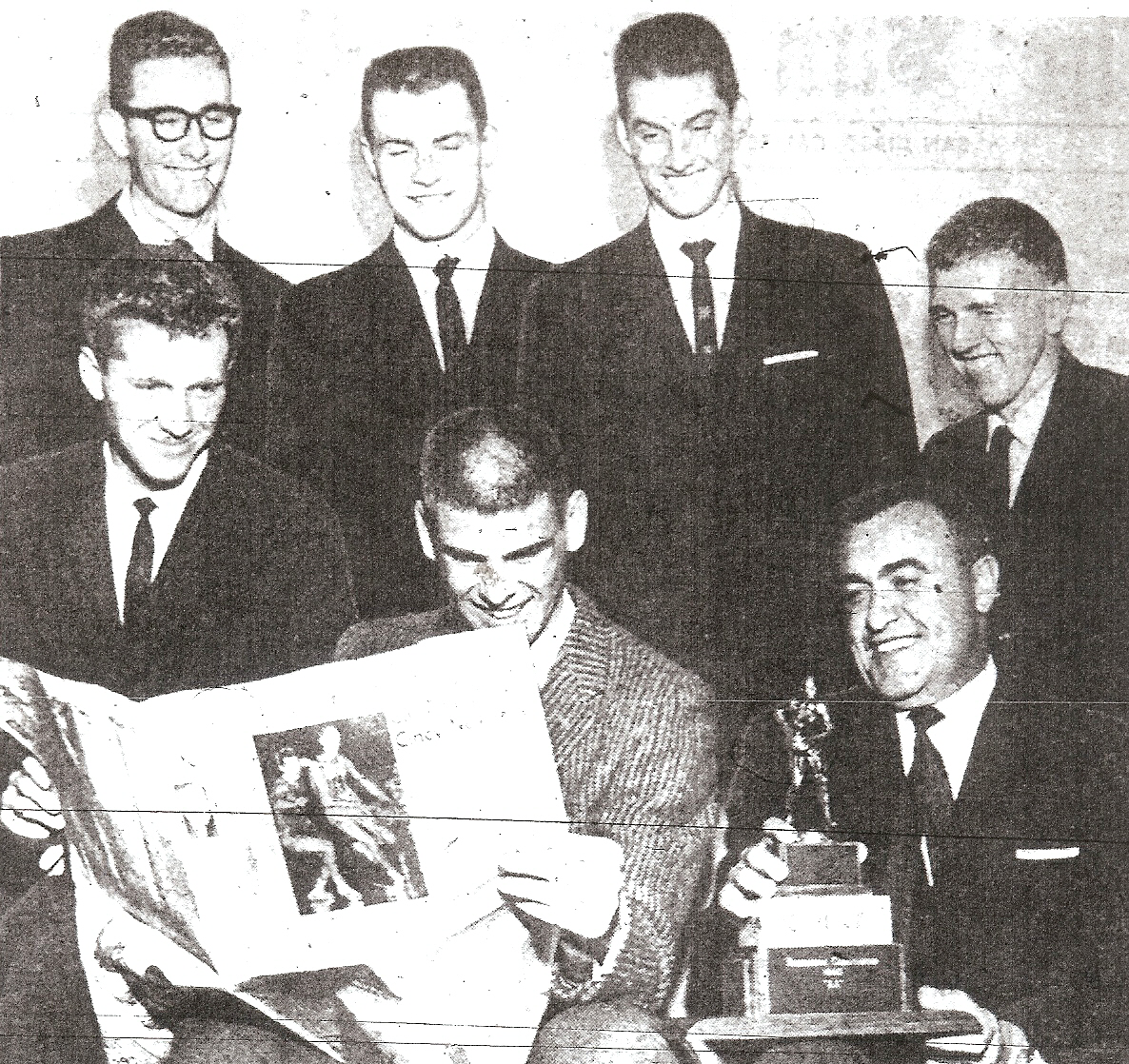
Yetta (front row, left) enjoyed reading news account of Point Loma championship with Don Sada and coach Hilbert Crosthwaite. Looking on in back are Larry Moore, Mike Dolphin, Dick Walden, and Doug Lawrence.
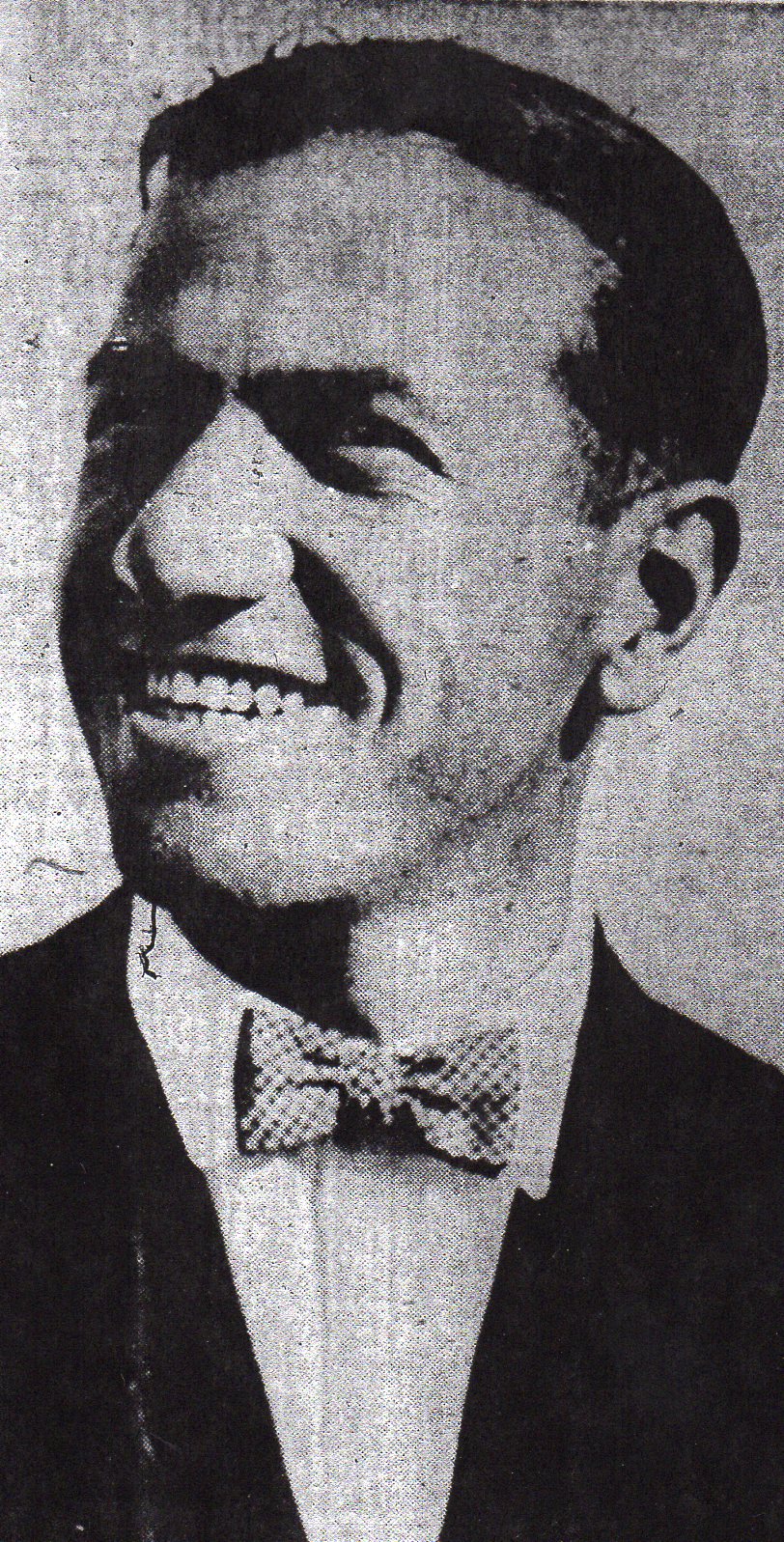
Winston Yetta, who led Point Loma to a Southern California basketball championship in 1959-60, and Ray Brokaw, a member of Birt Slater’s first two teams at Kearny, have passed away.
Yetta, a three-sport performer—football, basketball, and baseball—was the catalyst in the Pointers’ surprising, five-game title run in the CIF Southern Section AA division.
Point guard in coach Hilbert Crosthwaite’s weaving, pass-first offense, Yetta scored 22 points as the Pointers defeated San Marino, 52-36, in the finals at Los Angeles State to finish the season with a 17-10 record.
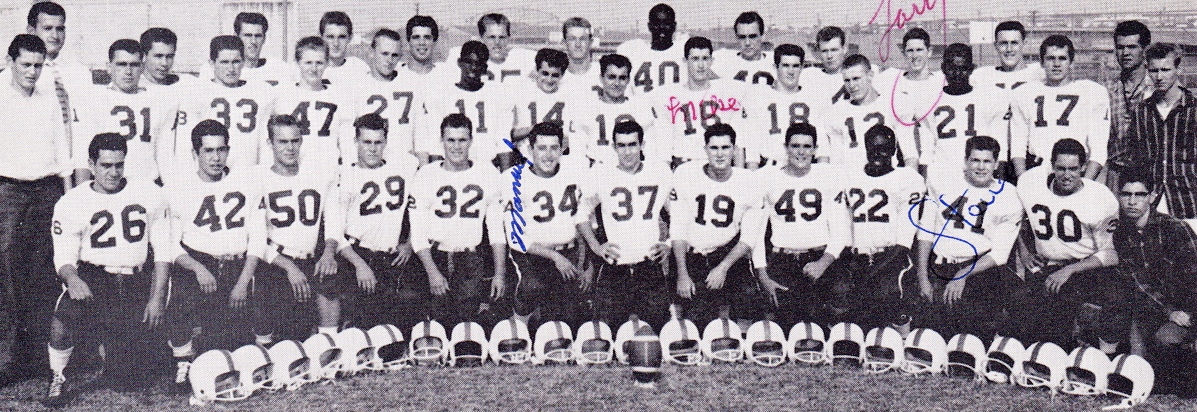
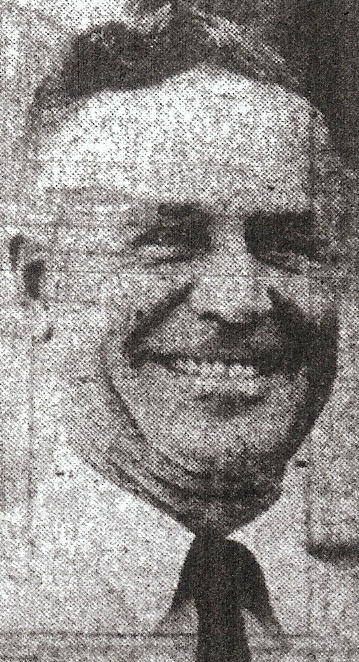
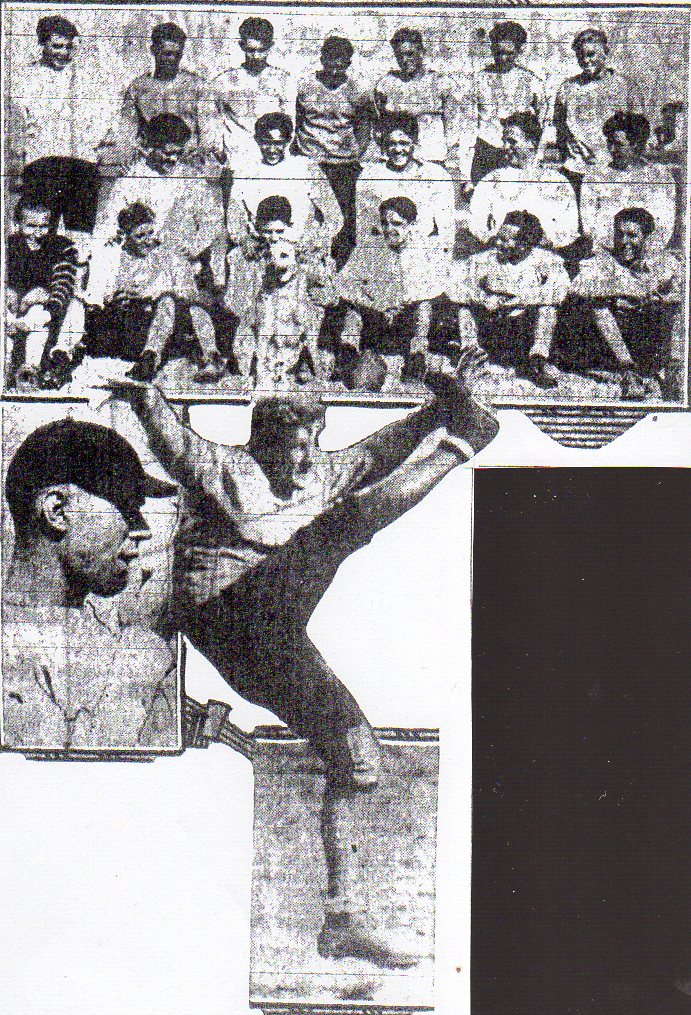
Brokaw and his twin brother, Jay, were two-way linemen on Slater’s 5-4, 1959 squad that won the first championship of the Western League, upsetting Point Loma, 12-7, and earning a berth in the Southern Section playoffs.
Ray is 32 in front row, next to Jay (29) on the Kearny’s 1959 Western League championship team.
The twins also were important contributors to the 1960 team that posted a 5-3 record.
The Brokaws were part of an eclectic group.
The 1960 team included all-league end Bob Mosley, who was a founding member of the band Moby Grape, and television newsman Harold (Red) Greene, reportedly the inspiration for the character played by Will Farrell in the movie Anchorman: The Legend of Ron Burgundy.
2015: Hamamoto Lone Active 200-game Winner
Ten active coaches are among the 41 who have won at least 100 games in the San Diego Section as teams begin practice this week in advance of opening games Aug. 28.
Ron Hamamoto, 201-127-4 in 30 years at University, Rancho Bernardo, Lincoln, and Monte Vista, ranks eighth on the all-time list, 12 victories ahead of Rob Gilster, 189-117-5 at Orange Glen and Valley Center, 47 behind leader John Carroll, who retired at Oceanside after the 2014 season.
A 12-win season would tie Hamamoto with Jim Arnaiz, No. 7 all time with a 213-77-11 record in 27 campaigns at Helix.
At least two more could reach 100 wins this year. Damian Gonzalez is 92-77-3 in 14 seasons at Army-Navy and Poway, and Paul Gomes is 91-75-7 in 12 seasons at Escondido and Rancho Buena Vista.
Others moving up but still seasons away are Vista’s Dan Williams, 73-54-2 in 11 seasons, and Helix’ Troy Starr, 72-16-1 in six, and El Capitan’s Ron Burner, 70-44-2 in 10.
Damon Baldwin is 69-43-1 in 10 seasons at Ramona, Brian Hay 69-84 in 15 at El Centro Southwest, Hilltop, Mar Vista, and Sweetwater, and Tom Karlo 68-43-2 in 11 at Mount Miguel and Grossmont.
Go here for the complete “Coach 100 Club“, or click the Football menu item and then Coach 100 Club.
Please email Rick@partletonsports.com with corrections or additions.
The active leaders:
Name
School
Record
Pct.
Rank/Years
Ron Hamamoto (1)
Monte Vista
201-127-4
.611
8/30
Ron Gilster (2)
Valley Center
189-117-5
.616
11/26
Willie Matson (3)
Mission Bay
170-123-6
.573
12/26
Sean Doyle
Cathedral
155-79
.662
14/19
Gary Blevins
Mira Mesa
132-97-4
.575
20/21
Matt Oliver
Christian
128-56-3
.693
26/16
Chris Hauser (4)
Mission Hills
124-57-2
.680
28/15
Jerry Ralph (5)
Hoover
121-68-2
.636
30/16
Mike Hastings
Point Loma
120-77-4
.607
33/17
Rick Jackson
Madison
100-31-1
.761
40/11
1) Hamamoto also was at University, Rancho Bernardo, and Lincoln. 2) Gilster also was at Orange Glen. 3) Matson also was at Kearny, Hoover, and University City. 4) Hauser also was at Vista. 5) Ralph also was at Santana, St. Augustine, and Del Norte.
2015: Eddie Logans, 70, One of “The Twins”
Eddie Logans, 70, from a family of athletes and achievers, died after a long illness on July 17.
Eddie and his twin brother, Elmer, preceded by footballer-wrestler-hurdler Tommy, were standouts at San Diego High..
Eddie ran the 440 in :49.6, the third fastest time in San Diego County, and Elmer was the County’s leading low hurdler and a qualifier for the state meet in 1962.
The twins led a spirited and undermanned San Diego team in a bid to upset Lincoln in a roaring 1962 dual track meet at Lincoln.
Eddie and Elmer each won their events against the favored Hornets, who finally pulled out a 57-47 victory.
Eddie got a measure of revenge later in the season at the Easter Relays at Sweetwater.
Logans anchored a 3:22.6 victory in the mile relay as the Cavemen soundly defeated the Hornets, anchored by the legendary Vernus Ragsdale.
Services will be held at 11 a.m. on Thursday, July 30, at Blessed Trinity Christian Ministries on Highland Avenue, 2609 Highland Avenue in National City.
Conducting will be the Rev. Dr. Clyde Oden of Los Angeles. Oden, the twins’ teammate in 1962 , was a standout half-miler who ran a career best in that meet at Lincoln.
1928: The Saints and Hilltoppers Have Eligibility Beef
The rivalry between San Diego High and St. Augustine, only a year old in football, had heated up.
At least six graduates of the high school continued to play on the prep level, for St. Augustine.
This was not uncommon throughout the CIF in the 1920s, but it was one explanation for the 30-year struggle the Saints endured while trying to gain respect and a league membership with San Diego schools.
The Saints were not trusted, had no district boundaries, and were not believed when they claimed to abide by the same CIF rules as other schools.
Athletic director John Perry had given the Saints, coached by the hard-charging Herb Corriere, a game in 1927 and another this year.
The Hilltoppers’ 6-2 victory marked the last season the teams would play again until 1946 and that was followed by another hiatus until 1957, when the Saints finally gained membership in the City Prep League.
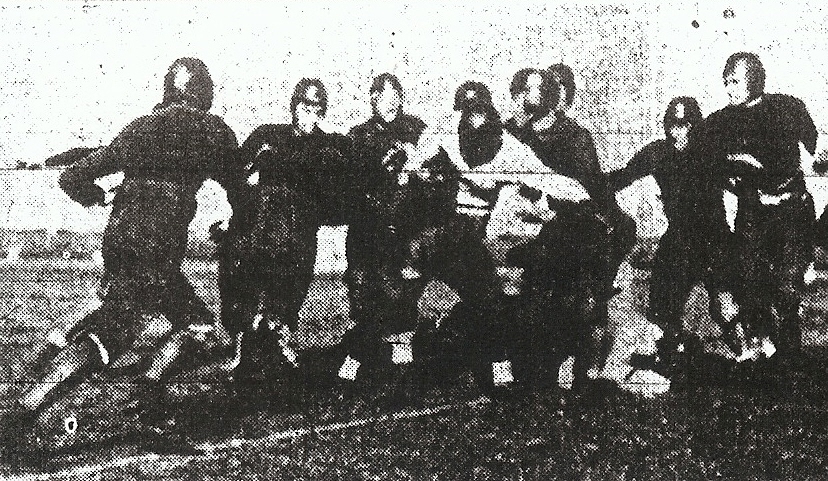
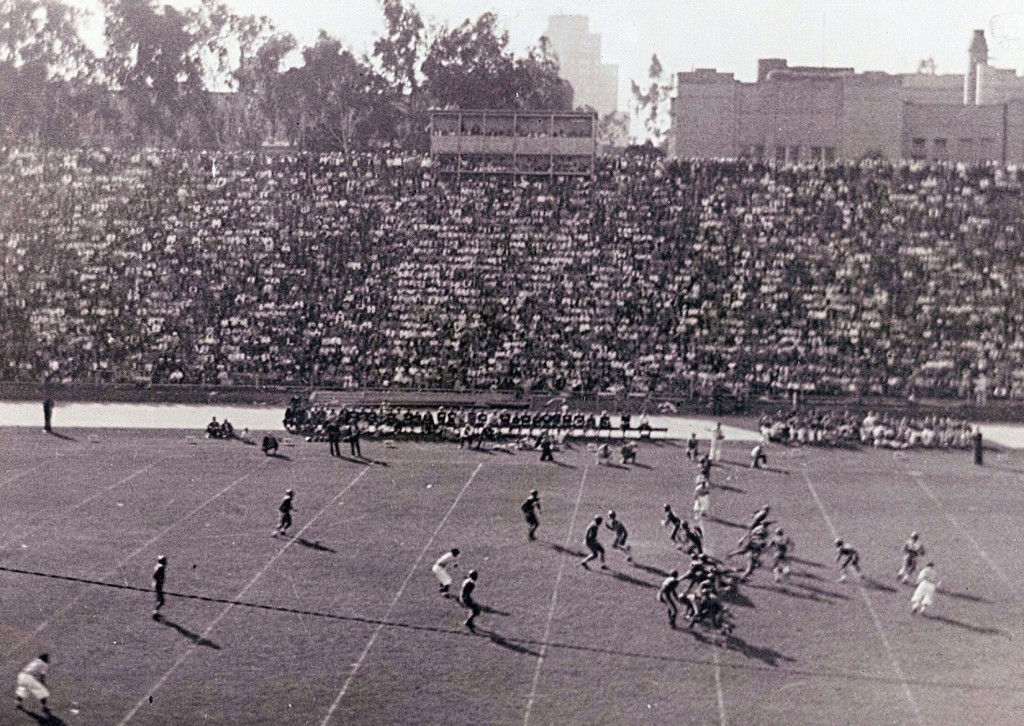
Alfred Ritchey (white jersey) is surrounded by gang of St. Augustine players in Cavemen’s 6-2 victory.
In the workup to this season’s contest, administrators from both schools denied an impending break in athletic relations.
A joint statement was issued by San Diego principal John Aseltine and Father O’Meara of St. Augustine:
“Athletic relations between the schools will continue in the future as they have been previously—in good harmony. Differences concerning the reported ineligibility of certain St. Augustine players have been ironed out.”
Ex-Cavers playing for the Saints included Kendall (Bobo) Arnett, Ashley Joerndt, Vic Limon, Frenchy MacLachlan, Blas Torres, and Bob Limon.
Rumors of the above being ineligible for the opening game in City Stadium were spiked by the school authorities after St. Augustine agreed to the following terms:
–No player 21 years or over will be allowed to play.
–A transfer player from San Diego High School must have a recommendation from principal John Aseltine.
–Athletes must be passed in their subjects to compete in any sport.
San Diego and the Saints continued to meet occasionally in basketball and the schools’ first baseball game was in 1937.
1928: Turbulent Season at San Diego High
The Roaring Twenties were coming to a disastrous conclusion.
A new school would rise in East San Diego honoring future president Herbert Hoover, who promised a chicken in every pot and a car in every garage, and San Diego High football was on a bumpy ride that began with John Perry’s departure as coach after the 1926 season.
The 1927-28 school year had concluded John Aseltine’s first as principal in June and the Stanford University graduate was looking forward to a leisurely summer.
But things got busy for Aseltine a few weeks later, after a seemingly innocent meeting at the City Schools’ office by a visitor from Central California.
Charlie Church, coach at a junior high in Fresno, applied for a position in San Diego’s physical education department, possibly in basketball or gym classes.
Church, who had coached at Santa Monica and as recently as 1926 at Alhambra, among other stops, was told that no change in coaching personnel was anticipated at the high school.
“Keep my name in case anything comes up,” said Church, perhaps smiling to himself.
Church was connected.
The superintendent of the San Diego City Schools was Walter Hepner, who had hired Church years before when Hepner was boss in the Fresno school system.
8/28/28
The San Diego Union reported that John Hobbs, head football coach at San Diego since 1927, had suddenly resigned, days before players were due to report.
Hobbs was 5-4 in 1927.
Hobbs, 27, apparently was making a career change, accepting a position with a newly-organized “building and loan operation” in Tucson, Arizona.
A star athlete at the University of Arizona in Tucson, Hobbs had been hired as basketball coach at San Diego after his graduation in 1923.
Hobbs succeeded Perry as football coach when Perry took a leave from coaching following the 1926 season.
The departing Hobbs created a sour taste with staff at San Diego and with members of the school board when it was learned that Hobbs had accepted his new position at least six weeks before the announcement of his “building and loan operation” appointment came in the mail from Arizona.
LET’S HIRE TEX
9/2/28
The San Diego school board announced that it had accepted Hobbs’ resignation “without regret.”
Gerald (Tex) Oliver, head coach at Santa Ana High, was favored by members of the board.
Board member Claude Woolman declared that it had been a mistake to let Oliver go to Santa Ana, where Oliver was hired in 1926.
”He developed a team that won the state Class B football championship,” said Woolman.
Oliver, who had been elevated from Memorial Junior High, actually coached the Hilltoppers’ lightweights to the Southern California title in 1925. There was no state championship for B’s.
Some Hilltoppers wanted Oliver to return.
9/3/28
Football practice began with interim coach John Perry, now the head of the physical education department, and assistant coach Dewey (Mike) Morrow welcoming about 80 candidates.
MANY NAMES SURFACE
—Billy Gutteron, a former Hilltopper athlete and University of Nevada player, seemed to be the favorite to replace Hobbs if Oliver was unavailable.
Grossmont’s Jack Mashin, Point Loma’s Clarence Cartwright, Monrovia coach and ex-Hilltopper Hobbs Adams, and Walter Davis, late of the University of Arizona, also were mentioned, along with Roy Richert, coach at an Oakland high school, and Bernard Nichols of Oceanside.
Gutteron and Adams attended the first day of practice. Adams claimed he was there hoping to schedule a game with the Hilltoppers in the last week of September or first week in October.
Nelson Fisher of The San Diego Sun declared that athletics director John Perry would recommend Gutteron at the school board’s meeting the following day.
Gutteron played on Perry’s first Hilltoppers team in 1920 and, after a collegiate career at Nevada, was an assistant coach at Alhambra.
Mashin, Davis, Richert, and Nichols reportedly withdrew from consideration. Neither apparently liked the projected salary.
LOUSY PAY?
9/4/28
Oliver’s name was withdrawn.
A story that did not cite sources said Oliver “has no intention of returning to the Hilltop.”
“Oliver coached here two years ago and left because of the low salary paid to coaches in San Diego, reported to be the lowest of any section in the state,” the story continued.
Oliver could make only $2,100 at San Diego because he had not taught for at least 10 years in the local school system. San Diego coaches with 10 years’ tenure usually were paid $2,400 per school year, although there was a ceiling of $2,600.
“Evidently the board didn’t approve of Perry’s recommendation of Billy Gutteron, for no mention of the former Hilltop player was made at the meeting, according to George Crawford, secretary to the superintendent of schools,” wrote Nelson Fisher.
SAME CHURCH, DIFFERENT PEW
Church had been around, knew people.
9/8/28
Charlie Church was announced as the new head coach by principal John Aseltine.
Aseltine went public following a conference with superintendent Hepner and W.A. (Bud) Kearns, supervisor of physical education for the City Schools.
“We have talked to Church and studied his record carefully,” said Aseltine, following the lead of Hepner. “He is a top-notch coach and we think we have made a real find.”
Church “realizes he faces a big task in building up a strong team at this late stage,” Aseltine said. “He said he is ready to pitch in and do his utmost to put the team in the running for the Coast League championship.”
9/10/28
Church arrived on campus but would not take part in actual coaching until Sept. 14.
SHORT RETIREMENT
John Hobbs was not long for a three-piece suit.
9/24/28
An announcement from the desert said Hobbs was joining J.P. McKale’s University of Arizona staff as backfield coach.
Hobbs eventually returned to San Diego and worked several years as a game official. He passed away at age 61 in 1962.
SHORT TENURE
9/29/28
Church coached a 6-2 victory over St. Augustine.
Church stunningly resigned after the game. He urged Aseltine to name Mike Morrow as his replacement.
The departing coach explained that Morrow was better suited for the job because Morrow was versed in the system used by Perry and Hobbs and that the players, also familiar, could adapt more quickly.
Those close to the program felt that Church took the football job only to ensure a position at the school.
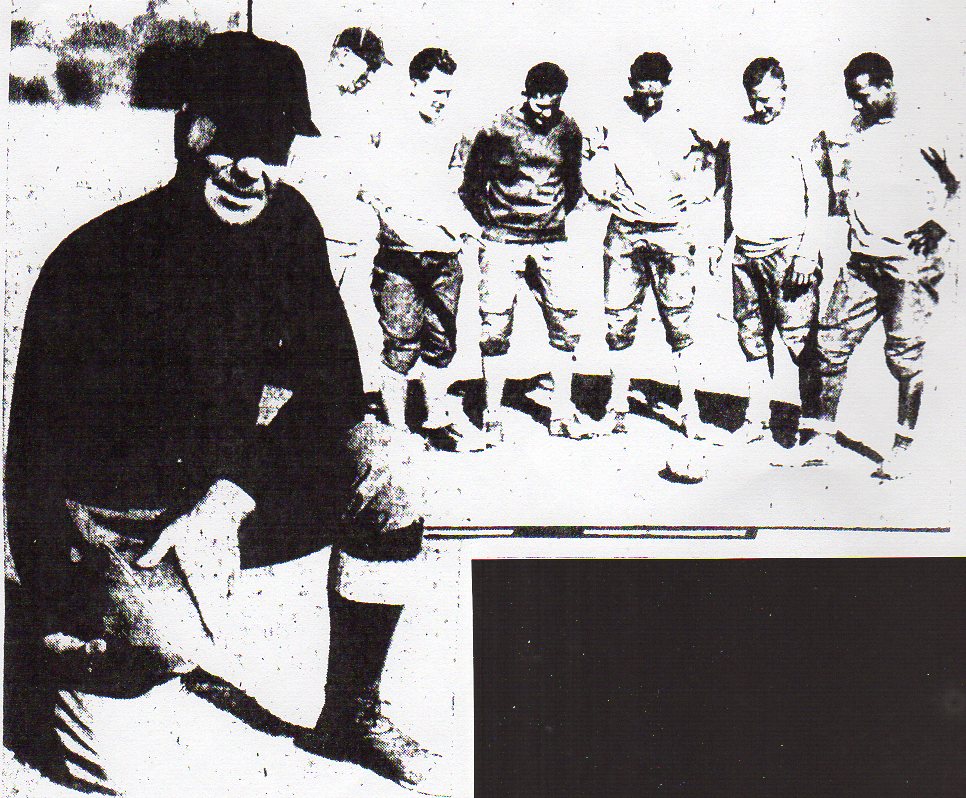
Mike Morrow (upper right) became head coach of 1928 team, posing for photo on practice field, with Balboa Park’s California Tower in background.
9/30/28
Aseltine, getting used to praising a man he hardly knew and who likely was not Aseltine’s choice, was forced to make another public statement.
“We feel that Church would enjoy a successful season at the helm of the Hilltop gridiron crew but he believes his lack of knowledge of the material…would retard the squad’s progress,” the principal said.
Aseltine pointed out that Church’s “first love” was basketball.
The native of Lowell, Massachusetts, became the Hilltoppers’ basketball coach for the next three seasons (and handled junior varsity football), then gave way to Morrow, who coached the 1935-36 team to the school’s only Southern California championship.
Church remained on staff in charge of intramural sports but eventually moved to Long Beach Poly and won championships in basketball in 1939, ’41, and ’42.
10/1/28
Morrow officially took over as head coach. He was an assistant to Hobbs in 1927 but would be better known as the coach of 10 Southern California baseball championship squads at San Diego until he moved to San Diego College in 1950-51.
SPY IN THE HOUSE?
It was Standard Operating Procedure for the Coast League.
Class B players were to be weighed, measured, and required to show birth certificates for the establishment of exponents.
The procedure took place at each league entity and was conducted by a member of an opposing school. Walter Bell, head of physical education at Long Beach Poly, did the honors at San Diego.
One of the rules was that a player attempting to play Class B for a second season could not weigh less than in the previous year.
Bell didn’t know it, but he was in the company of several future prominent San Diegans.
B squad members included Irvine (Cotton) Warburton, who’d go on to an all-America career at USC, enter the film industry, and earn an Academy award for cinematography in 1964 for the movie Mary Poppins.
Lineman Christy Gregovich was known a generation later as sports columnist Christy Gregg for The San Diego Union.
Raconteur Bob MacDonald owned the renowned Palace Buffet downtown and was a prominent sports figure.
Art Jacobs built his business, San Diego Periodicals, into a leading distributor of magazines and printed material.
Coronado (5-0) wrapped County League title with 25-0 win over 4-1 Point Loma, which featured 272-pound James Derrick, hoisting 115-pound and 125-pound teammates. Frank Greene (right) and Dave Jessop were Islanders standouts.
WHERE’S THE BEEF?
Point Loma listed seven linemen whose weight ranged from 125 pounds to 272.
Tackle Jim Derrick actually weighed 292 when fully dressed out.
The Pointers said the 16-year-old, 6 foot, 1-1/2-inch Derrick may have been the heaviest football player in the country. Documentation was not forthcoming.
Point Loma also boasted a 115-pound receiver, Lorne Shirtin.
THE THIRD TEAM
Members of San Diego’s Junior B squad were promised ice cream by coach Fred Klicka if they scored 20 points against Mountain Empire. Klicka’s youngsters defeated the Mountain Empire varsity, 20-0.
The Juniors served as a development eleven for the B team, as several players taxied back and forth.
B TEAM GETS A
Forfeit victories over Pasadena and Long Beach Poly, teams to which it had been outscored, gave coach Glenn Broderick’s B squad a perfect, 7-0 record.
Since 1924, when B competition was inaugurated, the Hilltoppers were 27-4-1, including 7-1 versus Southern California teams. Most of the games were against local varsities and reserves.
The Bees were scheduled to play Santa Monica for the Southern California championship but an influenza strike in early November forced cancelation.
MORE FORFEITS
San Diego’s varsity forfeited its final game to Santa Ana but was the recipient of a forfeit victory although on the short end of a 13-6 score against Pasadena.
CIF officials made the Bullpups forfeit when it was discovered that 5 varsity and B players belonged to outlawed school fraternities. The anti-fraternity rule was statewide.
Forfeitures also struck Santa Ana. The Saints were penalized after their 18-0 win over Glendale and following an 0-0 tie with Long Beach Poly.
Santa Ana had been using a player who had transferred from Bakersfield but lived with his father in Whittier, about 25 miles and at least an hour away.
Tex Oliver appealed the forfeits and the Saints won one appeal, rescinding the forfeit to Glendale.
San Diego was on the receiving end of a unique ruling at the start of practice. Lineman Tom Salisbury was declared ineligible because Salisbury had attended a business college in Los Angeles over the summer.
The CIF ruled that the “college” was not accredited.
FLU STRIKES AGAIN
Compared to the world pandemic of 1918, a flu epidemic this year was not nearly as deadly but still hit with force. About 50,000 Americans were said to perish from the virus and it struck teams in Southern California.
San Diego forfeited its final game to Santa Ana when coach Mike Morrow reported that 16 players were confined at home.
Santa Ana coach Tex Oliver said the Saints would postpone the game for a week, or until the Hilltoppers were fit, but San Diego officials declined.
They’d had enough.
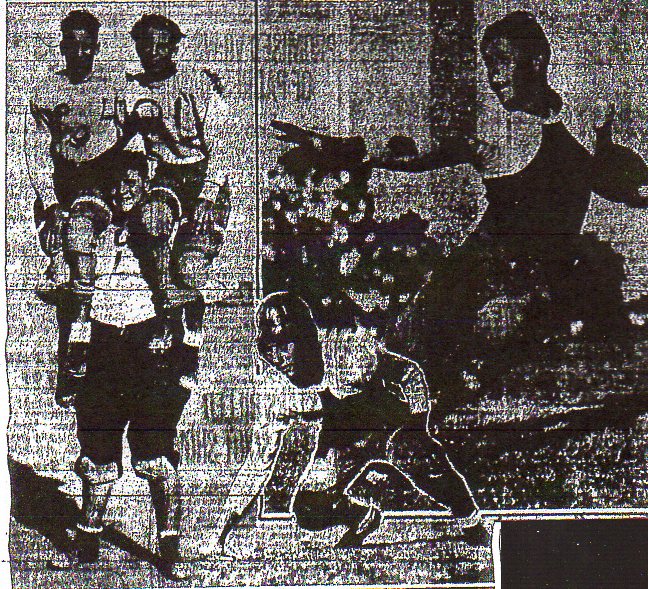
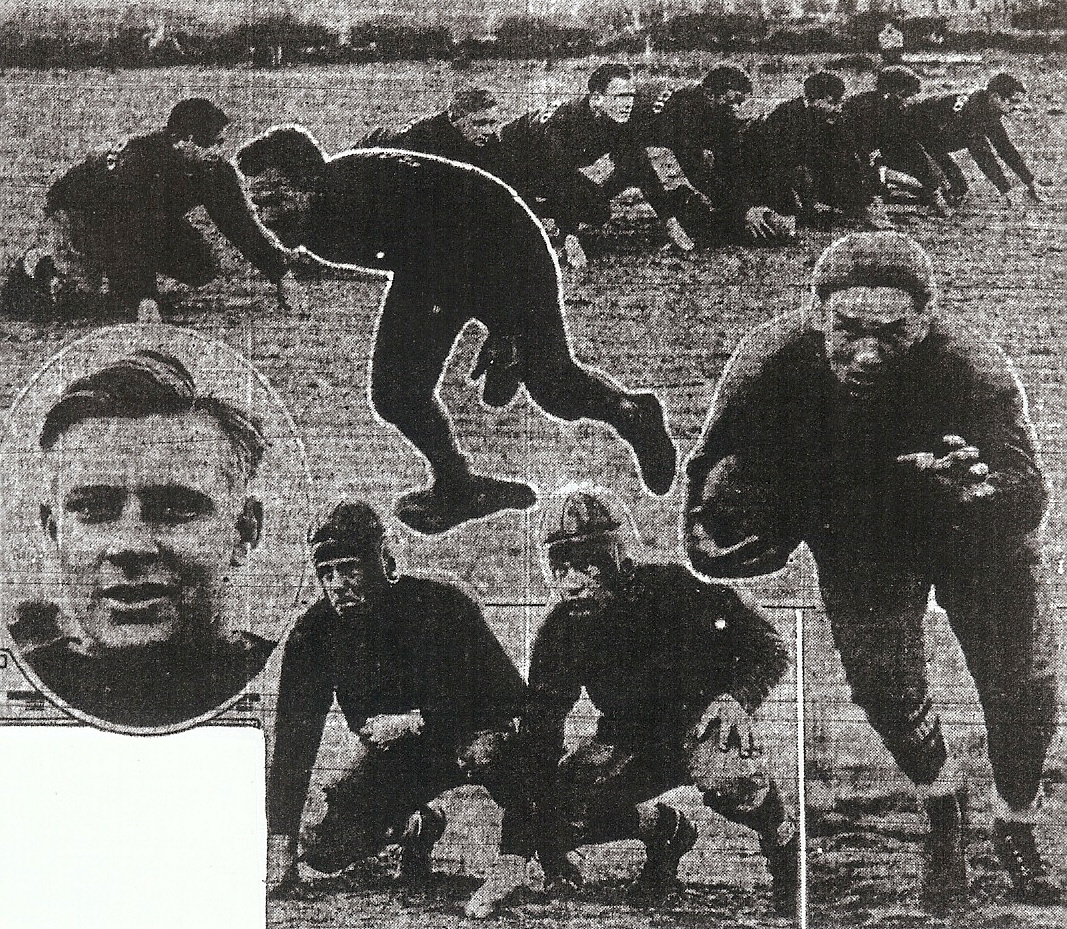
Despite the up-and-down season, San Diego’s Bill Schutte (inset) was one of the best players in the Coast League. Halfback Ted Wilson (right) and Bill Casey (center and third from left next to Schutte in photo of linemen) each had sons who starred a generation later, Wilson’s Ted and Gary at Hoover, and Casey’s Bill, at Clairemont.
SIGNS OF THE TIME
The police “dry squad” raided a house at 3736 Tennyson Street in Loma Portal, where it arrested nine men and five women, and seized 500 quarts of beer and bottles of gin and whisky.
When police arrived, those arrested were seated around a large living room, enjoying their libations. A search of the house, near Chatsworth Blvd., and blocks from Point Loma High, also revealed a large quantity of grape wine being made.
Because of the large number of persons arrested, it was necessary for the police patrol wagon to make two trips to the jail.
Also popped was a taxi-cab driver for providing information on where intoxicants could be purchased.
All were released on bail.
UP IN THE AIR
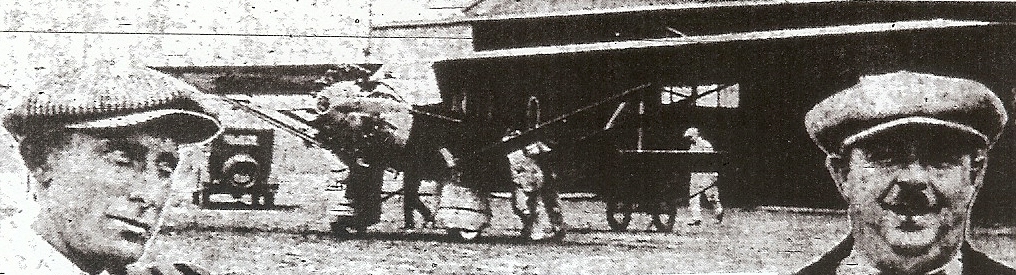
Schlee (left) and Brock liked to fly.
Edward Schlee and William Brock set an American flight endurance record of 59 hours, 30 minutes, 1 second, after takeoff from Rockwell Field, which eventually became North Island Naval Air Station.
The flight followed a route that repeatedly covered the area up and down the Coronado Silver Strand.
The pair extended their travel during daytime, flying as far as Jacumba, 65 miles east. Several planes would accompany the Bellanca monoplane. Pilots of those craft notified Schlee and Brock of news bulletins announcing their progress.
The aviators realized during the trip that their attempt at the world record was in jeopardy. They had discovered a leaky fuel valve.
On the final day a note was dropped to the ground crew.
“If we have not landed by dark turn the lights on, as the gas is running low,” was the message.
Schlee and Brock were seven hours short of the global mark.
SHORTER POSTSEASON
The postseason was being shortened. A “Tri-League Champion” would come from the Southern, Imperial or Orange County circuits.
Coronado, the Southern League champion, was eliminated in the first round by Calexico, 7-0.
Long seasons in which some teams played and practiced well into December were a continual headache for the CIF, according to president Harry Moore of Long Beach Poly.
Many solutions were tried until a consistent format was adopted in the years following World War II.
Charlie Church was not long for football coaching togs. Line coach Mike Morrow, with players Bill Casey, Eddie Reed, Fuller, Bill Schutte, and Earl Ritchey, did most of the head coaching.
BEAUTIFUL HOME
For basketball.
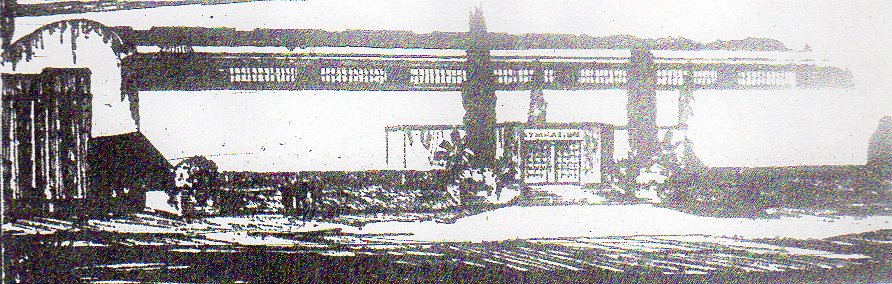
San Diego architect Frank Allen’s plans were approved for a new gymnasium on the North edge of campus. The facility would have room for about 800 persons on expansive bleacher seating.
Two regulation courts, the first in the city, were to be side by side, allowing room for additional seating that would bring capacity to 2,000. The gym would be ready for the 1930-31 season.
The San Diego High gymnasium, at a cost of $80,000, was scheduled for opening in 1930.
BELIEVE IT OR NOT
The game story for the 6-6 tie between Escondido and Grossmont declared that Escondido completed 24 of 25 attempted passes.
INVENTIVE VIKINGS
Following an example coach George Dotson said was introduced by Stanford University and the U.S. Military Academy, La Jolla replaced the traditional water boy with a rolling water tank, capable of holding more H2-o and able to dispense at a faster pace.
The machine was made by students in one of the school’s industrial arts classes.
The water boy still was needed to hustle the tank onto the field when players were injured or play was stopped.
St. Augustine coach Herb Corriere, punter Louis Bailey and teammates posted 6-3 record but lost, 14-6, to South Pasadena Oneonta Military, a team the Saints beat, 73-0, in 1927. Corriere’s club made amends with 98-0 win over L.A. St. Agnes.
TRUE GRID
The San Diego County Football Officials’ Association was founded on Sept. 23 in a meeting of coaches and officials at San Diego State…Army-Navy’s 25-0 win over Los Angeles Loyola represented the Cubs’ first loss in two seasons…they were 9-0 in 1927…Grossmont players wore black armbands in honor of school trustee A.B. Foster, who passed the week of a game with Point Loma…San Diego was the largest school in the area, and one of the largest in the state, with 3,022 students in three grades…second largest in the County was Roosevelt Junior High with 1,550…Coronado was passing on the last play against Sweetwater…Frank Green’s pass to Eric Afferson was in the air as the gun sounded…Afferson scored on the 30-yard play as the Islanders won, 32-7…Green missed an earlier game because he had cut his hand on a band saw…Sweetwater band director Jimmy Seebold took his group downtown and it serenaded the offices of The San Diego Union and Evening Tribune…Bill Schutte, San Diego’s 172-pound lineman, was named to the all-Coast League squad and went on to a long football career, eventually serving as San Diego State’s head coach from 1948-55…Schutte’s younger brother George was on the 1941 and ’42 Hilltoppers teams and later was head coach at San Diego Junior College…Coronado represented football heaven…coach Amos Schaffer’s team had recently dedicated a new, turf field, which observers said would do credit to a college, and a field house with lockers were under construction…a big one who got away was Santa Ana’s Alva Reboin, one of the top runners in Southern California and a former Roosevelt star…senior class president at Escondido was William (Bill) Bailey, destined to coach outstanding teams at San Diego…”The most discouraging prospects in my six years at Grossmont,” said Jack Mashin, whose 1927 team was 8-0-3 and won the Southern California minor division crown but fell to 2-5-1 this season….
1935: Redbirds and Rioting
A 27-0 loss to the Muir Technical Mustangs of Pasadena in the first round of the Southern California playoffs did not dim the luster of one of the greatest seasons in the history of Hoover High football.
John Perry, who guided the Cardinals’ program from its beginning in 1930, directed the Eastside club to its first victory over San Diego, won the new Bay League championship, and led the Redbirds to a 7-1-1 record.
Hoover has had few teams equal that kind of success.
Only the Cardinals squads of 1949 (8-1), 1954 (8-2), 1956 (8-2), 1962 (7-2), 1963 (7-2-1), 1986 (8-4), 1998 (8-4), 1999 (10-2), 2006 (9-3), and 2014 (10-3) won as many.
Walt Harvey, 92 years young and residing in El Cajon, spoke in the summer of 2010 and remembered the Muir squad.
“We knew nothing about them, probably that they were this small, technical school,” said Harvey, a Cardinals halfback in the fall and sprinter on the track team in the spring. “They came down here and just ran up and down the field.”
The visitors were not a collection of future electricians or mechanics.
One of the Mustangs’ touchdowns, before the largely Hoover evening gathering of 4,000 persons (almost 1,000 came south from Pasadena), was on a 16-yard halfback-option pass from Jackie Robinson (yes, that Jackie Robinson) to Mickey Anderson.
Robinson, whose older brother Mack would be a medal-winning sprinter on the U.S.’ 1936 Olympics team, and Anderson, whose brother George was a world-class sprinter at California-Berkeley, were just part of a fleet stable of Mustangs that also included sprinters Bill Sangster, Brainard Worrill, and Preston Clipper.
The San Diego Union sportswriter Harry Hache described the visitors as “streamlined, like the Burlington Zephyr… class wrapped up in a pigskin whirlwind.”
Hache and other observers were not happy that Hoover and Muir were to meet in the quarterfinals (first round). According to the scribe, “It had been a foregone conclusion that these were the two best teams in Southern California and were destined to meet in December for the championship.”
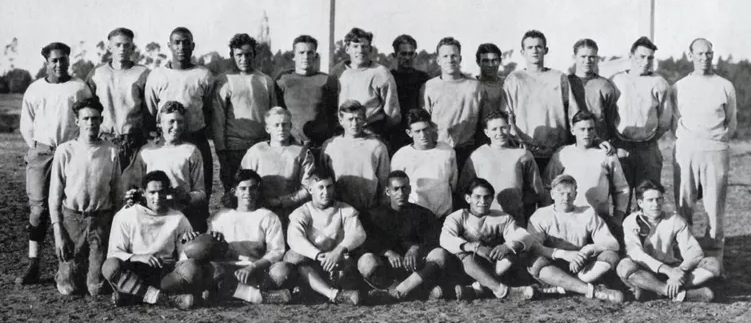
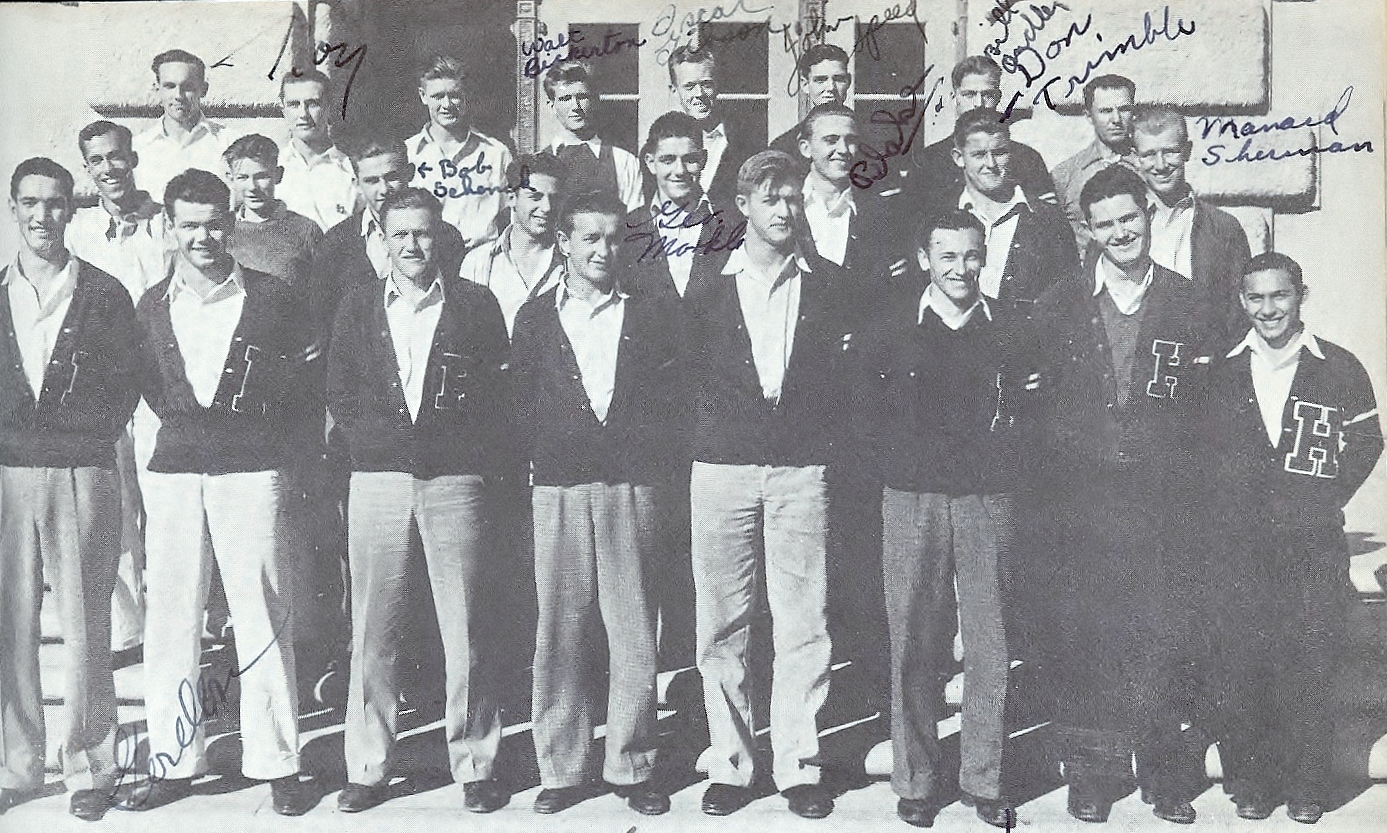
Harvey, third from left in top row, next to Roy Engle, was essential part of 1935 Cardinals. Future California political leader Joe Shell is fifth from left in front row. Head coach John Perry is in top row, right.
SCRIBE KNOCKS CIF BOSSES
“CIF officials, apparently having a case of blind staggers, threw facts to the wind,” Hache declared, pointing out that Hoover came into the contest with a 7-0-1 record and had outscored its opponents 196-14. Muir was 8-1, with only a 7-6 loss to Santa Ana and with a 202-32 scoring advantage.
This may have been a matchup of the top two but there was a wide gap between 1 and 2. Muir led 7-0 at halftime, then turned the game into a rout in the fourth quarter. Hoover never was in it. The Cardinals were on the Mustangs’ five-yard line at the end of the game but only after recovering a fumble.
First downs favored the visitors, 19-2.
The Northern team had not heard the last of Hoover, however. The Mustangs were poised to take on Santa Barbara for the championship two weeks later after a 14-6, semifinals victory over Monrovia, then suddenly were ruled out after discovery of an ineligible player.
Hoover was fortified with star backfield of (from left) George Markle, Joe Shell, Morris (Moose) Siraton, and Roy Engle.
DREADED ADMINISTRATIVE GLITCH
Tony Beebe, a Muir backup quarterback who had transferred from Army and Navy Academy in San Diego’s Pacific Beach suburb, was scholastically deficient, having failed to pass in one of three classes at the military school.
Beebe’s status was first questioned by Hoover principal Floyd Johnson, a ubiquitous and omnipotent figure in all things Hoover and the surrounding Talmadge Park. Johnson resided in that upper middle class enclave, virtually within walking distance of the campus, where he held sway from 1930-56.
Although Johnson is said not to have lodged a formal protest (Johnson said he notified the Muir principal) or reveal how the information came to light, word began to circulate.
The Pasadena school honcho and Army-Navy’s commandant confirmed that Beebe had flunked Spanish. Col. Thomas Davis also declared that Beebe’s scholastic woes were noted when the student’s transcript was mailed to the Northern school.
When Muir was eliminated, Floyd Johnson suggested that Monrovia and Hoover meet for the right to play Santa Barbara but CIF boss Seth Van Patten ruled out the idea of an extra game and selected Monrovia as the opponent for the Golden Tornado.
GO TO YOUR RESPECTIVE CORNERS AND…
Hoover-Muir was just half of a huge prep weekend in San Diego. Long Beach Poly came South Saturday afternoon and took on San Diego High for the Coast League championship.
Poly’s hard-fought, 7-6 victory and 18th win in a row before more than 7,000 persons in City Stadium was the highlight of a spectacular show that included card stunts by the Hilltoppers’ cheering section and halftime entertainment by more than 100 students of the visiting Jackrabbits’ girls drill team and 50-member band.
The game was followed by an event even more spectacular, a 30-minute, uninterrupted brawl. “Boys and Girls in Wild Riot at San Diego!” was the headline on the front sports page of the Los Angeles Times.
Emboldened by the defeat of their arch rivals, Poly students and “non-students” charged the gridiron and knocked down a set of goal posts after the teams and game officials left the field.
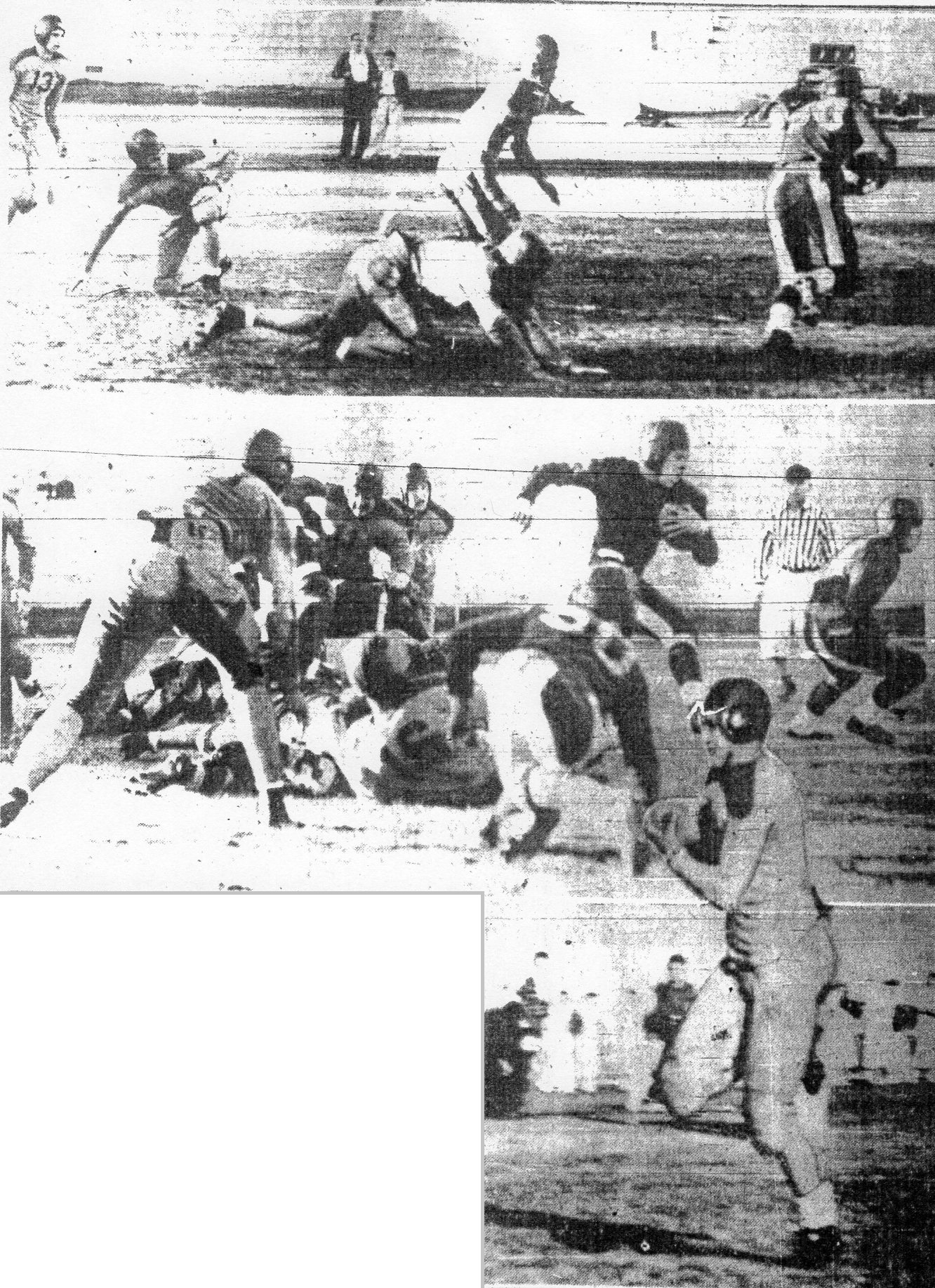
San Diego’s Bob Howell circles Long Beach Poly flank to score Hilltoppers’ touchdown, which was set up (middle) by Tom Williams’ run. Poly’s Bruce Wilcox (bottom) scored Jackrabbits’ touchdown.
“Aroused San Diego students then launched an offensive of their own,” wrote Harry Hache. “In short order massed fights and individual bouts started all over the field, the most prominent being a hair-pulling, punch-tossing, and scratching duel between two girl students who went at it when one attempted to snatch the other’s pom pom.”
The Associated Press reported that “Harry Smock, 21, of Long Beach, received treatment for a possible broken jaw, face cuts, and severe bruises. A girl, whose name was not learned, was severely burned about the neck when someone lit a match to a pom-pom she was carrying.”
SIGNS OF THE TIMES
Harmony and campfire songs were not in abundance at other venues.
Former San Diego High coach Clarence (Nibs) Price, an assistant at California, sustained a black eye when mysteriously sucker-punched by an irate St. Mary’s booster following the game between UCLA and St. Mary’s in San Francisco.
Price, who was scouting for California, was attacked as he left the field. The assailant fled after game referee Jim Blewett came to Price’s aid.
Meanwhile, a self-styled vice investigator of alleged corrupt San Diego public officials was punched several times by the San Diego district attorney during a secret session of the County Grand Jury. D.A. Thomas Whelan was unrepentant. “He called me a liar,” said Whelan.
SOMETHING NEW
While the CIF created an age limit of 20, boss Seth Van Patten, okayed a pigeon race as the first event at the 1935 Southern Section track championships.
Public schools in Los Angeles broke from the Southern Section to form their own section. The four private schools in Los Angeles, Cathedral, Loyola, Mt. Carmel, and St. Agnes, would be released in 1937 and return to the Southern Section.
The Southern Section’s largest high school wasn’t in California. Phoenix Union, a provisional member, had 4,145 students. Smallest school was Big Pine with 20.
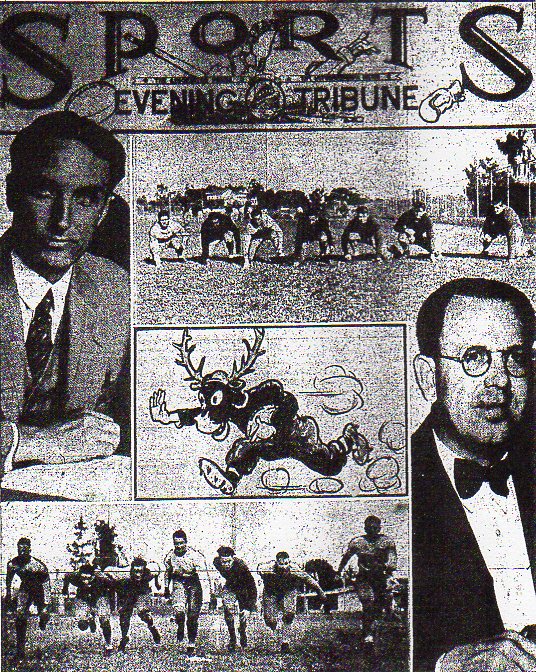
Principals John Aseltine of San Diego (upper left) and Floyd Johnson of Hoover were important figures in the third annual Elks Charity game. Linemen from San Diego (top) and Hoover share some of the attention with a Evening Tribune artist’s idea of a ball-packing Elk.
LIGHTS OUT AT LA JOLLA
La Jolla principal Clarence Johnson, concerned about hooliganism and other undesirable night-time activity in the surrounding neighborhood, switched the Metropolitan League showdown with Point Loma to the afternoon.
The game ended at dusk, so lights installed one month before at Scripps Field were put to use. La Jolla (5-0) and Point Loma (5-1) came into the game with a combined 10-1 record.
The Vikings, who touted their “Four Norsemen”, Bill Mayne, Ray Penwarden, Monte Soule, and Johnny Bancroft, defeated the Pointers,14-0, and went on to a 9-0 season. La Jolla would wait 58 years for another undefeated team. Dick Huddleston’s 1993 squad was 13-0 and won the San Diego Section III title.
ARE YOU SERIOUS, COACH?
Grossmont coach Jack Mashin, who visited Japan and China during the summer, was prepared to make another long trip, by foot.
In a moment of weakness, or insanity, Mashin promised his squad that he would walk back to school if the Foothillers won the season’s final game at La Jolla.
A Grossmont victory would have meant a tie for the Metropolitan League title with the Vikings but the 20-12 loss took Mashin off the hook. The coach rode the bus with his players and averted a 23-mile hike through the chill November air.
La Jolla turned the game with three pass interceptions that led to touchdowns.
COAST LEAGUE TO CIF: DROP DEAD!
The Coast League withdrew from the CIF playoffs, opting instead for a financially successful carnival before 12,000 persons at Long Beach Poly, proceeds going to the Parent-Teachers’ Association milk fund.
The league said the playoffs made the season too long but principals also were unhappy with the CIF, particularly because the ruling body had ignored the four-school Coast League’s request for additional members.
Long Beach Wilson and San Diego Hoover would leave the Bay League and join the Coast League in 1936.
The Coast “diss” was a blow image-wise and financially to the struggling CIF, which derived income from the playoffs and was losing its most prestigious affiliate.
San Diego, Santa Ana, Alhambra, and Poly each played two 16-minute quarters in the carnival. The South, comprised of the Hillers and Santa Ana, won 12-8. The Hillers defeated Alhambra 6-2 in the second quarter but lost to Poly 6-0 in the fourth.
Santa Barbara topped Monrovia 14-12 for the championship, although the Dons’ 9-2 season was marked by losses to Poly (20-13) and Santa Ana (13-7).
With El Cortez Hotel looming in background, Hoover and San Diego went at it on hazy afternoon in October, 1935.
ALWAYS A CARDINAL
In 1955 Roy Engle became Hoover’s head coach and served in that position for 23 seasons, but his legacy began years before as the hero of the Cardinals’ first victory, 7-6 over San Diego.
Engle gained 64 yards in 17 carries and rushed the final 25 yards in three carries in the fourth-quarter, 17-play, 80-yard, winning touchdown drive that took more than seven minutes off the field clock.
The Cavers’ “Dancing Jack” Hoxie was the game’s leading rusher with 86 yards in 16 carries as more than 17,000 looked on in City Stadium.
PERRY’S X’s AND O’s
Coach John Perry on Hoover’s defense: “We use what is commonly called a 6-3-2. My boys are taught man for man and zone defense when our opponents are passing. A high school coach, if he is smart, will make his defensive system fit his players and his opponents’ styles of play.”
Cardinals foes completed seven passes in 50 attempts in the first five games, including San Diego’s 1 for 8.
DEE-FENSE
Hoover had acquired a defensive reputation with five shutouts to start the season in 1934, a record that was equaled only by Ramona, against a largely junior varsity schedule, in 1954 and Lincoln in 1977 (the Hornets’ streak lasted six games).
“I don’t remember being that good on defense as a junior,” said Engle in 1977 as he wound down his coaching career at Hoover. “We always played the top eleven players, whether they played offense or not. We’d get mad if the coach took us out.”
One play remained with Engle. “We went through the league without allowing a point until the last game and even then it wasn’t a safety,” he said to Steve Brand of The San Diego Union.
Hoover defeated El Segundo, 13-2, for the Bay League title. Engle was back to punt and tackled in the end zone for two points. The coach swore he was down on the two-yard line and was pushed into the end zone.
CARDINALS HANGOUT
The “Hoover Drug Store”, which opened to popular review across the street from campus, at 45th Street and El Cajon Boulevard, offered sandwiches, homemade pies, and hot chocolate at a nickel each, malted milks and “Hoover Specials” for a dime.
QUICK KICKS
Escondido defeated Coronado 12-7 for the Cougars’ first victory ever over the Islanders…Coronado had a 17-0-3 record against the Grape City entry, dating to the first game in 1914…San Diego’s Glenn Broderick and other area coaches were hosted at the U.S. Grant Hotel and spoke of their visions for the 1935 season…ex-Grossmont gridder Dinon Busch moved South from Hemet High to replace Vance Clymer at Sweetwater…Point Loma, under new coach Joe Beerkle, unveiled a grass field after years on dirt and rocks…Beerkle welcomed 40 candidates on the first day of practice and 30 more when school started…Hoover greeted 18 lettermen, San Diego 11…the Hilltoppers’ Ben Sohn and Mike Sisto still were working summer jobs and missed the first week of practice…to avoid conflict with San Diego State’s Nov. 8 game in the Stadium, Hoover switched dates with Beverly Hills so that it could meet the Hillers on Oct. 26… San Diego scrambled to fill a date when Santa Monica backed out… the Cavers signed Long Beach Wilson, a school named after former Democrat President Woodrow Wilson… coincidentally President Franklin Roosevelt, another Democrat, was scheduled to appear at San Diego’s California-Pacific Exposition in Balboa Park the same weekend…thirty-four San Diego players worked out under the lights at Arizona’s Phoenix Union High after an all-day bus ride that began at 7 a.m., the same script as followed in the 1934 game… the Hillers tied the Coyotes 12-12 the following night, then bused back the next morning… San Diego visited Santa Ana a week later in the 25th renewal of a rivalry that began in 1905… the 10-7 victory gave the Hillers a 13-12 lead in the series… Santa Ana dropped out of the Coast League after the 1936 season and the teams did not meet again until the 1959 playoffs…a 14-13 loss to arch-rival Sweetwater in Week 5 ended a Grossmont streak of 23 victories and 1 tie without defeat dating to 1932… the Foothillers held sole possession of the County record until Kearny went 23-0-1 from 1963-65… The San Diego Union sports editor Ted Steinmann, complained about the “outdated”, manually-operated City Stadium scoreboard and suggested “one of those new (electric) timing clocks Western Union has”… Wallace Slattery of Hoover and Charlie Adair of San Diego, both starting centers, saw their careers end in mid-season because of high school age limits… Adair still made the all-Southern California second team…Roy Engle was on the third team and San Diego sophomore tackle Ed Becker on the fourth team….