1941:  “I Want to Play Someone I Can Beat”

33VanPatten and logo0001That refrain was heard early and often in the CIF Southern Section.  It is heard today, a century later.

Coaches, players, administrators, fans, even the media, want to see their teams positioned to win or at least able to compete evenly.

That’s the way it was when the interscholastic federation was formed in 1913, as about 30 high schools from Santa Barbara south actually were playing football, in 5 or 6 very loosely formed “leagues”.

The latest attempt to find competitive balance resulted this year.  Schools of substantial enrollment tried something radically different.

According to Southern Section historian John Dahlem, commissioner Seth Van Patten on May 18, 1940, appointed a committee to study re-leaguing, specifically as it was related to the CIF’s larger entities, i.e., San Diego, Hoover, Long Beach Poly, and others.

Van Patten named four administrators to the group, including the No. 2 man at San Diego High, vice principal Edward Taylor.
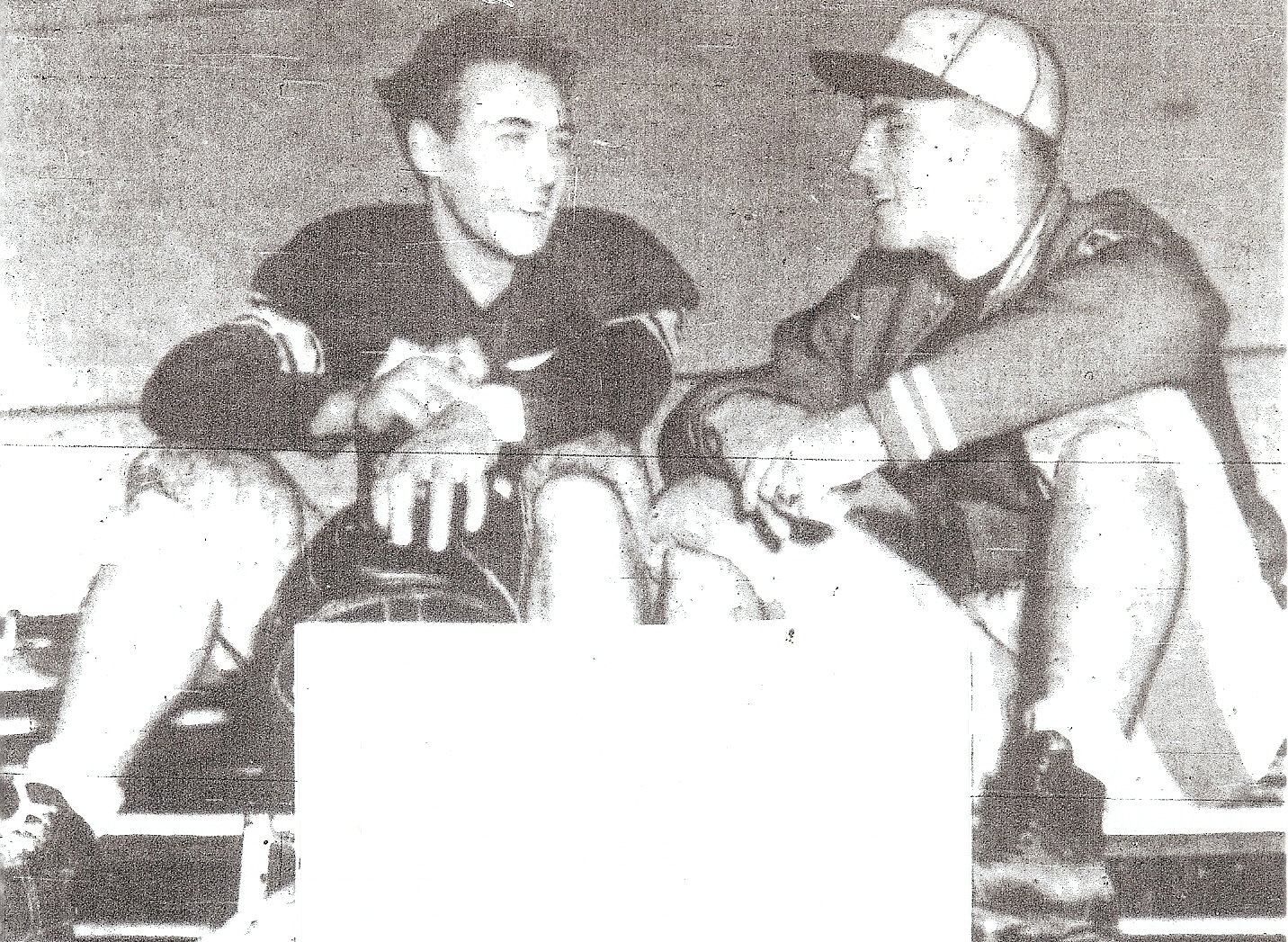
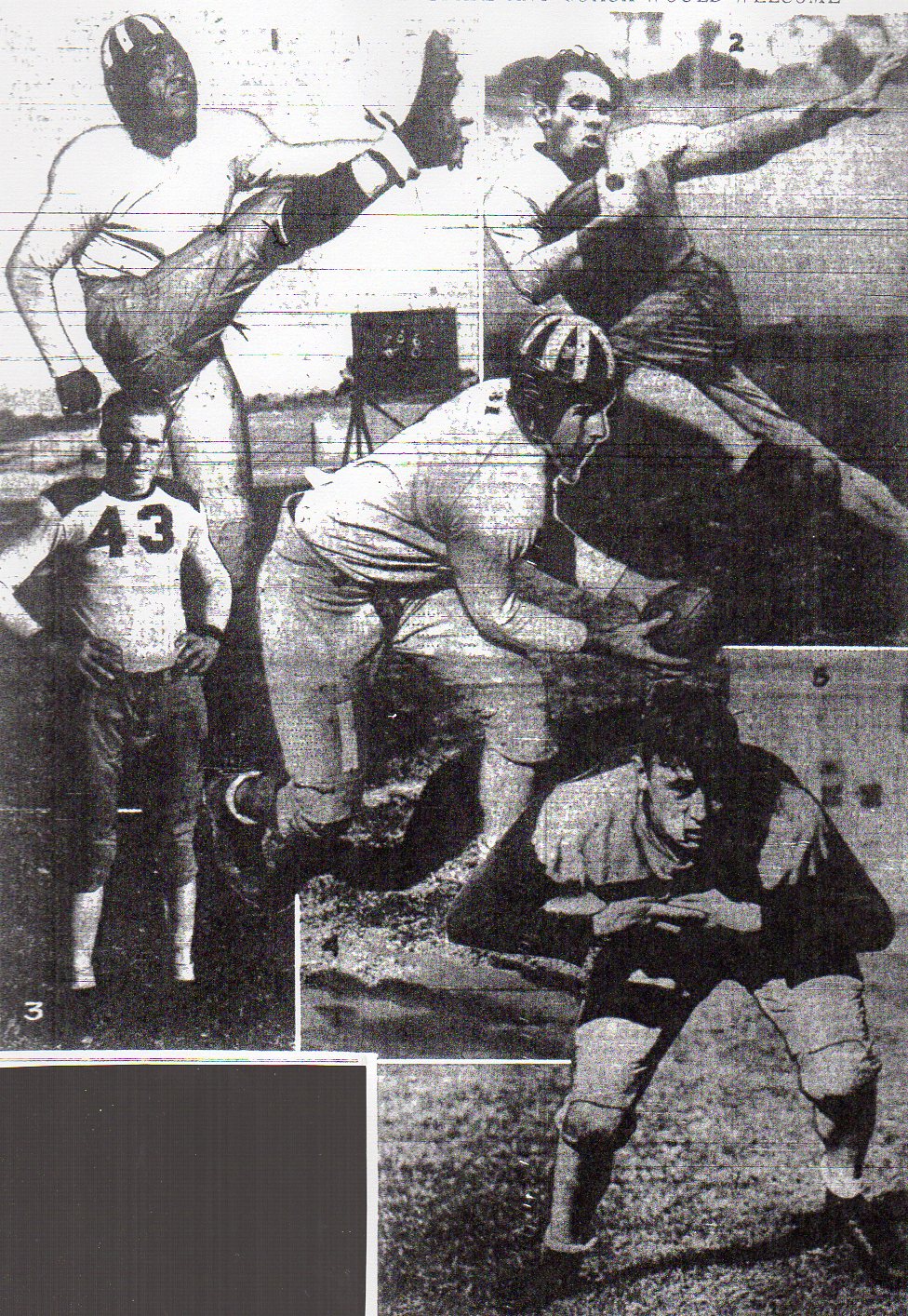
All-CIF end Eldon Johnson welcomed Roy Engle to Hoover coaching staff in a year of change for Cardinals and Coast League.

Excerpted from the CIF Annual Report for 1940-41:

–The “reorganization committee” was charged with addressing the “problems of releaguing.”

–The group met four times during the first semester of the 1940-41 school year and presented its recommendations to the section’s Executive Council on Feb. 1, 1941:

“(a) That all leagues except the Coast League (which included San Diego, Poly, and Hoover) remain as set up at that time.

“(b) That the Coast League be disbanded.

“(c) That for Class A football only a “Major Conference” of seventeen large schools be set up and a schedule for a two-year period be adopted.”

(The seventeen large schools were Alhambra, Alhambra Mark Keppel, Beverly Hills, Compton, Glendale, Glendale Hoover, San Diego Hoover, Inglewood, Long Beach Poly, Lawndale Leuzinger, Pasadena, Redondo Beach Redondo, San Diego, Santa Barbara, Santa Monica, Whittier, and Long Beach Wilson).

“(d) That in all sports except Class A football, San Diego Hoover, Poly, Pasadena, San Diego, and Santa Barbara compete as free-lance.

“(e) That the five schools named in paragraph (d) elect a representative to the Council.”

LOOKS GOOD TO US

The Council approved the recommendation in paragraph (c) and a schedule was drawn  for 1941 with the understanding that for 1942 the same schedule would be followed with sites of games being reversed.

The events in Pearl Harbor, Hawaii, on December 7, 1941, changed everything.

The Major Conference lasted one year as the CIF retreated and struggled through World War II, but the conference served as another example of the unending difficulty of scheduling and  finding balance.

Putting all of the big schools together seemingly gave those with fewer enrollment numbers a more level field on which to compete for league championships.

“It was the problem of individual schools wanting to determine where they were re-leagued and what gave them their best possible chance of winning,” said Dahlem.   “Same problem today.

“The schools which hadn’t done well wanted into an ‘easier competitive league’ and were tired of never winning a big championship.
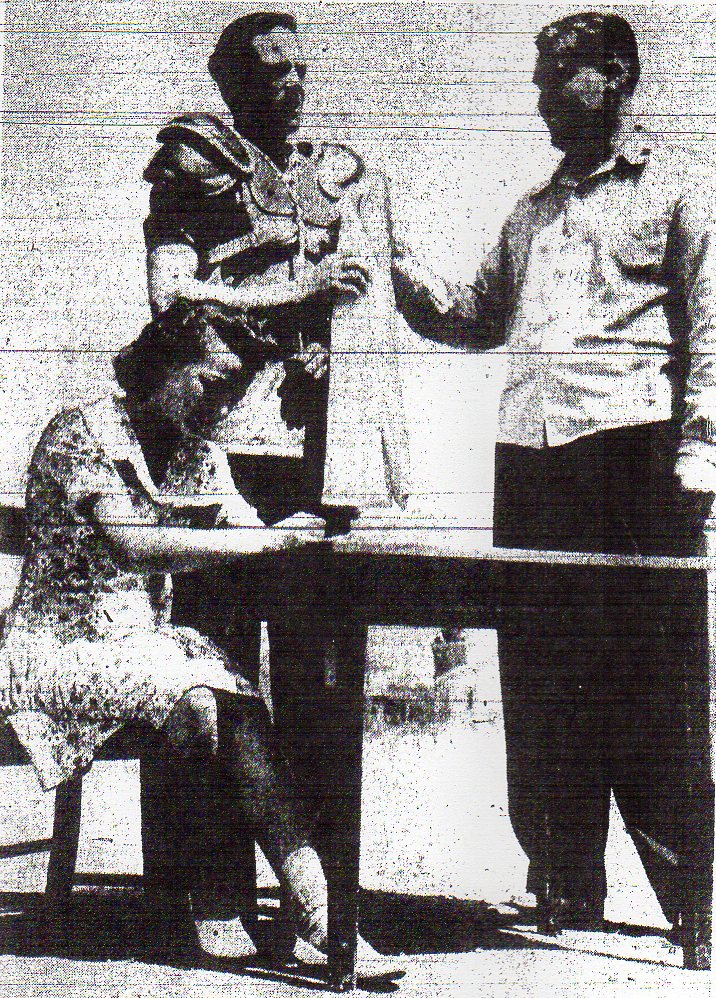
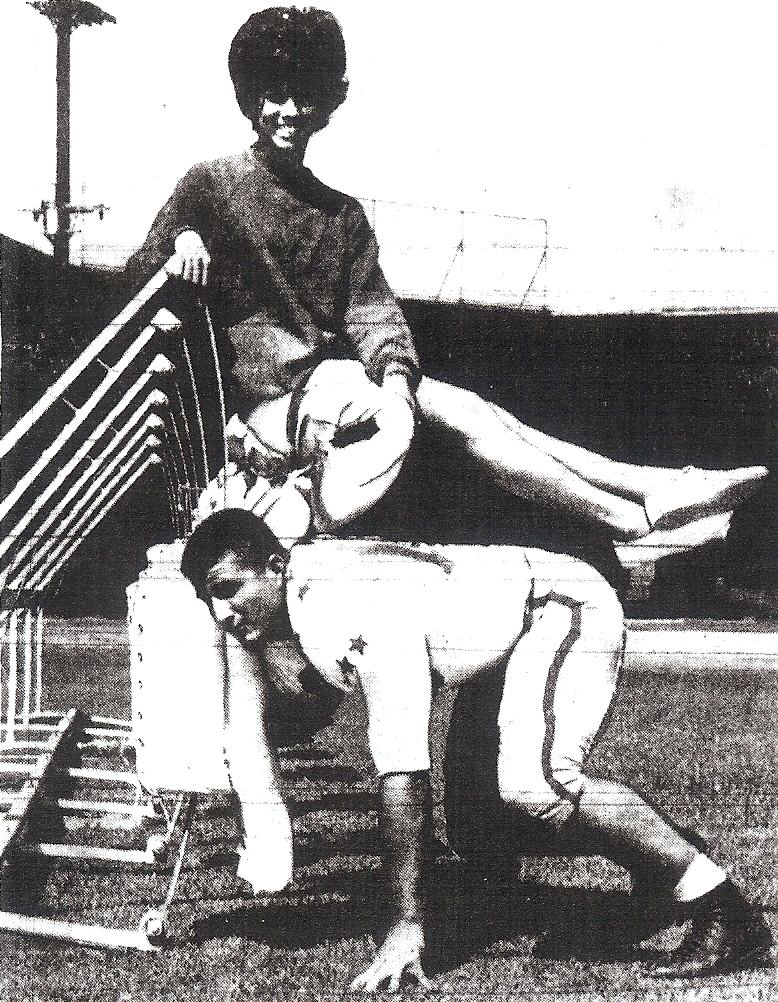
While administrative aide Jean Franck noted issuing of equipment to halfback Tom Davis, Hoover coach Pete Walker sizes up Cardinals’ ball packer.

“The seventeen-school conference,” Dahlem added, “was the temporary answer to age-old questions of re-leaguing, meaning,  ‘I want to play someone I can beat.’”

The top three finishers in the Major Conference qualified for the playoffs.  The winner of the San Gabriel Valley League would provide a fourth postseason qualifier.

Talk of disbanding the playoffs often was on the table.  The playoffs would continue this season and a four-team bracket would take care of the postseason in two weeks.

FIX THE COAST LEAGUE

San Diego was a charter member with Long Beach Poly, Whittier, Santa Ana, Pasadena, and Fullerton when the Coast League was re-constituted in 1923-24, but schools came and went as travel and competition was problematic.

Glendale and South Pasadena joined in 1925-26 as Fullerton dropped out.  Whittier and South Pas bailed in 1929-30.  Long Beach Wilson came aboard in 1930-31.

Wilson left the League and Fullerton returned in 1931-32. Fullerton was out again in 1933-34.  Pasadena and Glendale said sayonara after the 1934-35 school year.

Always strong with from six to eight schools, the Coast was down to four, San Diego, Alhambra, Poly, and Santa Ana, in 1935-36. The number returned to six in 1936-37, when San Diego Hoover and Long Beach Wilson were added.

Charter member Santa Ana dropped out in 1937-38.  Wilson was gone again in 1938-39 as only Alhambra, Hoover, San Diego, and Poly remained.

Alhambra exited after 1938-39. The Coast was down to San Diego, Hoover, and Poly.
San Diego coach Joe Beerkle could be contemplating Cavers’ departure from Coast League as tackle George Schutte (middle) and center Roy Guy concentrate on football in coach’s hands.

John Dahlem said there was a general consensus before the 1941 re-leaguing process that “if the Coast League could be settled for football  re-leaguing problems would be settled.”

It never was settled.

The Major Conference may have been a good idea, but W.W. II ended that option.

The war was over in 1945, promising prosperity and the G.I. Bill,  but the Coast League never regained its early form.

By 1947-48 there was a shaky alliance of San Diego, Hoover, Pasadena, Compton, Pasadena Muir, Grossmont (except football) and Bakersfield (football only).

In 1950, San Diego, Grossmont, and Hoover helped form the San Diego City Prep League.

WARY EYE ON TEAMS IN SOUTH

“Not many schools wanted to play San Diego because of its prowess and the distance to travel,” said John Dahlem.

Other factors were in play.

“There were many complaints against Oceanside High School and its lack of control over eligibility, and the Metropolitan League (of which Oceanside was a member) was under constant scrutiny,” said Dahlem.

Van Patten had suspended two Oceanside players in 1940 after determining they were illegally recruited and forced the Pirates to forfeit two victories.

CALL HIM BIFF
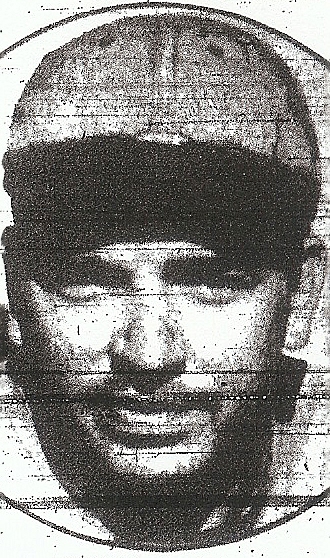
Gardner helmed Sweetwater's 8-0 season.
Gardner helmed Sweetwater’s 8-0 season.

Cletis Gardner, also known as “Biff”, was a  former Villanova fullback who enjoyed 35-year career in San Diego as coach, game official (several years in the NFL), and master of ceremonies, and guided Sweetwater to an 8-0 record and the school’s first undefeated season.

It wasn’t until 1972, when Dave Lay led the Red Devils to a 12-0 record, that Sweetwater repeated an all-victorious season.

Freeman Moeser led the Red Devils and the Metropolitan League with 8 touchdowns in league play.

AVAILABLE REAL ESTATE

Escondido had a new coach, Bill Duncan, who came South from El Monte to replace Charlie McEuen, who replaced Marvin Clark at La Jolla, where McEuen was joined by assistant  coach Don Clarkson.

Duncan moved into the house in Escondido that McEuen vacated.

The Cougars’ boss had a history with San Diego.  He was an assistant coach to Wallace (Chief) Newman at Covina, which defeated San Diego, 13-6, in an infamous Southern Section championship game  in 1925.

Covina was found guilty of using players from the Riverside Sherman Institute, but the Colts never gave up the title or the championship trophy.
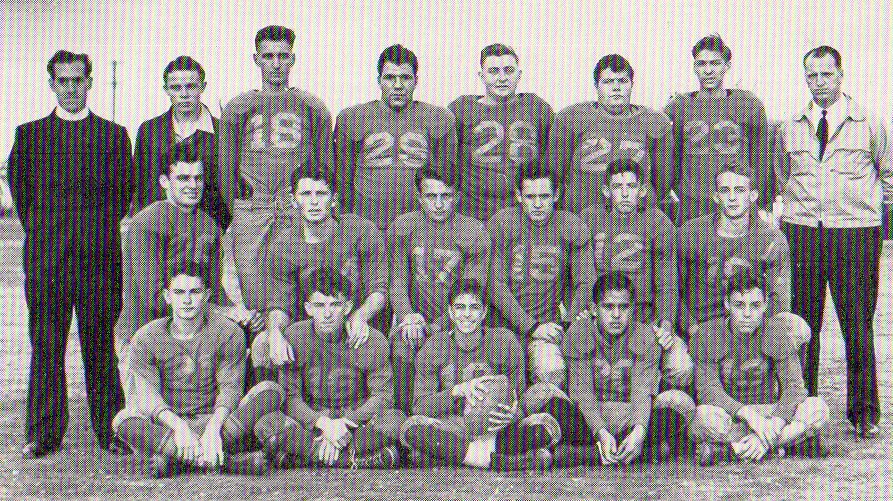
St. Augustine’s 6-1 record represented the best won-loss percentage in school’s 20-season history.  Ed Martin (right, in back row) coached the Saints.

ENGLE BACK AT HOOVER

Roy Engle, the star of Hoover’s first victory over San Diego in 1935, returned to his alma mater and was an assistant coach to Pete Walker.

The 23-year-old Engle took over for Walker early the week of the San Diego game when Walker was down with the flu.

Engle the following spring coached Hoover to the Southern California baseball championship.  Among Cardinals standouts on the baseball team was future major leaguer Ray Boone, whose two sons, Bob and Bret had long careers in the majors, as did grandson Aaron.

LONGEST EVER?

Hoover’s Ben Chase, who did not attend school in 1939-40, returned as Hoover’s quarterback and threw perhaps the longest pass in area history, 63 yards in the air.

From his 45-yard line Chase reared back and flung a towering spiral that end Eldon Johnson caught 8 yards deep in the end zone, according to writer Bob Angus of The San Diego Union.
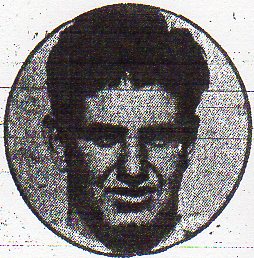
Cardinals’ Ben Chase had the arm.

Pasadena weathered Chase’s shot and went home with an 18-13 victory.

Chase’s throw bettered the 57-yards-in-the-air completion by San Diego High alum Harold (Brick) Muller, who connected with teammate Brodie Stephens in the 1921 Rose Bowl.

Some reports disagreed on Muller’s distance.  His Wikipedia profile says 53 yards.  Another says his pass was 70 yards.

LOCKOUT

San Diego coach Joe Beerkle padlocked gates to Balboa Stadium on the first day of practice before the Hoover game and issued a terse statement to the media following practice:  “We worked on offense and defense.”

Beerkle the next day held relay races, seniors against underclassmen, on the upper practice field, then took the team into the stadium for another closed workout.

San Diego defeated Hoover in the big game, 19-7, before about 12,000 persons.

SIGN OF THE TIMES

Parking meters were being installed downtown, necessitating a need for taxi stands, hotel manager H. A. Williams argued before the city council.

Williams said that unless there were cab stands hundreds of hacks would be forced to “cruise” for fares.

Traffic congestion was growing, accelerated  by private and public vehicles used by thousands of new residents  working in the suddenly critical defense industry.

SIGN OF THE TIME, CONT.

On Oct. 3, 1941,  Jim Londos defended his share of the world heavyweight wrestling championship by pinning Juan Umberto in the 43rd minute of a one-hour, one-fall match in the Coliseum, 15th and E Streets.

Danno O’Mahoney won over LaVerne Baxter by a disqualification.  Myron Cox pinned Manuel Rodriguez via a Japanese headlock.  Chris Zaharias defeated Pete Peterson and Hardboiled Hardy Kruiskamp took the measure of Vic Hill.
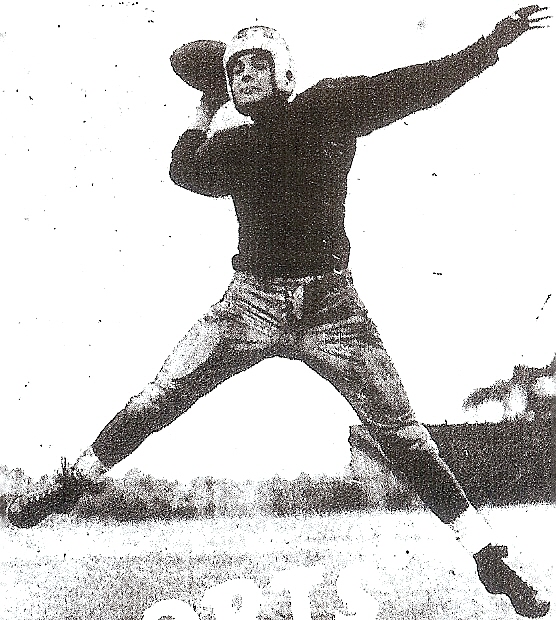
Red Devils rolled with Freeman Moeser.

HONORS

Hoover end Eldon Johnson was named to the all-Southern California third team, the only local athlete honored.

QUICK KICKS

St. Augustine was a member of the Southern Prep League but its games did not count in league standings…the Saints’ 6-1 record was bolstered when Brown Military and Fallbrook forfeited in the last two weeks of the season…About 100 boys and girls from Hoover took part in “Ice Activities” at Glacier Gardens on Harbor Drive…Ice skating as a CIF sport?…The battle between Army-Navy and Brown Military academies was postponed a week as cadets were released to go home for the Thanksgiving holiday…the teams battled to a 6-6 tie when they got together days later…Hoover and Grossmont kicked off at 3:45 p.m. for a day-night single header…first half was played under the sun, second half under the lights at Hoover…San Diego and Hoover defeated Point Loma and La Jolla, 21-7, in the third annual City Schools carnival before about 7,000 in Balboa Stadium…San Diego High vice principal Edward Taylor became principal of the new, Kearny Junior-Senior high on Kearny Mesa…rained out on Friday night, Hoover and Santa Barbara met the next afternoon on the Cardinals’ gridiron…the visiting Dons, destined to win the Major Conference and CIF titles, coasted to a 27-0 win…it was a strange year at Fallbrook…the Warriors finished with a 4-0-1 record to win the Southern League, then forfeited their final game to St. Augustine…along the way, head coach Forrest Lindsay stepped down after three games and was replaced by Lloyd Dever and Charles Coutts….
2015: Hurdler Bob Fortin, Coach Morris Shepherd

Track standout Bob Fortin, 68, and Vista and Chula Vista head coach Morris Shepherd, 95, passed.

Fortin was one of top hurdlers in the San Diego Section and had a best time of :14.7 in the 120-yard high hurdles as a senior at Crawford in 1964.

“Snortin” Fortin, as he was affectionately known because of the guttural sounds Fortin made exerting himself over the barriers, had the fourth best time in the area.

Morrie Shepherd was head coach at Vista in 1948 and Chula Vista in 1949 and ‘50, with an overall record of 13-12-1.

The 1948 Vista Panthers were 7-2, 4-0 in the Southern League, and outscored league opponents, 148-0.

Vista defeated San Dieguito, 20-0, for the league championship on Armistice Day but were beaten, 20-13, by Tustin in the Southern California lower division championship game.

Shepherd was on the staff at Sir Francis Drake High in San Anselmo and was head of driver training for the Tamalpais School District for many years before retiring in 1981 and returning to the San Diego area.


1937: Vexed Wex(ler) Pulls Plug

Escondido was penalized 15 yards before it participated in the kickoff or took a snap at the beginning of the second half of a Metropolitan League game at Grossmont.

Referee Charlie Smith, also the San Diego State baseball coach, penalized the Cougars for not being on the field and ready for kickoff after the 15-minute halftime.

Escondido coach Harry Wexler at first was dumbfounded and then angry.

After pleading with the uncompromising Smith, the Cougars’ coach likely suggested the referee do something that was physically impossible and offer Smith a middle-finger salute.

Wexler then pulled his team off the field.

Writer Charlie Byrne of The San Diego Union pointed out  that the Spaulding Official Rules of Football stated that teams should be ready and on the field after the break. Game officials, the rule book pointed out, were not required to notify the teams.

TIMING OFF?
“I even told the team I thought halftime was a little long,” explained Wexler, who expected the usual, three-minute heads up from one of the flag throwers.

Grossmont coach Jack Mashin seem to side with Wexler but reluctantly accepted the penalty  before the start of the third quarter when Smith informed the Grossmont captain, who looked for direction to Mashin on the sideline.

“If I didn’t have my team’s back in a situation like that I would lose support of the team and the student body,” said Mashin.

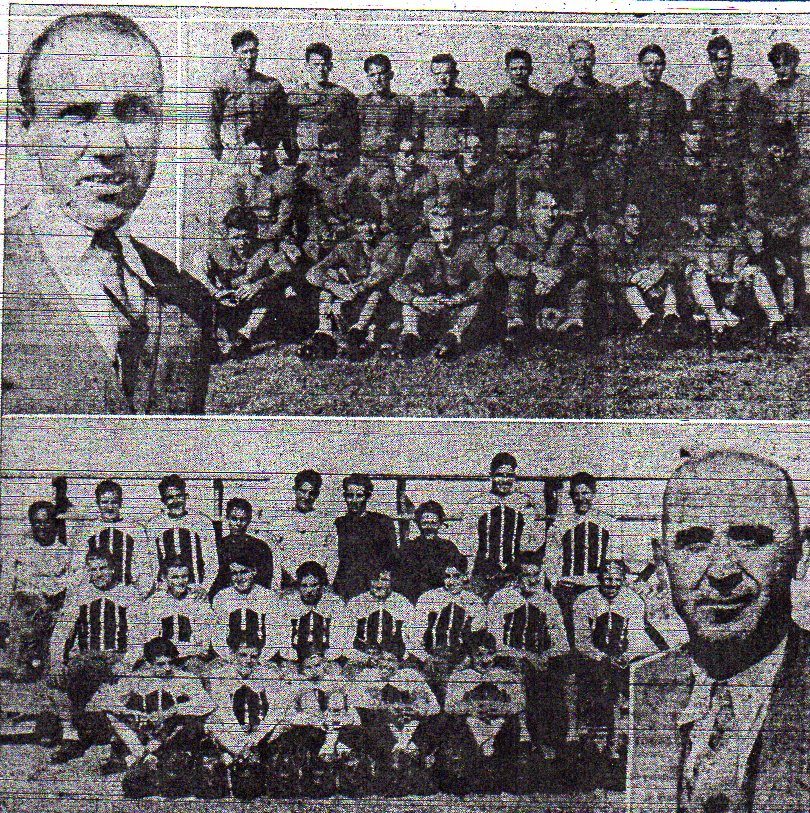
Jack Mashin’s Grossmont Foothillers (top) and Harry Wexler’s Escondido Cougars tied for league championship with Coronado.

King Kaufman, president of the Grossmont School Board, was at the game and tried to convince Wexler to continue. Wexler refused. Meanwhile, several hundred spectators milled about the officials, although there was no disorder, reported Byrne.

Escondido players appeared shocked at their coach’s decision and stayed on the field for several minutes before heading to their buses and the trip home.

Referee Smith was unavailable for comment. Grossmont the winner by forfeit, 1-0.

WOE IS US

Joe Beerkle was 6-4 and 6-0-1 in his first two seasons at Point Loma but offered a gloomy outlook for 1937.

“Everybody is going to be gunning for us,” said Beerkle of Point Loma’s defending Metropolitan League champion, “but the sad part of it is we’re not going to have anything worth gunning for.”

The Pointers didn’t get the memo.

Point Loma rolled to an 8-0 record. Beerkle moved on to become head coach at San Diego the following year and was there through 1942, when he became principal at Memorial Junior High.

The Hilltoppers were 18-14-2 under Beerkle.

Beerkle’s record does not include the split squads of  Cavemen and Hillers that were a combined 13-2-2 in 1942.  San Diego was 1-0 as a complete squad that season.

GOLF OVER FOOTBALL

The Pointers had seven returning lettermen  but had lost 11 and returned only one starter. Two other letter winners moved away and three more either were nursing injuries, ineligible, or in the case of one, recovering from an appendectomy.

Harry LeBarron, a strapping, 175-pound end, contributed to Beerkle’s woe by announcing that he was retiring.

LeBarron was giving up football to concentrate on golf.  He had qualified for the 1936 Southern California Junior finals.

But LeBarron returned in Week 2 and made the all-Metropolitan League second team.

Paul (Red) Isom was a threat every time he touched the ball and the rising power on the peninsula raced to an undefeated season, punctuated by a 64-13 rout of Oceanside in the final game.

Keeping with tradition, the Pointers declined to participate in the Southern California minor division playoffs.

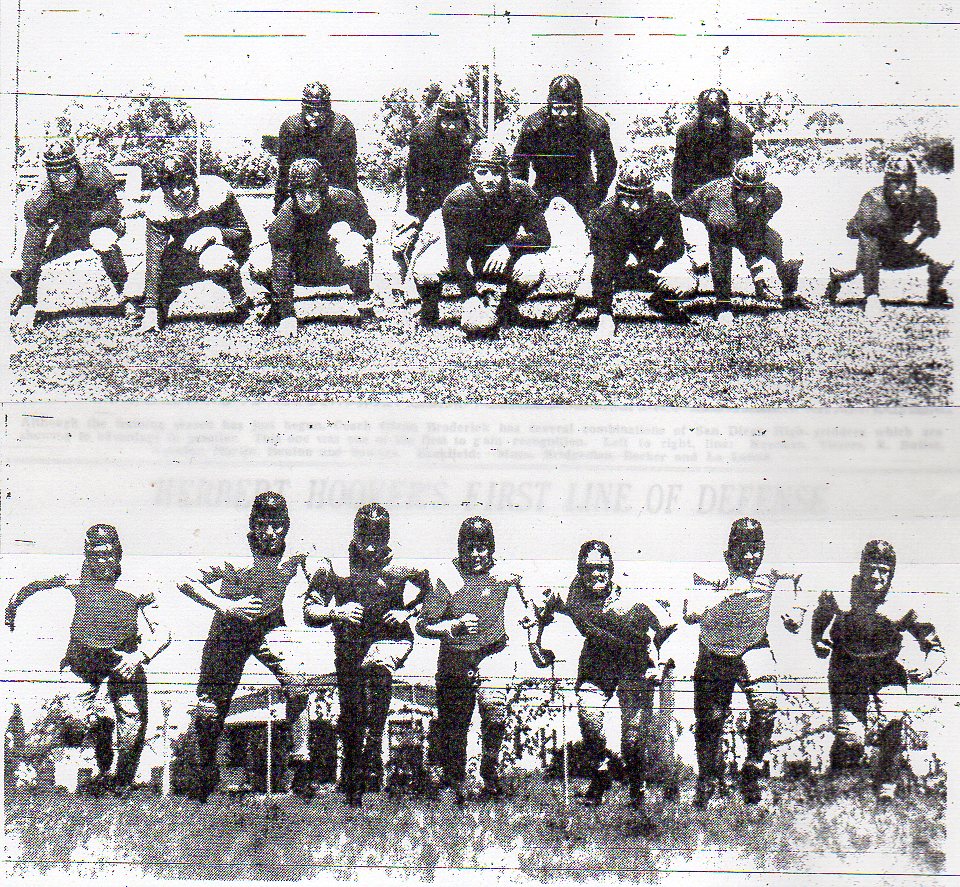
The opposing teams, San Diego High offense (top) and Hoover defenders. Hilltoppers (front, from left): Newman, Vissers, R. Butler, Amador, Martin Bouton, Sawaya. Backfield: Muns, Bridgman, Becker, La Lanne. Hoover linemen: Prusa, Krutzsch, Homesley, DeLauer, Nelson, Baker, Harer.

IN THE BLACK

The highlight of Glenn Broderick’s last season as head coach at San Diego was a 14-13 win over Coast League rival Alhambra.

Leonard Black ran 96 yards with an intercepted pass for a touchdown and Bob Bridgeman kicked two points after touchdowns as the Cavemen  took a 14-7 lead into the final minutes.

Alhambra scored a touchdown but its try for point hit the crossbar, leaving San Diego in front, 14-13.

Problem.  The Cavemen were off-side.  The Moors lined up for another try, this time attempting a running play, but Black stuffed the runner at the goal line.

FRUSTRATION AND INJURY

The season record was the poorest since 1914 and the Hilltoppers were last in the Coast League for the first time since the circuit was formed in 1923.

“Wish they had that fight all the time,” Broderick remarked to Charlie Byrne, after a particularly spirited practice before the annual intersectional battle at Phoenix.

“If the fellows were like that all the time we’d win all our games,” said Broderick.

The Hillmen offered little at Phoenix, outgained, 280-91, out-downed, 14-5, and outscored, 19-0.

The team returned home but Broderick had to remain in the Arizona city, arranging for hospital care for lineman Dick Butler, stricken an hour after the game and operated on for a hernia.

Butler would be hospitalized for two weeks, but Broderick made sure a radio was placed in his room and Phoenix officials agreed after San Diego complaints that they would not use local officials for future games in Arizona.

It was that kind of trip.

Hoover coaches Lawrence Carr (front row left) and head coach John Perry (front row right) presided over 6-2 team that won rivalry game with San Diego.

HILLERS WIN STATE TRACK

Broderick, who joined the faculty in 1926,  left San Diego at the end of the school year and went out a winner.

The Cavers were beaten by Hoover, 63 1/2-58 1/2, and finished in a tie for the Coast League track and field title with the Cardinals and Long Beach Wilson.

But the Cavers scored 24 points to beat the runner-up Cardinals in the Southern California finals and outscored 88 other teams with 18 points and won the state team title.

Broderick left teaching and worked at Convair for many years.  He eventually returned to a first love, track and field, and was a finish judge and timer for many years at area events.

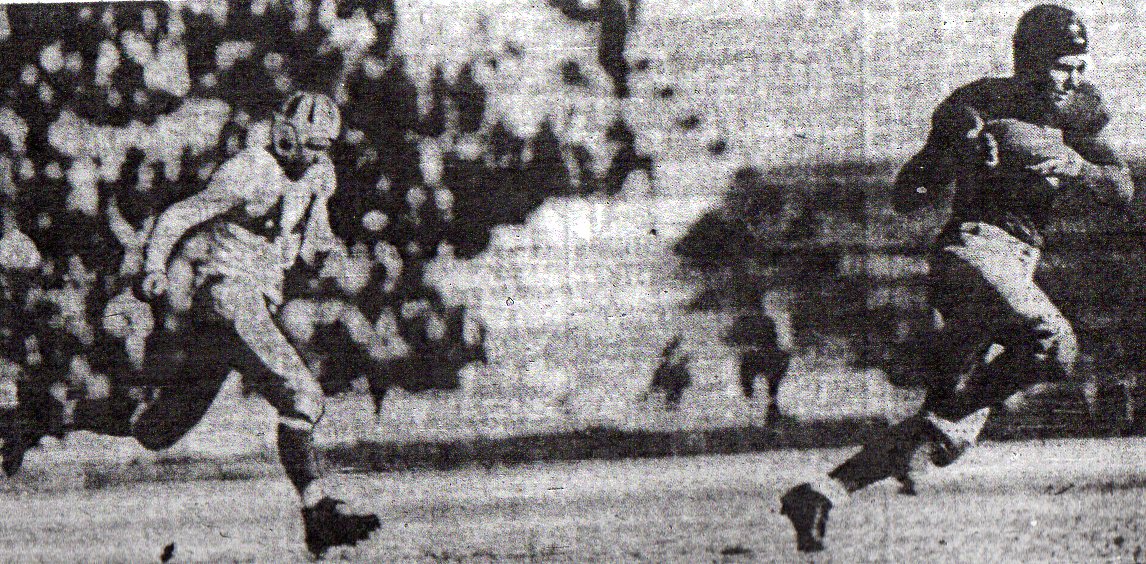
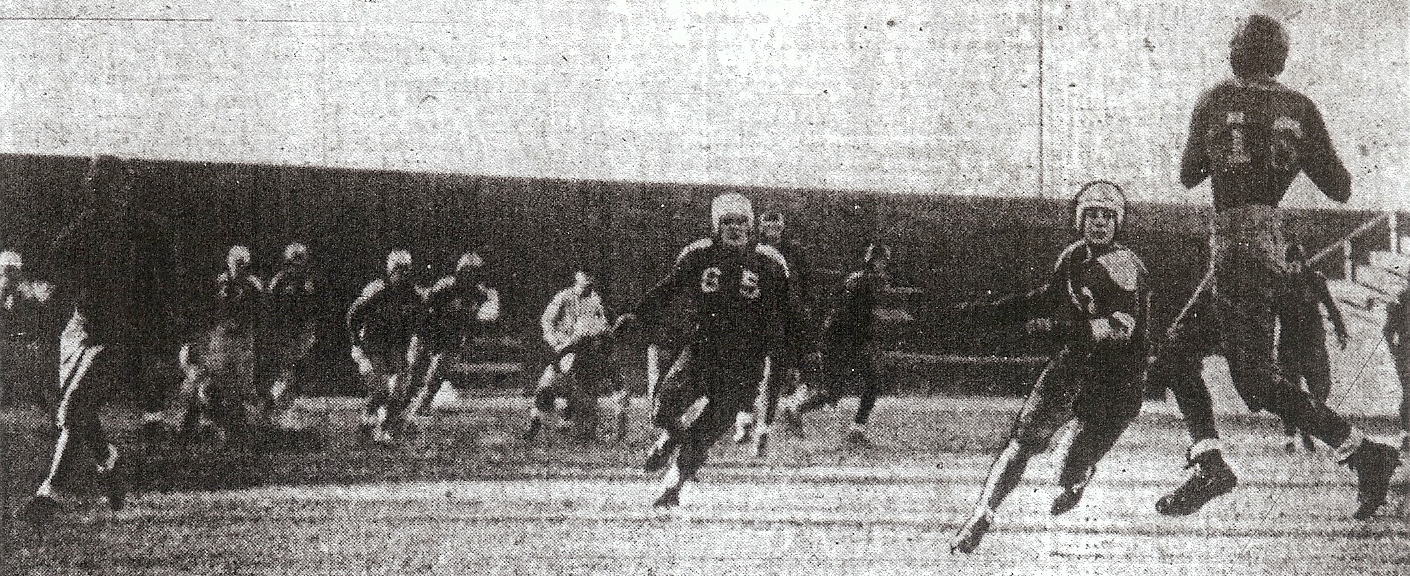
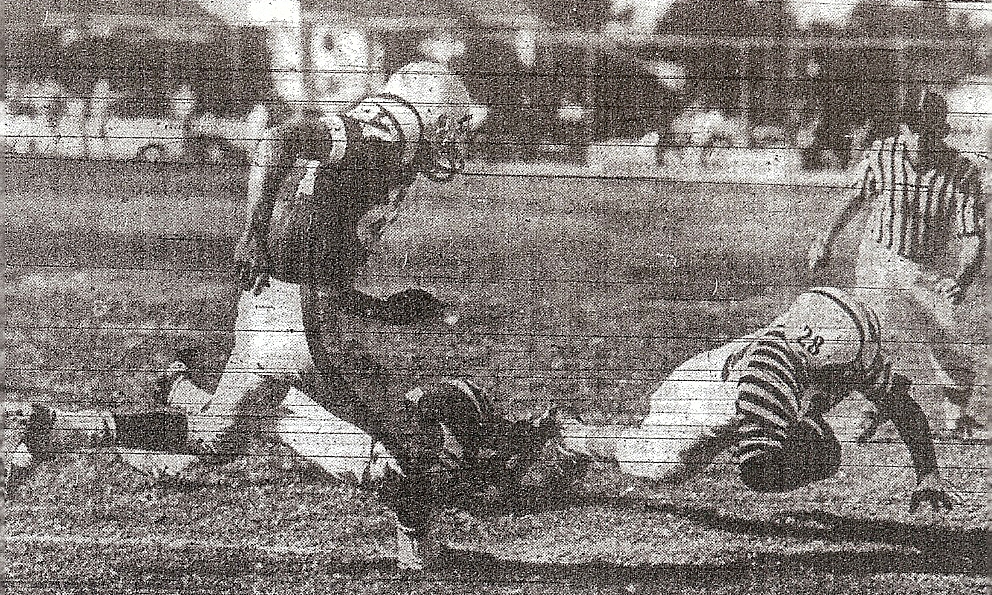
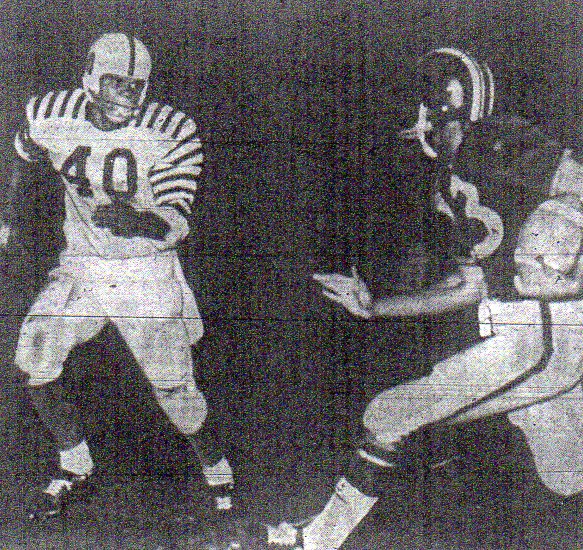
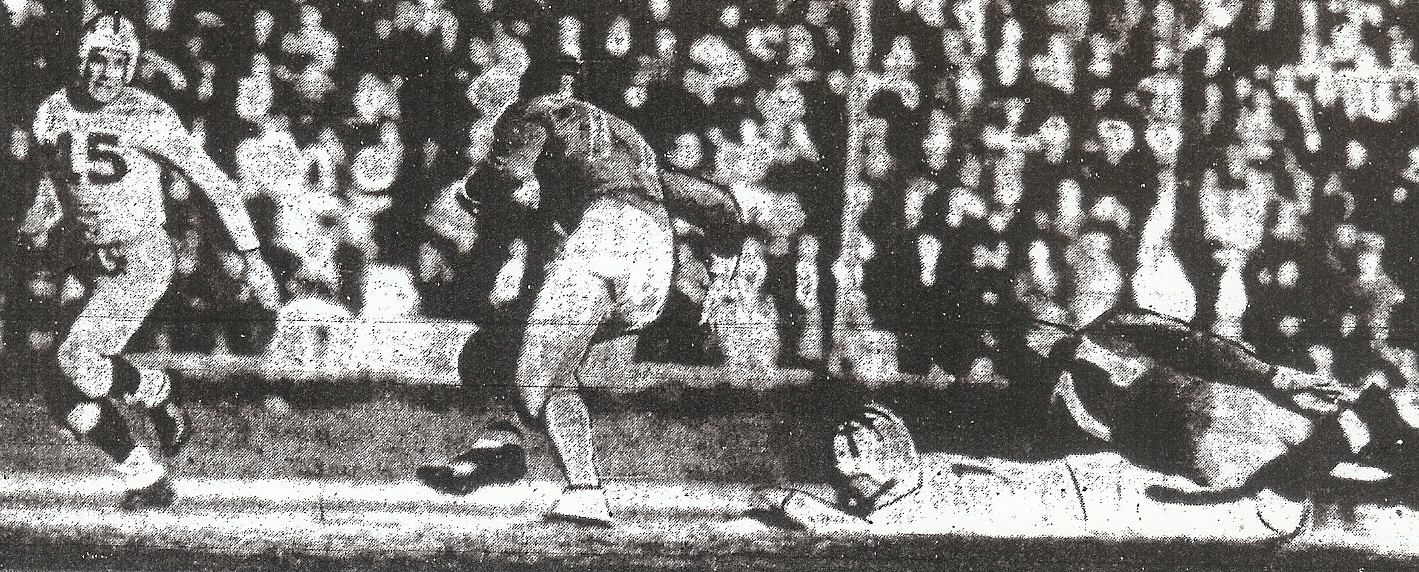
Hoover's Bob Carr turned Ernie McNulty's pass into a 28-yard touchdown play and left one San Diego defender on the ground and another he faked as Carr made his way to end zone.
Hoover’s Bob Carr turned Ernie McNulty’s pass into a 28-yard touchdown play that  left a teammate and one San Diego defender on the ground and another wary and uncertain as Carr faked his way to end zone.

MANY COME BUT ONLY ONE CALLED

From an original group of at least 15, San Diego High officials whittled the list of candidates to replace Broderick to six.

Joe Beerkle of Point Loma eventually would be appointed.

Others considered for the job included Frank Ribbel, coach at Richmond High in the East Bay area of San Francisco and a San Diego High alum; Bob Erkine, Brawley High; Dean Johnson, coach of the high school in Freeport, Il., and Gil Kuhn and Gaius (Gus) Shaver, former USC grid stars.

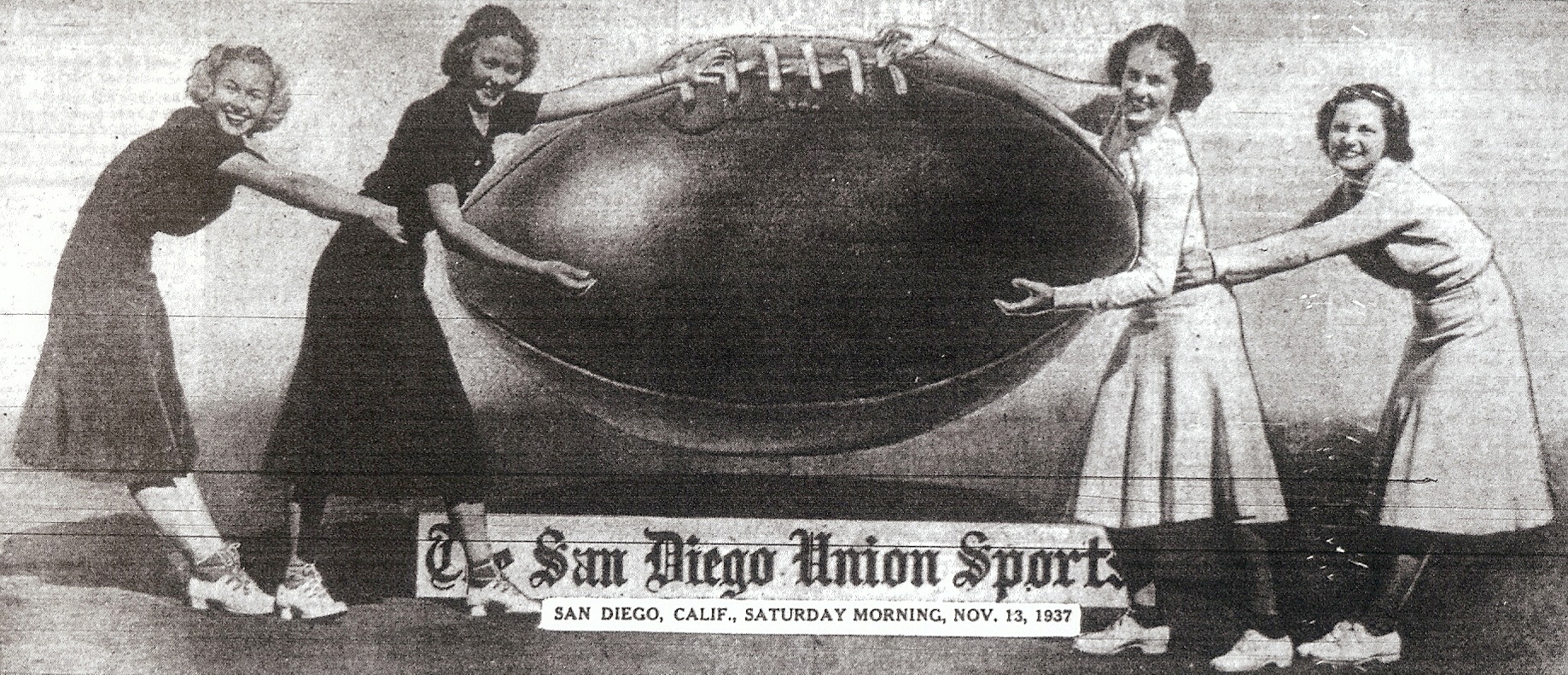
San Diego cheerleaders (dark dresses) Eveline Matheson and Carol Remington agreed that there was nothing bigger than a football game with Hoover and its cheerleaders, Betty Jane Thompson and Corine Bailey (from left).

HOOVER ASCENDS

Hoover was 6-2 and defeated San Diego, 13-6, for its second victory in three years over the Cavers.

Ernie McNulty led all rushers in the San Diego game with 50 yards in 12 carries and punted with amazing power, averaging 43 yards on  eight attempts.

Hoover had a 104-yard advantage in the kicking game.  San Diego averaged only 29 yards a punt.

McNulty also boomed a 50-yard, coffin-corner kick that expired on El Monte’s six-yard line.  The Cardinals’ 19-6 win over the visiting Bears in the final game was a season highlight. El Monte was champion of the Pacific League in the San Gabriel Valley.

Hoover’s Leon Carver caught pass from Bob Beckus after slipping behind San Diego defense and scored go-ahead touchdown on 63-yard play that was sent in from Cardinals’ sideline in 13-6 victory. San Diego’s Ervie Davis trails.

CARDINALS’ BLING
So impressed was the Hoover booster club that the group, made up of area businessmen, presented 25 players with engraved gold footballs.
The Cardinals also were celebrated as city champions, although they didn’t play unbeaten Point Loma. St. Augustine claimed the city private school championship with a 25-0 victory over Brown Military Academy.

Ed Becker
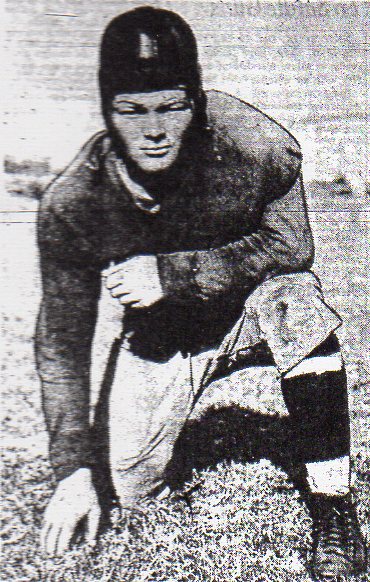
Ed Becker, like Hoover’s Bob Beckus, was all-around athlete and all-Southern California for San Diego.

3 TEAMS, 2 GAMES

Sweetwater’s Dinon Bush scheduled two opponents in one day.  The Red Devils played to a scoreless tie with San Juan Capistrano and defeated San Dieguito, 18-6.

Bush, an  ex-San Diego State gridder who most recently coached at Hemet, divided a squad of 50 players into three units.  Quarters were 10 minutes instead of the standard 12.

Non-lettermen with experience played Capistrano. Sweetwater players who lost to El Centro Central the previous week took on San Dieguito.

The triumvirate was complete when sophomores played in both games, relieving the first two groups.

HORACE GREELEY, I HEAR YOU

First-Year La Jolla coach Marvin Clark followed the road west.

Clark played at the University of Arizona in Tucson and then accepted a position  240 miles away, on the Arizona-California border, where he was head coach for nine years  at Yuma.

Clark moved  west another 73 miles when he was head coach for two seasons at Brawley in California’s Imperial Valley, and finished his voyage next to  the shores of the Pacific Ocean when Clark moved to La Jolla, 134 miles from Brawley.

Clark found his niche in the seaside community.  He eventually became the Vikings’ principal before retiring in the early ‘sixties.

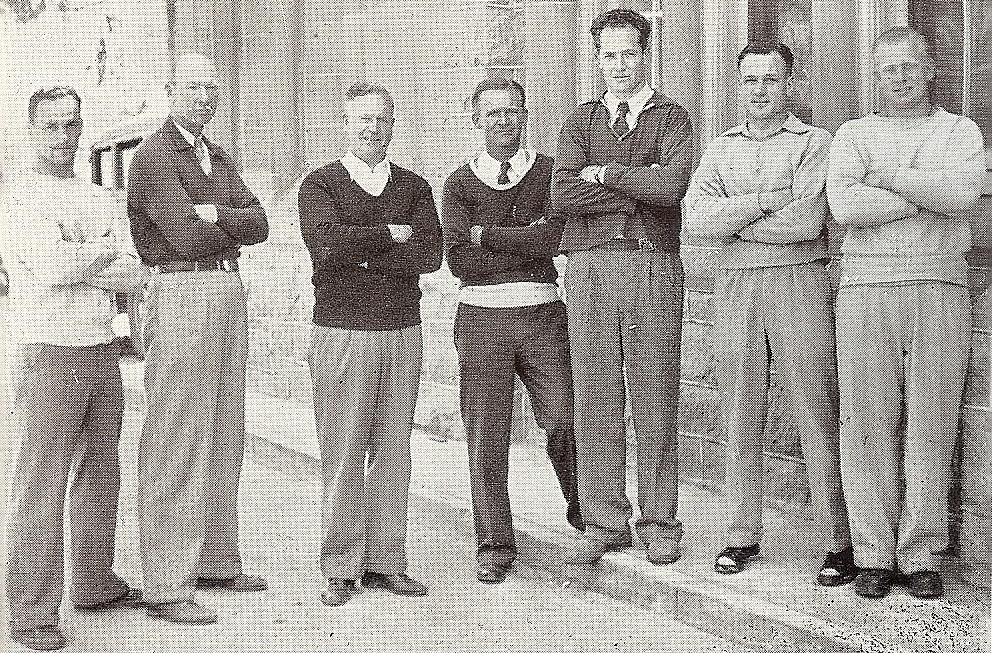
Glenn Broderick (fourth from left) was a senior athletic department official at San Diego High with Mike Morrow (second from left). Others (from left) are Ted Wilson, Charlie Church, Ed Ruffa, Frank Crosby, and Bill Schutte.

SIGNS OF THE TIMES

Seventeen players from Carlsbad High in Southeast New Mexico marched into the city room of the Carlsbad Current-Argus and announced they were boycotting the next day’s Thanksgiving Day game with hated rival Artesia.

According to the Associated Press, school officials had refused the players permission to watch the USC football team practice.  The Trojans, as is custom, stopped in Carlsbad on their railroad trip to South Bend, Indiana, to play Notre Dame.

Insult, according to the AP, was added to injury when the Carlsbad players also were denied permission to accept an  invitation to accompany the USC squad on a sight-seeing tour through Carlsbad Caverns.

School officials somewhat condescendingly said, “They’ll play tomorrow.”

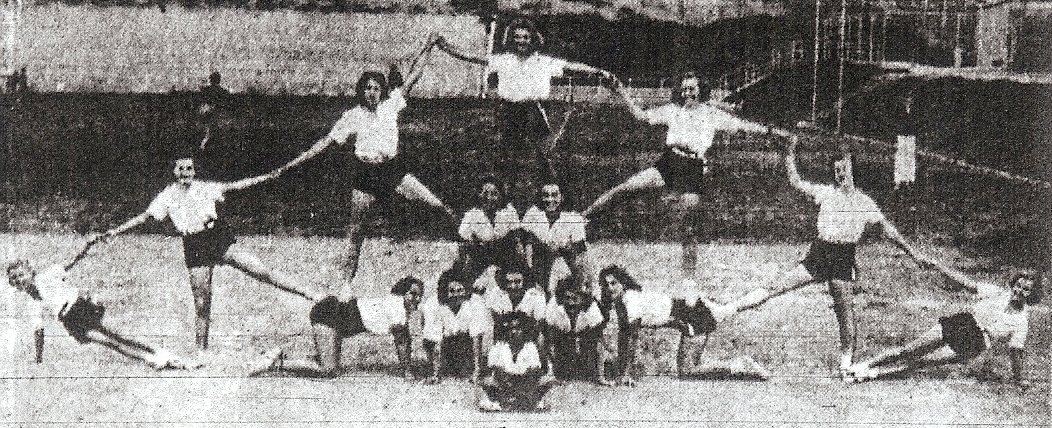
The girls' tumbling squad provided halftime entertainment at La Jolla's home games.
The girls’ tumbling squad provided halftime entertainment at La Jolla’s home games.

VAN PATTEN REWARDED

Southern Section commissioner Seth Van Patten was elected for another term that would pay him $2,400 annually.  The CIF budget was approved at $4,500.  A 19-year-old age minimum was established and schools in the city of San Francisco formed the sixth CIF Section.

Van Patten moved the CIF office to South Pasadena High and Bill Schroeder of the Helms Athletic Foundation in Los Angeles created the first, recognized All-CIF Southern Section team.

NATURAL STRIKE

More than 170 firefighters battled a blaze on the west slope of  Mount San Miguel, which overlooked the Southeast corner of the County.  The fire was started by a bolt of lightning and fueled by Santa Ana winds and hot, late-summer temperatures.

The All-Metropolitan League squad included five of the loop’s best, clockwise from upper left: quarterback Eddie Estrada, Grossmont; halfback Roy Tillinghast, La Jolla; tackle Wesley Mulkins, Escondido; tackle George Abel, Point Loma, and end Vaughn Stewart, Grossmont.

TRUE GRID

Two changes in the football rule book would stand the test of time…kickoffs were reduced to one attempt…if the ball went out of bounds, the receiving team automatically started on its 35-yard line …numerals were required on the fronts and backs of game jerseys…Point Loma’s 64-13 victory over Oceanside represented the most points by a San Diego team since Coronado defeated La Jolla, 73-6, in 1929…Pomona claimed the biggest lineman in the country, 311-pound Bruce (Tiny) Twerill, who had pared from 317 pounds in 1936…Hoover coach John Perry locked gates around the Cardinals practice field before the San Diego game and had “husky” alumni and ROTC personnel keeping visitors away…actor Leo Carrillo owned a ranch in Vista and was said the be a sponsor of the first-year school’s football team…with Fallbrook playing football for the second season, only Ramona, Mountain Empire, and Julian did not field teams…Escondido’s Frank Thames kept it short, scoring on runs of 3, 3, 4, 2, and 1 yards and adding as point after in the Cougars’ 39-7 win over La Jolla…pinched financially as the Great Depression worn on, San Diego attempted to find another opponent after its season ended in a 7-0 loss to Long Beach Wilson, but there were no takers…San Diego standout Leonard Black also served as president of the senior class…when Sweetwater coach Dinon Bush announced that the Red Devils would field a “pony” backfield and big line, Coronado’s Hal Niedermeyer said, “We’re going to have a pony line and a midget backfield”….

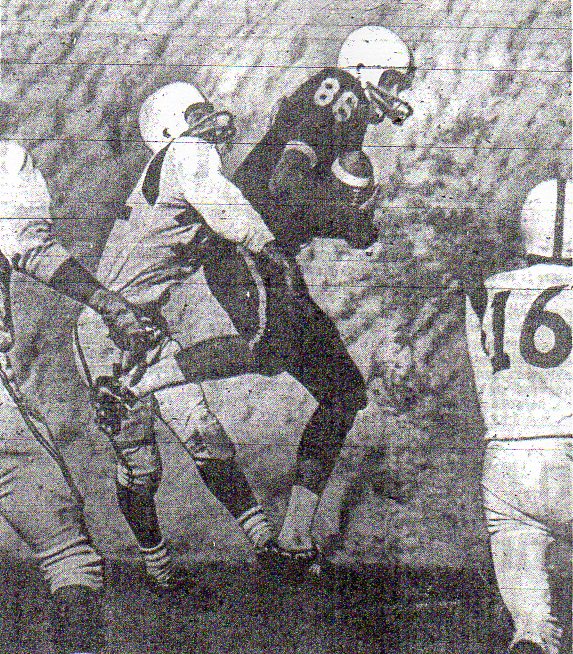
Joe Rinder (16) and quarterback Red Keough teamed on 50-yard touchdown pass play in St. Augustine's win over Brown Military.
Joe Rinder (16) and quarterback Red Keough (background, between two white helmets) teamed on 50-yard touchdown pass play in St. Augustine’s win over Brown.


1965:  Bennie Didn’t need Postseason Relief

Teams with losing records didn’t make the playoffs.  Neither did some with winning records, or even the undefeated.

Only league champions were invited.

Four large school and two small school squads would make up the 1965 San Diego Section postseason.

Bennie Edens wasn’t playing “one game at a time.”  He was looking a few weeks down the road and he feared some deja vu.

The Point Loma coach wasn’t the first to raise a voice in support of larger postseason brackets, but his may have been the most compelling.

The Bennie did not have 50 or 60 teams in mind, a number that would be routinely reached by the millennium.   Edens just rued the possibility of another good season going unrewarded.

The Pointers were 6-3 in 1964 and 4-1 for second place in the Western League but came up postseason empty.  This year’s group was unbeaten with two games remaining but could be left out again.

Edens took advantage of a unique forum when he was invited to address the Union-Tribune Quarterback Club at its weekly luncheon in Town and Country Hotel.

Edens wanted more playoff teams.

Bennie suggested that each winner from the section’s four major leagues, Eastern, Western, Grossmont, and Metropolitan, and the leagues’ runners-up be slotted into an eight-team bracket.

“It would add one week to the schedule, but it would be worth it,” said Edens.

“Some ties (in the standings) are shaping up…and a good way to resolve the situation would be to have both the first and second-place teams in the playoffs.”

Edens expanded on the subject when interviewed a day later by Wayne Lockwood of The San Diego Union:

“Usually the league finishes are so close that they really aren’t a definite indication of which is the best team,” said Edens.

“Being in the playoffs is important to a school—it creates a lot of pride in the student body—and I’ve never seen a school hurt by going into the playoffs.

“They already take the top two teams in basketball and baseball,” added the Bennie.

The peninsula school sage hadn’t gone all altruistic.  He also was looking out for his Pointers.

Two weeks remained in the regular season. Kearny, 2-0-1, was the Western League leader. Clairemont, 2-1, was tied for second with Point Loma, 1-0-2.

Edens’s club could win its last two games, finish with an undefeated league record and overall 6-0-3 but not make the postseason.

KOMETS TAKE HIT

That’s because if Kearny won out, the Komets would be 4-0-1 and in the throne room, possessor of the circuit’s only playoff berth.

The question became academic when Clairemont, under first-year coach Leroy Dotson, upset Birt Slater’s Kearny club, 21-20, and opened the door for Point Loma.

Point Loma finished with a 3-0-2 league record, followed by La Jolla, 3-1-1. Kearny, 2-1-2, tied for third with Clairemont, 3-2. Madison, 1-3-1, and Mission Bay, 0-5, brought up the rear.

Don Clarkson, the executive secretary/commissioner of the San Diego Section, responded to Edens’ comments.

“The principal purpose of forming the San Diego Section in 1960 was to cut down on the length of the playoffs,” Clarkson told Lockwood.

The genial, old-school Clarkson was following the company line that was uttered by administrators and various school board suits in the late 1950s:  Football season was too long, playoffs were too long, and we’re going to have more say.

Escondido quarterback John Ahler gets play from coach Chick Embrey (left) and returns to action, while Lincoln’s Marvin Galliher and coach Shan Deniston discuss options in semifinal playoff which Hornets won, 19-6.

IT’S AN L.A. THING

The real reason for the departure from the Southern Section was because the small-thinking school honchos and their friends in local business leadership didn’t like the idea of San Diego’s being “bossed around” by someone in Los Angeles, in this instance Southern Section commissioner J. Kenneth Fagans.

So the locals took 28 area schools and moved to their own, tiny sand box.

The San Diego Section bosses would go so far as to ridiculously create one champion from the City and one from the County in 1967 and ’68 in order to keep the postseason at two weeks.

The suits finally bowed to media, fans, and coaches’ complaints  and added a third week in 1969.

Additional playoff divisions eventually became reality and a fourth week came about in 1986, equaling the number of weeks that had been status quo when San Diego schools were in the Southern Section.

By the turn of the century there was playoff frenzy.

Forty-four of the 76 schools playing football got postseason bids.  The number would continue to grow.

Lewis King ran 68 yards for a touchdown on Lincoln’s first offensive play and Hornets shut out Morse, 13-0, to take command in the Eastern League.

WHAT’S IN A NAME?

Rio Seco High, a new school in Santee, was introduced last year in anticipation of its opening in time for the 1965 football season.

But students and citizens requested that such name be tabled and leaving the school unnamed until others were offered, according to Harlon Bartlett of the Evening Tribune.                                                                                           

Grossmont School District officials waited and met again later in the year.

On the table were  “Rio Seco”, “Santee”,  “Santana”, and one other.

Santana won.

The school’s title was not intended to pay homage to Carlos Santana, who was 17 and still a few years from making his international mark in rock music.

Or to Pedro Santana, a dictator in Dominica in the mid-19th century.

Nor has there always been agreement on definition of the word.

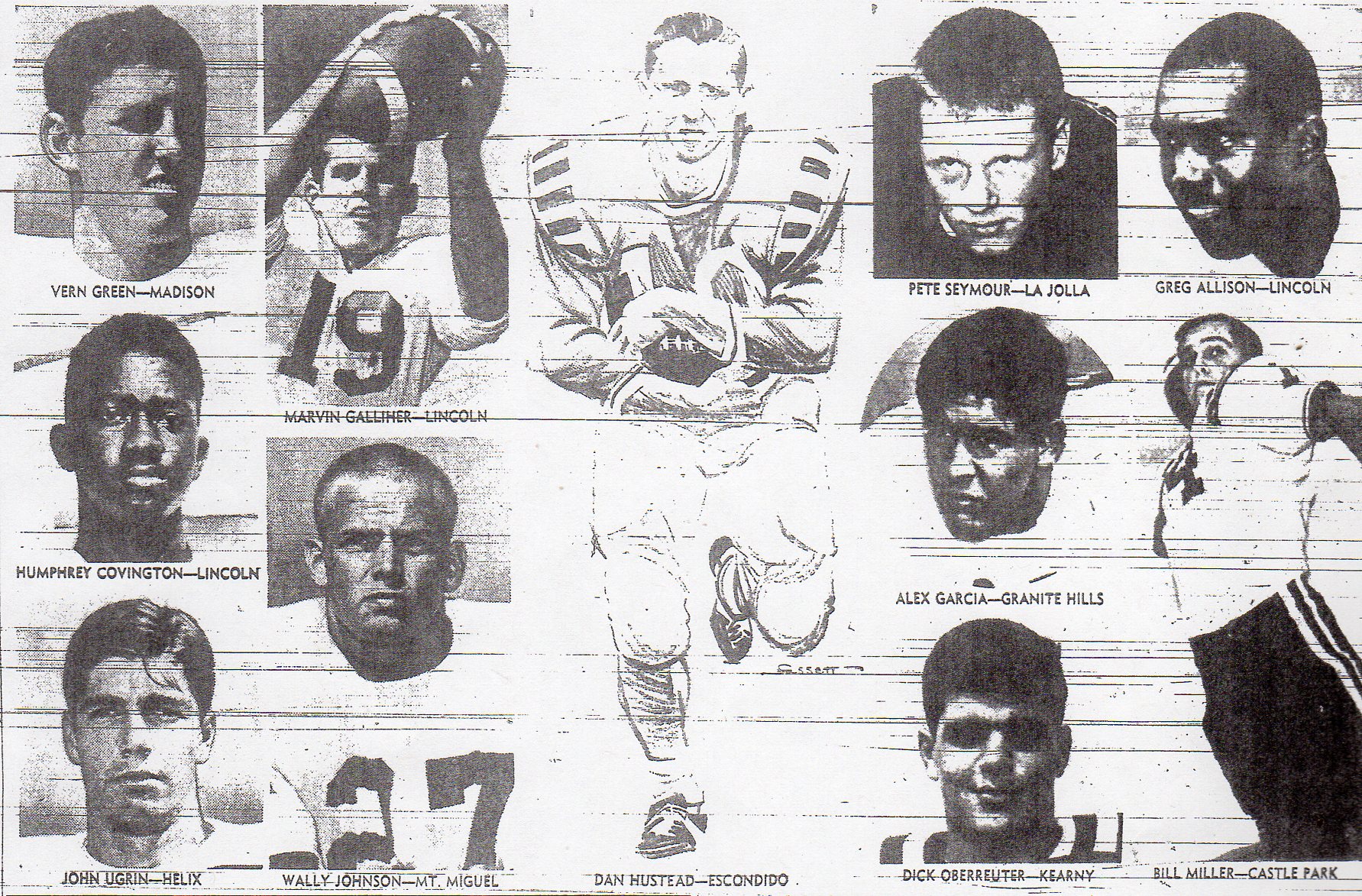
Escondido’s Hustad was San Diego Section player of year, while Lincoln had three on first team.

RIVALRY BLOSSOMS

Some say Santana is a derivative of Santa Ana, which also has been known as the “Devil Wind” and a potentially dangerous force of nature in Southern California.

Others say the Spanish word is meant to describe “holy” or “Saint”.  It also enjoys popular usage in identifying baby boys and girls.

Santana High, by any name, adopted “Sultans” as its purple, gold, and white mascot, and opened on Mast Blvd., in Santee with 1,200 students in four grades this year.

Coach Gordon Teaby guided the team to two wins and six losses.

Forget the record.  Of more import is what took place in the season’s third week.

The Sultans won their  first-ever game, 23-13, defeating their immediate archrival, El Capitan, located in Lakeside 4 1/2 miles and maybe 10 minutes away by automobile.

From that beginning, Santana and El Cap played every year until 2014, when a releaguing took place in the Grossmont Valley League.  El Cap led the series with 31 victories against 16 losses and two ties through 2013.

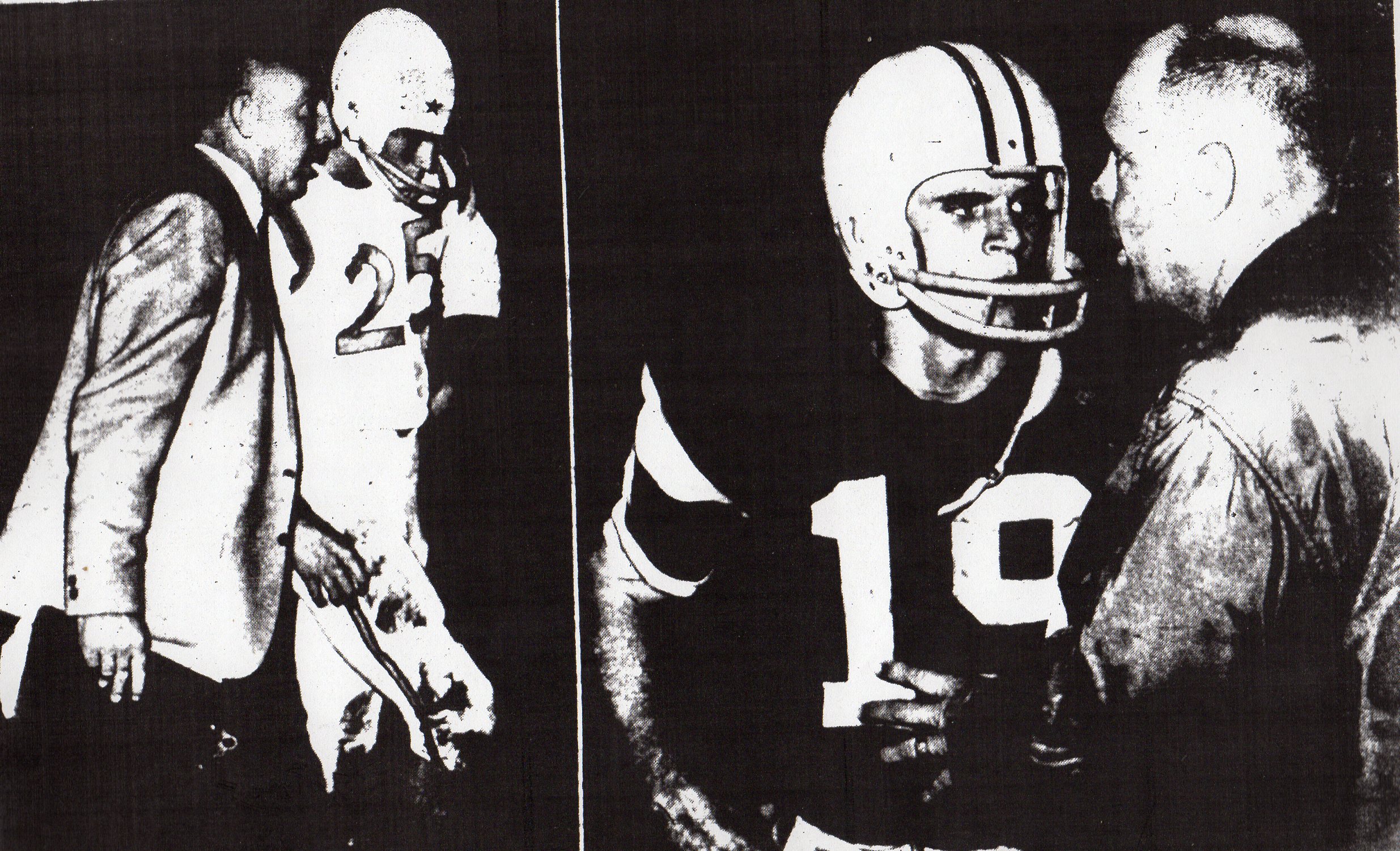
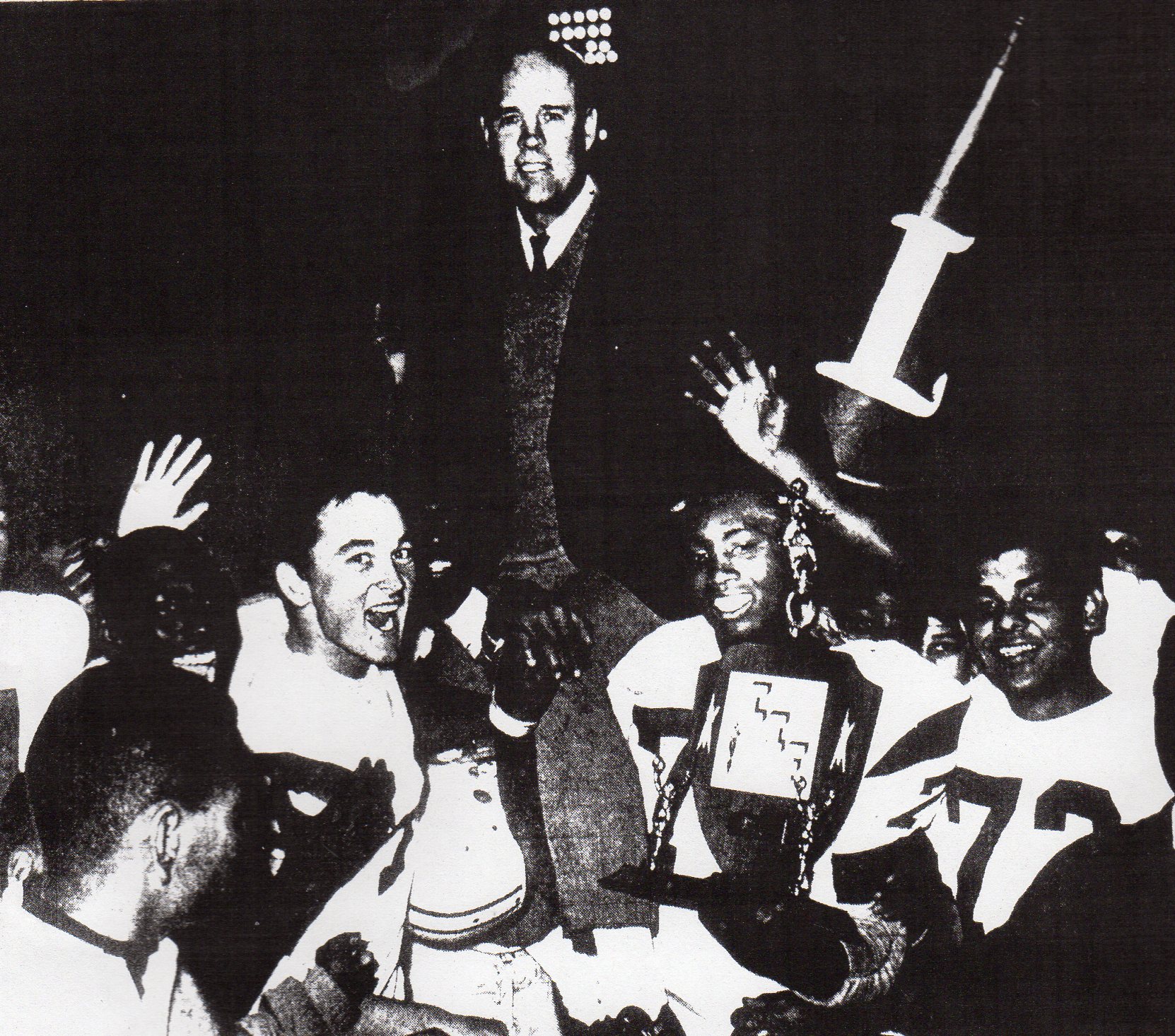
Lincoln coach Shan Deniston got  ride after Hornets’ championship-game victory.

SHAN AND BENNIE

Glib Shan Deniston and  dour, less quotable Edens were rival coaches in the San Diego Section finals.

Deniston: “At the start of the season we didn’t think we’d win a game.  After we lost the opener (14-12 to University) we were sure of it.”

Edens:  “This is a real surprise.  We were more or less resigned to a rebuilding season.”

The animated Deniston’s team defeated the reserved Edens’ team, 21-14, before about 12,000 persons in Balboa Stadium.

Point Loma’s conservative and often challenged offense operated behind Bill Settles, a solid quarterback.

Lincoln won its last 10 games, behind a flock of future Division I players, including fullback Humphrey Covington and linebacker James Gunn, bound for USC, and tackle Gregory Allison, headed for Iowa.

“He’s been with me three years and before the Crawford game (in Week 5) I finally decided to let him call all the plays,” Deniston said of quarterback Melvin Jackson. “I told him that way I could blame him if we lost.”

Deniston was kidding, sort of.  “We won, 35-6,” said the coach.  “Of course, I took all the credit.”

Jackson’s favorite target was future pro baseballer Marvin Galliher, who caught 8 touchdown passes.  Galliher manned one receiver position and Phillip Shelley an outstanding, two-way player was the other end.

John Cervinsky covered last four yards for touchdown between Lincoln’s Marvin Galliher (left) and Phillip Shelley. Point Loma led by two touchdowns before Lincoln rallied for 21-14, championship game victory.

POINTERS HAVE SCENT

Point Loma took a 14-0, second-quarter lead against Lincoln on a four-yard run by John Cervinsky and Settles’ only completed pass, a 67-yard touchdown strike to Roger Wagar.

Lincoln  eventually pulled in front in the third quarter as Jackson passed (8×14 for 154 yards) and ran (10-yard, tying touchdown) the Hornets to victory.

REMEMBER THE NAME

Chris Chambliss, a converted end, rushed for 153 yards in 22 carries as Oceanside defeated San Dieguito, 21-7, before an overflow turnout of 7,500 Simcox Field for the 1-A title.

Chambliss became better known 11 years later, when his home run won the 1976 American League pennant for the New York Yankees.

Crowds of at least 6,500 were on hand in Aztec Bowl (Point Loma, 20, El Cajon Valley 7) and at Balboa Stadium (Lincoln, 19, Escondido 6) in the playoff semifinals.

CLASSIC REVAMPED

After 16 years, the annual San Diego College Prep All-Star Football Classic was moving from Aztec Bowl.

“We’re laying the groundwork for what should be the largest crowd in the history of the series–twenty thousand,” said Syd Russell, the game’s executive director of the sponsoring Breitbard Athletic Foundation, who added that a crowd that size would be impossible at the 12,000-seat capacity college facility.

Quarters also would be expanded from 12 to 15 minutes and the collegiate-favored two-point conversion would be introduced,

CITY DEFEATS COUNTY

Breitbard queen and Morse graduate Marcia Woods and Hoover’s John Stephenson of City squad helped publicize the game.

A Balboa Stadium turnout of 12,242 persons watched stars from San Diego city schools defeat a squad picked from County schools, 19-0.

The City, coached by Robert (Bull) Trometter of University High, outgained the suburban team, 335-149, and recorded a second consecutive shutout.

The Breitbard game’s format from 1949-55 matched Southern California stars against players from the Los Angeles City Section.  It was L.A. City versus San Diego from 1956-63.

TOUGH MATCHUP

Escondido had Dan Hustead, the player of the year and author of 20 touchdowns, but the Cougars couldn’t get past Lincoln.

“I don’t know how we do it,” said Escondido coach Bob (Chick) Embrey. “We’ve been in the playoffs four years (out of six) and have drawn the best team in the first round every time.”

The champion Cougars defeated San Diego, 19-13, in 1960, beat Hoover, 28-26, in 1962, and lost to champion Kearny, 27-14 in 1963.

University stretched its winning streak to 13 games as Bill Rozek scored on 16-yard touchdown pass from Steve Dunning and Dons topped Orange Glen, 35-7. Patriots’ Bruce Williams makes late stop as Gary Urdahl (16) arrives.

STREAKS

Grossmont’s 1932-34, 23-game winning streak and 24-game unbeaten run was on the line.

Kearny came into the season with 21 straight wins and was a heavy favorite to repeat its Western League and San Diego Section titles.

With quarterback Billy Bolden, the 1964 Section player of the year, and halfback Bobby Johnson on hand plus a healthy list of lettermen, the Komets of coach Birt Slater seemed potentially dynastic.

But Johnson sustained a serious ankle injury in a 25-0 victory over Grossmont that pushed Kearny’s record to 23 straight.  He missed three games including the two most important.

The Komets led Morse, 13-0, the following week before the Tigers scored two touchdowns in the final nine minutes for a 13-13 tie.

Shelley and Lincoln defense stopped Komets and Ty Youngs (28).
Phillip Shelley and Lincoln defense stopped Komets and Ty Youngs (28).

Kearny still could tie Grossmont’s 24-game mark but was beaten, 21-12, by Lincoln the next week. The Komets fumbled on the first play of the game and Phillip Shelley policed the ball and ran 25 yards for a touchdown.

Another tie and two more losses short-circuited the potential dynasty.

STREAKS, CONT.

–Grossmont’s 20-12 win over Helix was its first since 1959 against the Foothillers’ younger, neighborhood brother and eliminated the Highlanders’ from contention.

Helix had won or tied for the title in all four years of the Grossmont League.

–Football continued to be a stranger to Monte Vista, which had not won a league game since it opened in 1961 with the streak now at 31 games.

The Monarchs had ended a 15-game nonleague stretch by defeating Mission Bay, 13-0, in the season opener.

–El Cajon Valley’s 7-0 win over Helix was the Scots’ first loss at home since a 19-0 blanking by Grossmont in the 1959 opener.  Helix was 21-0-2 at home since and 9-0-1 all-time versus Valley.

William Jones (21) is observer as Glenn Killingworth of Point Loma stops La Jolla’s Robbie Dykstra. Old rivals tied, 7-7, in 40th battle for the Shoe. Point Loma leads  series, 24-12-4.

WHAT TO REMEMBER?

For Hilltop’s Ward Lannom it will be his five-touchdown performance in a 53-20 victory over Vista.

Lannom scored on runs of 16, 61, and 6 yards, on a 13-yard pass from Mike Filson, and on a 90-yard kickoff return.  He also ran for a point after.

Lannom would rather forget his final game.  He was ejected after a sideline scuffle in the Lancers’ 35-6 loss to Castle Park.

LIGHTS, ACTION

Granite Hills opened Valley Stadium, a lighted facility on campus.  The stadium drive was led by Dr. George Brown, the Hoover star of the late 1930s; all-America lineman at Navy, and later a standout at San Diego State.

Brown’s son, George III, was a strapping 200-pound junior who would become one of the state’s leading shot putters in track and field and played on Don Coryell’s San Diego State squads.

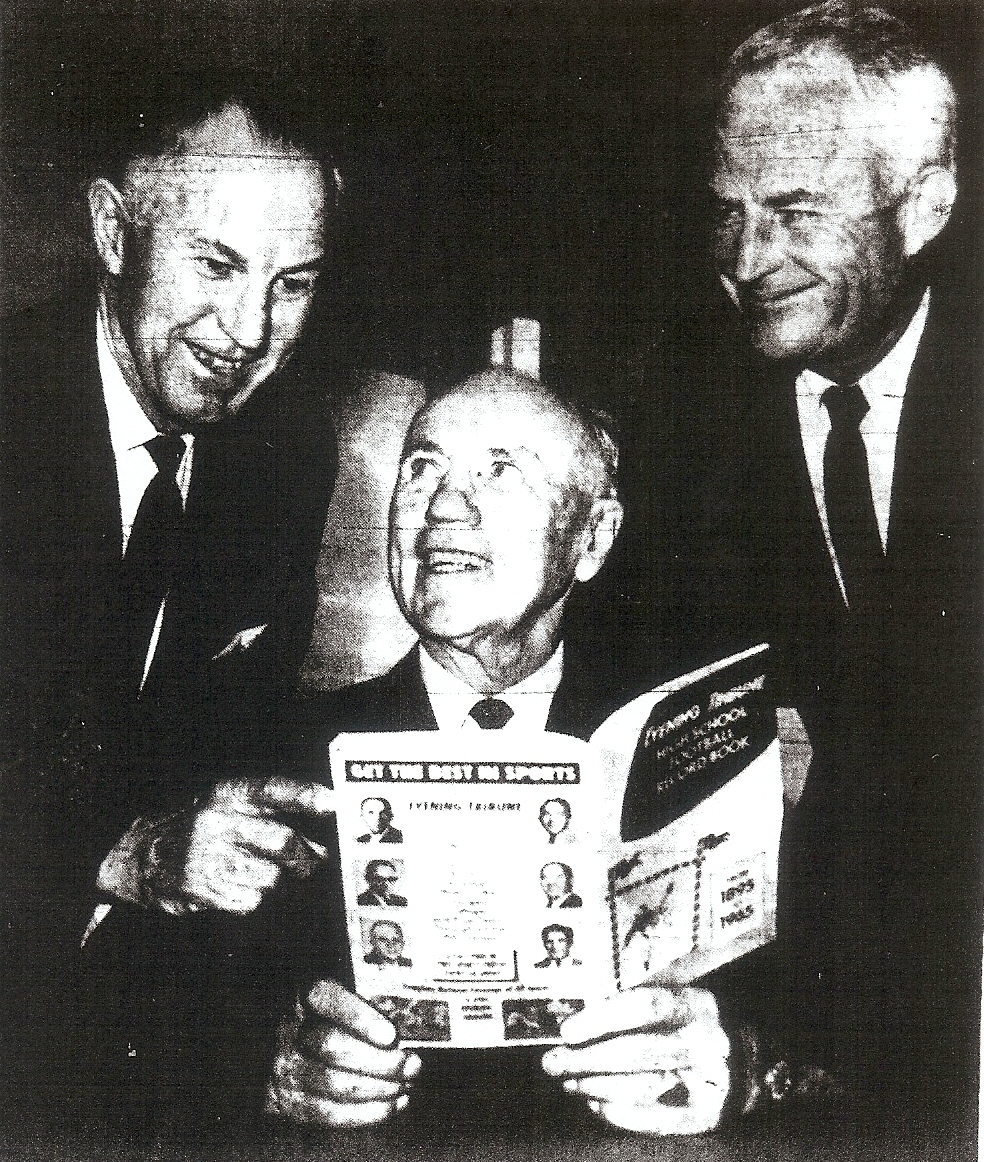
John Perry (left) joined retired coaches Jack Mashin (center) and Bill Bailey in perusing newly-published copy of Evening Tribune prep football record book in 1965.

QUICK KICKS—With a big hand from Bud Maloney of The San Diego Union I attempted to research and  log the score of every high school game in San Diego County from the beginning in 1895…my newspaper, the Evening Tribune, published the book…Nick Uglesich, 22-13-4 in four seasons at Sweetwater, resigned to become head coach at Anaheim Western (future golfer Tiger Woods’s alma mater years later)…the Red Devils won two Metropolitan League titles under Uglesich, who was taking assistant coach Don George to Western…before Sweetwater, Uglesich was at Huntington Beach…Matt Maslowski, a future Los Angeles Rams receiver from tiny University of San Diego, was out for football at Mission Bay…Gerry Spitler quit at Mission Bay after five games to become a  “teacher on special assignment” at San Diego High…Ken Bailey coached the Buccaneers in the final three games…rare coaching candor by Mount Miguel’s Perry Miller, whose team outrushed San Diego, 207-70, in a 14-6 victory:  “It could easily have been 35-0”…Hoover lineman Alan (Zeus) Dwyer went on to renown as a professional wrestler and was an owner of South Mission Beach’s renown “Beachcomber” watering hole…University, the defending San Diego Section A champion, was a 20-0 winner over Thermal Coachella, defending Southern Section A champion…Mountain Empire of the Southern Section was eliminated by Claremont-Webb, 34-27, in the first round of the small schools postseason…Morse followed Granite Hills when lights were delivered to its campus facility….

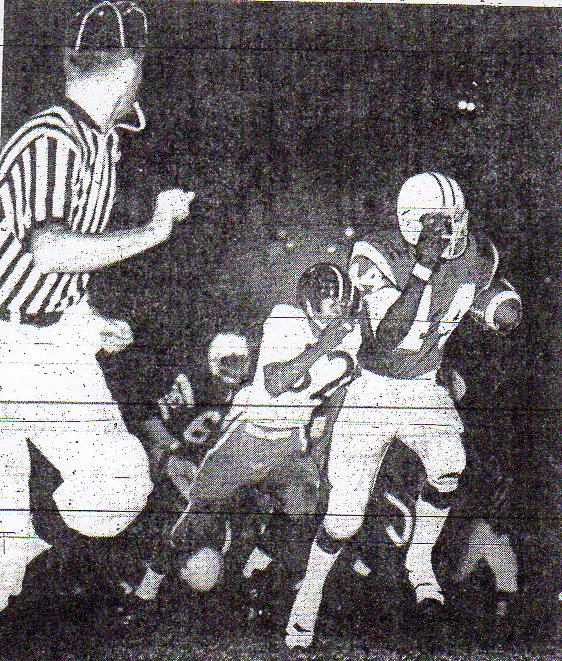
When not eluding Hilltop tacklers Ed Saffer (17) and Wayne Zacharias (25), Castle Park’s Billy Miller passed for three touchdowns and ran for a point after touchdown as Castle Park won, 35-6. Miller completed 13×27 passes for 215 yards.

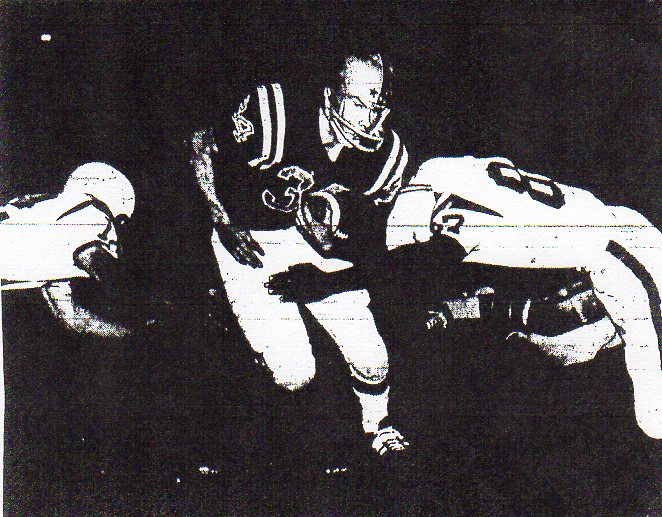
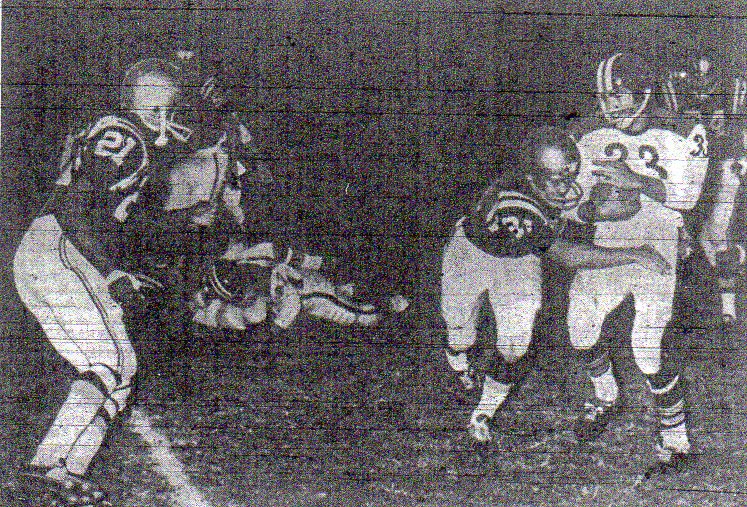
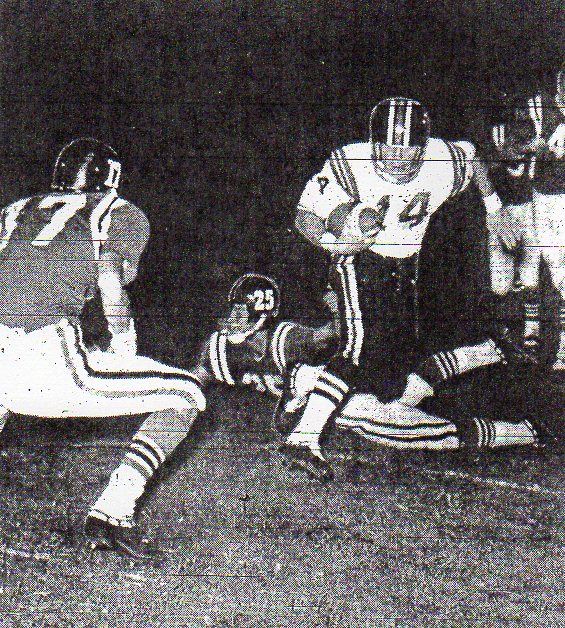
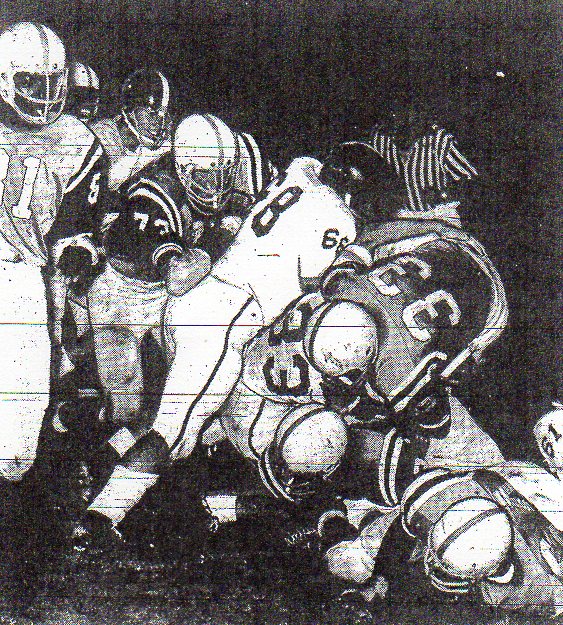
Anthony Jackson of San Diego (33) broke tackle of Jim Curtis (33) and Mark Stephenson (68) of Hoover as Cavemen won 27-19, and took 24-9 lead in 33-season history of city rivalry.

German exchange student Wilfried German exchange student Wilfried Huelsemann of Mount Miguel was one of the area's early soccer-style placekickers, sideswiping in practice as Dain Norman holds. Huelsemann lived with Norman's family.
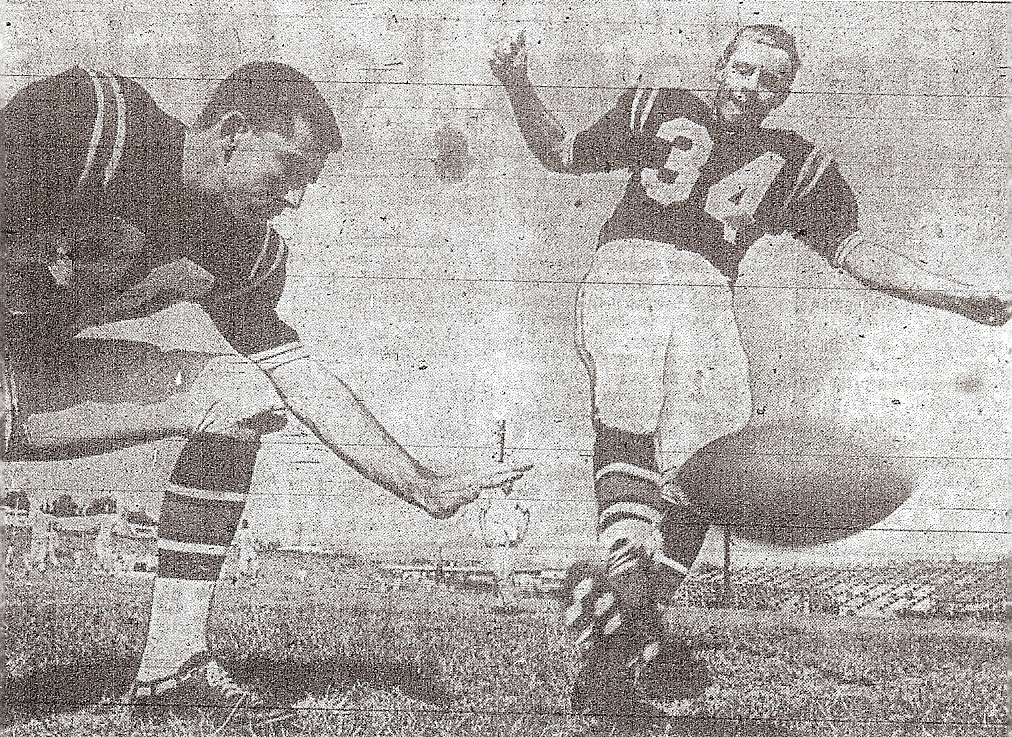
German exchange student Wilfried Huelsemann of Mount Miguel, one of the area’s early soccer-style placekickers, sideswiped as Dain Norman held. Huelsemann lived with Norman’s family.

Kearny’s Dick Oberreuter closed in on Morse’s Allen Lee, but Lee and Tigers rallied with 13 points in final nine minutes to tie Komets, 13-13.


2015: Bill Van Leeuwen, Star on Aztecs’ Defense

Bill Van Leeuwen, a standout defensive lineman during some of the most successful years of the coach Don Coryell era at San Diego State, passed away June 10 in Wickenburg, Arizona.
 
Van Leeuwen, 66, was an undersized, cat-quick tackle in a 4-3 defensive alignment on the 1968 and ’69 Aztec teams that posted a combined record of 20-0-1.
 
Van Leeuwen concluded his four-season collegiate career having never been in a losing game.
 
A graduate of Anaheim Loara High, Van Leeuwen was a standout on Fullerton College squads in 1966 and ’67 that  were 21-0-1.
 
For the last seven years, “Coach Van,” as he was known, was a volunteer assistant coach for the Wickenburg High Wranglers.

“He was one of a handful of Division I defensive tackles that played at 205 pounds,” said teammate Del Pifer.  “Small man, big heart.”
 
“Bill Van Leeuwen was a great friend and teammate,” said Fred Dryer, who played defensive end on the ’68-69 teams before going on to a 14-year career in the NFL.  “He was an inspiration to me and to his many friends.  It truly is a sad day.”
No services were held.  A memorial is planned.


2015: San Diegans Close With a Rush

Five bests in the state meet, nine in the season’s final two weeks and some competitive  efforts in the finals at Clovis Buchanan High allowed area tracksters to finish on a strong note.

15stateprogram0608150001Weak in the flat races as compared to the rest of the state and with only one sprinter in the state’s Top 10, San  Diego Section athletes still earned 13 medals and scored 57 points. By comparison, the Section had eight medals and 38 points in 2014.

Oceanside, with strong performances by Charles Lenford and Jordan Miller, was fifth in team scoring with 23.

Lenford’s powerful performance in  the discus produced a gold medal.  He opened with a 189-foot, 11-inch throw that blew out the competition and finished with a 195-4, sixth longest in section history.

Lenford, a junior, will lead the cast of returnees already thinking about 2016. Medal-winning underclassmen also  included Nia Akins, Dani Johnson, Laulauga Tausaga, and sophomore Kiley McCarthy.

Junior Tanner Batthika didn’t make it past the long jump trials but his 24-2 long jump in the Section finals ranks among the leaders in his event.

San Diego Section athletes in the state Top 10, with rankings in parenthesis:

GIRLS

EVENT NAME SCHOOL MARK STATE NAME SCHOOL
100 Suzie Acolatse (4) Mission Hills :11.46w :11.24w Francis Oxnard Rio Mesa
200 Acolatse (7) :23.69 :22.68w Williams Westlake Village Oaks Christian
800 Kiley McCarthy (7T) Carlsbad 2:08.85 2:07.09 Schroeder Santa BarbaraSan Marcos
Nia Akins (9) Rancho Bernardo 2:09.07 2:08.44 Smith Clovis North
100 Hurdles Dani Johnson (10) Cathedral :13.88 :13.17 Graham Corona Eleanor Roosevelt
300H Johnson (3) :41.34 :40.73 Graham
Leah Molter (7) Valhalla :42.32
Shot Put Laulauga Tausaga (3) Mount Miguel 48-3 ½ 53-5 ½ Bruckner San Jose Valley Christian
Discus Tausaga (4) 156-7 182-8 Bruckner
4×400 Relay Cathedral (6) 3:47.63 3:43.33 Inglewood St. Mary’s College

BOYS

EVENT NAME SCHOOL MARK STATE NAME SCHOOL
Shot Put Lenford (4) Oceanside 61-8 72-0 Katnik Bellflower San John Bosco
Discus Lenford (1) 195-4 194-8 McMorris Santa Ana Mater Dei
Pole Vault Tristan Zawadski (8T) Patrick Henry 15-7 16-3 ¼ Laut El Dorado Hills Oak Ridge
High Jump Cedell Morris (6T) Steel Canyon 6-9 7-0 Burke (1T) Lemoore
Holmes (1T) Roseville Oakmont
Thomas (1T) Mountain View St. Francis
Long Jump Tanner Batthika (4) St. Augustine 24-2 24-10 ½ Vann Oxnard Rio Mesa
Jordan Miller (6) Oceanside 24 ½
Triple Jump Miller (4) 48-4 49-9 ¾ Brooks Kingsburg