Rumblings out of the South Bay have become a roar.
Mater Dei Catholic and Sweetwater barged into the upper half of the ratings in the U-T San Diego poll this week.
Mater Dei, a 26-7 squad and Southern California Division IV regional semifinalist in 2012-13, is no surprise, posting a 12-2 record and losing only to San Juan Capistrano JSerra and West Hills Chaminade, two schools from higher divisions.
The second-ranked Crusaders received two first place votes and their 118 points are only one less than top-ranked St. Augustine.
Sweetwater’s Running Red Devils went from unranked to No. 5.
At 12-0, the Red Devils are the only unbeaten team in the top 10 and adamantly made their intentions known in a 91-56 victory over a regarded Poway club last week.
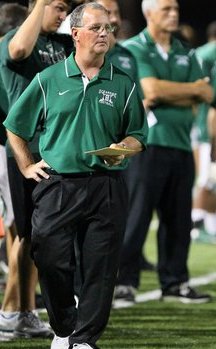
The Red Devils are in their fourth season under coach Jesse Aguirre, who took over a team that was 0-23 in 2009-10. the Red Devils were 13-11, 17-12, and 12-13 in Aguirre’s first three seasons.
SAINTS RECOVER
Despite two losses in the Under Armour Tournament at Torrey Pines during the Christmas break, St. Augustine stayed on top.
The Saints regrouped with a 73-63, home victory over La Verne Damien, which was 13-1 coming into the game.
The Saints were muscled in a 66-55 loss to Chino Hills and beaten, 62-61, by a mid-level Lakewood Mayfair squad in the Torrey Pines event.
#
Team (1st place votes)
W-L*
Points**
Last Week
1
St. Augustine (8)
13-2
119
1
2
Mater Dei Catholic (2)
13-2
118
6
3
La Costa Canyon (2)
13-2
107
2
4
Torrey Pines
13-2
93
T3
5
Sweetwater (1)
12-0
67
NR
6
Francis Parker
12-1
54
9
7
El Camino
12-3
54
9
8
San Marcos
11-4
53
5
9
Poway
9-5
14
10
10
Hoover
7-6
7
T3
**Points awarded on 10-9-8-7-6-5-4-3-2-1 basis
NR Not ranked.
Thirteen sportswriters, sportscasters and CIF representatives from throughout San Diego County vote in the weekly poll:
John Maffei, Craig Malveaux, Don Norcross (U-T San Diego);
Terry Monahan (U-T San Diego correspondent);
Bill Dickens, Andrew Smith (eastcountysports.com);
Steve Brand (San Diego Hall of Champions);
John Kentera and Jack Cronin (The Mighty 1090);
John Labeta (CIF San Diego Section office);
Rick Smith (Partletonsports.com);
Bodie DeSilva (sandiegopreps.com);
Aaron Burgin (fulltimehoops.tumblr.com).
2013-14: Saints Hold off Damien
St. Augustine saw an 18-point lead in the third quarter dwindle to 4 but finally put away La Verne Damien, 73-63, as a full house of about 800 persons nervously looked on at St. Augustine Saturday night.
Trey Kell had 22 points for the winners but it was six free throws in the final 38.7 seconds by sophomore Martin Tombe that got the Saints over the finish line against the resilient visitors, who were 13-1 coming in.
St. Augustine, which led 41-25 at halftime and 50-32 midway in the third quarter, improved to 13-2.
Damien formerly was Pomona Catholic and is the alma mater of baseball slugger Mark McGwire and former San Diego State quarterbacks Dennis Shaw and Dan McGwire.
1922: Student Gives Newspaper Inside Scoop
San Diego High had an unusual relationship with The San Diego Union.
Student Alan McGrew, who also served in a business position as the “Temporary Football Manager of San Diego High School,” was the de facto Hilltoppers beat writer for the newspaper.
McGrew filed daily reports on the Hilltoppers, the headline sports attraction in the city. He also provided inside information on coach John Perry’s team along with up-to-date messages on scheduling.
Who the Cavemen were playing and where often was the question of the day, as money guarantees were negotiated and games agreed to on virtually a moment’s notice.
McGrew’s access to the team was apparent on the pages of the Union:
—A player reported to be smoking on a downtown street and who admitted his “guilt” when quizzed before the entire team was suspended by coach John Perry for the opener with Sweetwater and lost half of his letter-earning, game quarters participation.
Youthful Perry laid down the law.
—Perry had established an 8 p.m., be-at-home curfew with retirement by not more than an hour later. The only evening players would be allowed to stay out “late” was after a game, when curfew would be at 10 p.m.
According to McGrew the team voted unanimously to abide by the Perry Rules. The third-year head man was 24, not much older than his players.
UNBEARABLE VICTORY
McGrew’s San Diego High bias also was obvious. The intrepid high school correspondent was one unhappy camper after the Hilltoppers’ 6-3 victory over Sweetwater in the season’s opening game.
Expecting a rout, McGrew was forced to acknowledge a stunningly difficult outing.
“The local players were taken off their feet by the county gang,” wrote McGrew. “They were dazed, it appeared.”
McGrew continued. “Possibly some of the players were unstrung, the game being the first of the season, and when they discovered the Sweetwater team had all kinds of power (they) went to pieces.”
Sweetwater had been 0-3 against the San Diego varsity, losing, 54-6 in 1915, 65-7 in ’20, and 40-0 in ’21.
Fullback Charles Williams drop-kicked a 25-yard field goal to give coach Herb Hoskins’ Red Devils a 3-0 lead early in the first quarter.
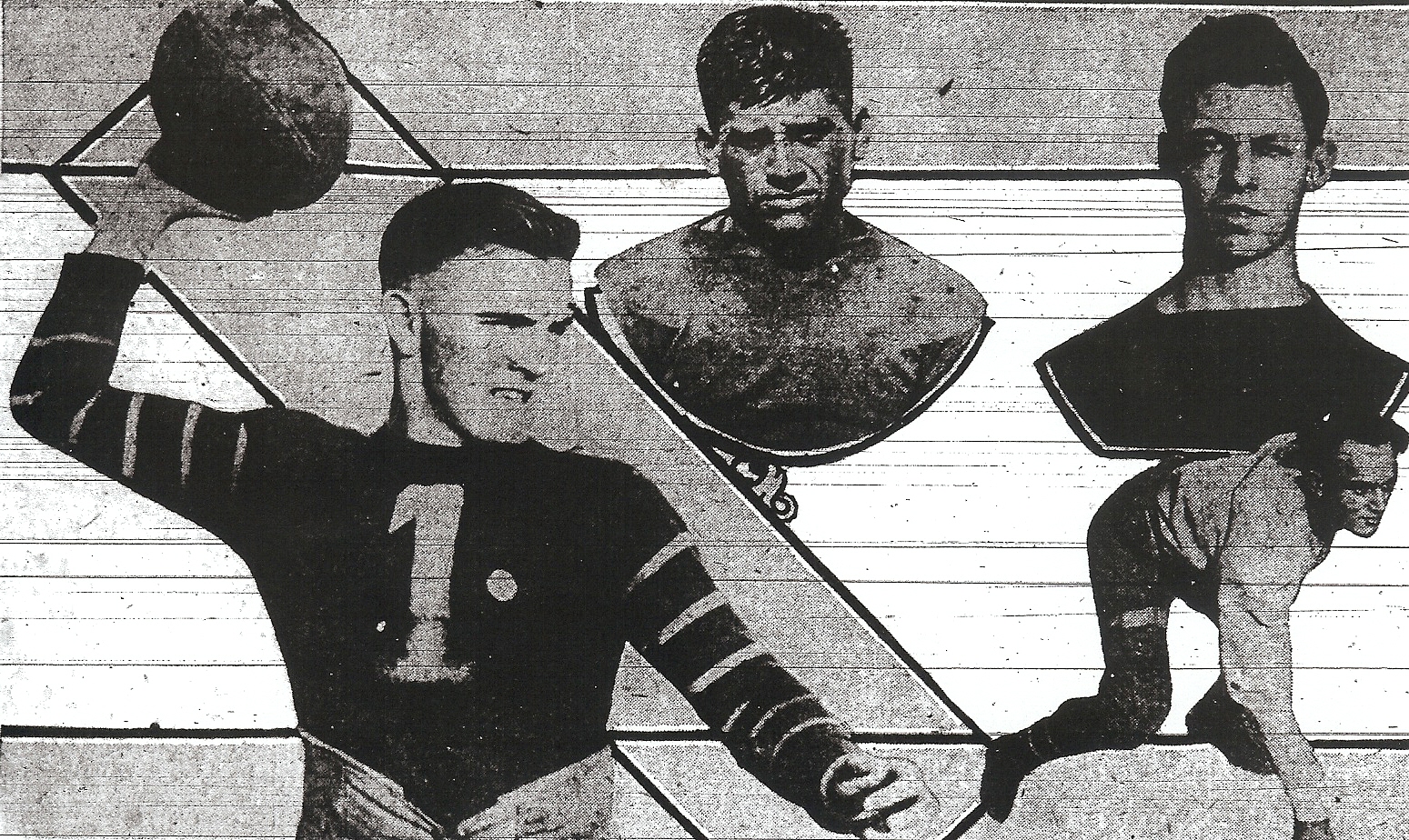
Clockwise from left, Hilltoppers’ aces Norton Langford, Coney Galindo, Rex Driver, Kenny Zweiner.
Norton Langford scored to put the Hilltoppers ahead, 6-3, later in the quarter, after which San Diego was stymied by the determined National City squad.
The following week, under a story without byline, the writer hadn’t yet moved on, still unhappy and describing the Sweetwater game as a “catastrophe”.
RED DEVILS NO PUSHOVERS
Sweetwater opened as National City School 1907 and, according to available records, played football in 1910.
For the first 11 years, including the 1913 season when they didn’t field a team, the Red Devils were 10-24-3, according to infrequent newspaper reports.
Herb Hoskins took over as coach in 1919 and was 5-9-2 in his first three seasons, but the Red Devils won the four-team County League with a 5-0-1 record this season and manned up once more in the playoffs against San Diego.
Sweetwater thrived under Hoskins.
The Cavemen this time prevailed by a 13-6 score, but Sweetwater had established itself as a credible program.
The Red Devils were 34-16-5 under Hoskins from 1922-27 and made three playoff appearances.
NO ROOM FOR HERB?
Writer Jess Puryear pointed out that Hoskins apparently had not been considered after the Sweetwater mentor showed interest in filling a position that opened on the San Diego coaching staff.
Hilltoppers basketball coach A.E. Shaver had left after the 1921-22 school year.
RESEMBLING EARLY MAN
San Diego High historian Don King corrected a story which promoted many different versions over the years.
How did the name Cavemen evolve?
In 1921 the football team dressed in dingy quarters beneath the 400 building on campus, King wrote in Caver Conquest, the 1993 history of San Diego High athletics.
There was only one entrance to the dressing room and that was through a long, dark tunnel that supposedly looked like that of a passageway to the caves used by our earliest ancestors, King noted.
Alden Ross, a reporter for the school newspaper (and a future member of the 1922 squad), was standing outside the players’ entrance when the squad exited for a game and was struck by the similarity to cave dwellers of the past.
Ross referred to the “Cavemen” in the next issue of The Russ.
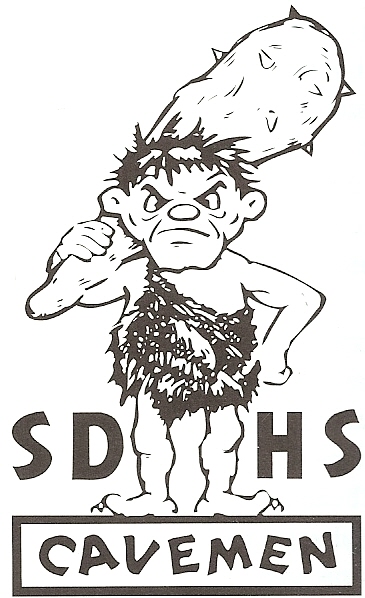
“Cavemen” caught on and was used thereafter along with “Hilltoppers”, “Hillers”, and “Cavers.”
When girls began participating in the 1970s, the name was officially amended to “Cavers,” to correct gender inequity, said King.
Vintage San Diego High Caveman decal.
PREGAME HYPE?
USC Freshmen coach H.W. Hess, responding when asked in a telephonic interview with San Diego writers if there were “any stars who have been showing up” on the Trobabes’ squad:
“There are no stars, but eleven men on the team…and they’re all rotten,” declared the coach.
San Diego coach John Perry said he expected his squad “to be fighting all through the game (but) I do expect to be beaten by more than forty points.”
Interest in the USC team was such that the frosh’s pregame meal was assessed: two poached eggs and a cup of tea.
The frosh, featuring many 1921 prep stars from throughout the state, prevailed, 21-0.
THE LONGEST TRIP
According to one writer, 19 players and two coaches traveled for a game to Bakersfield by automobile.
Presumably more than one automobile, although Alan McGrew wrote that the team was scheduled to leave at 8 a.m. on a Friday morning for an 11-hour trip by “stage”.
Travel would include 48 miles on what was known as the Ridge Route, beginning at the Castaic Junction and featuring switchbacks and sudden turns over the mountains north of Los Angeles.
Climax to this sometimes dangerous stretch was the Grapevine, a six-mile downgrade that took travelers from 4,233 feet to the floor of the San Joaquin Valley, passing native grapevines growing on the hills near Fort Tejon.
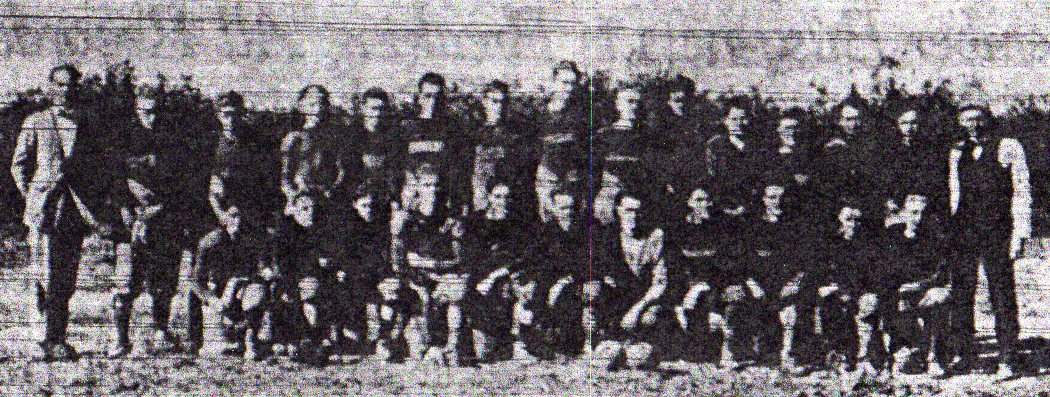
Sweetwater won its first County League championship. Coach Herb Hoskins is right in top row.
WHY?
In this still developing period of motorized conveyance (passenger railroad travel was not available to or from Bakersfield), why schedule a game so distant and so difficult to reach?
Alan McGrew pointed out that “almost every school south of the Tehachapi pass had received letters seeking games from Hilltop management, but refused.”
San Diego High was feared in the North, particularly around Los Angeles, said McGrew. Scheduling the defending state champion Drillers would curtail some of the criticism about Perry’s perceived reluctance to schedule strong opponents.
There was some history with Bakersfield. The Hilltoppers declined an invitation to play a state championship playoff with the Drillers after San Diego had posted 12-0 record and won the Southern Section championship in 1916.
Hilltop coach Clarence (Nibs) Price sensed his team was fatigued and was not interested in a New Year’s Day game in San Diego. The Drillers claimed the state championship and that San Diego had forfeited.
Price did schedule the Drillers in 1917, when the school known as Kern County Union High came south and was beaten by the Hilltoppers, 18-7.
This year’s result was different. Dwight (Goldie) Griffith’s Drillers, who were rumored to play some adult roughnecks from the neighboring oil fields, scored a 32-0 victory.
Age limits were seemingly flexible and nonexistent. San Diego’s outstanding lineman was Al Scheving, who would be 21 when he graduated in June, 1923.
“I was only eighteen months older than my team captain,” coach John Perry told writer Jim Trinkle in 1954.
TWO GAMES IN TWO DAYS
Without a league and of independent classification, San Diego was required to have five victories against high school competition for inclusion in the CIF Southern Section playoffs.
Scheduling was madcap.
With the SCIF postseason beginning in a week, the Cavemen were pressed to play two high school games in two days.
John Perry shrugged when it was suggested that no prep team in California had ever been asked to meet such a challenge.
The Hilltoppers teed up at 9:15 a.m. Friday in City Stadium, where they defeated the 7-2 Whittier Cardinals, 26-0, then followed at 12:30 the next afternoon with a 41-0 victory over weak Anaheim, against which Perry employed only four varsity starters.
Students were all for the doubleheader. They were dismissed from school Friday to watch the games.
The Hilltoppers were fortunate not to have to travel for the Anaheim contest, which originally was scheduled in the northern community but was moved to San Diego because of an Armistice Day parade in Anaheim.
HOW MANY GAMES?
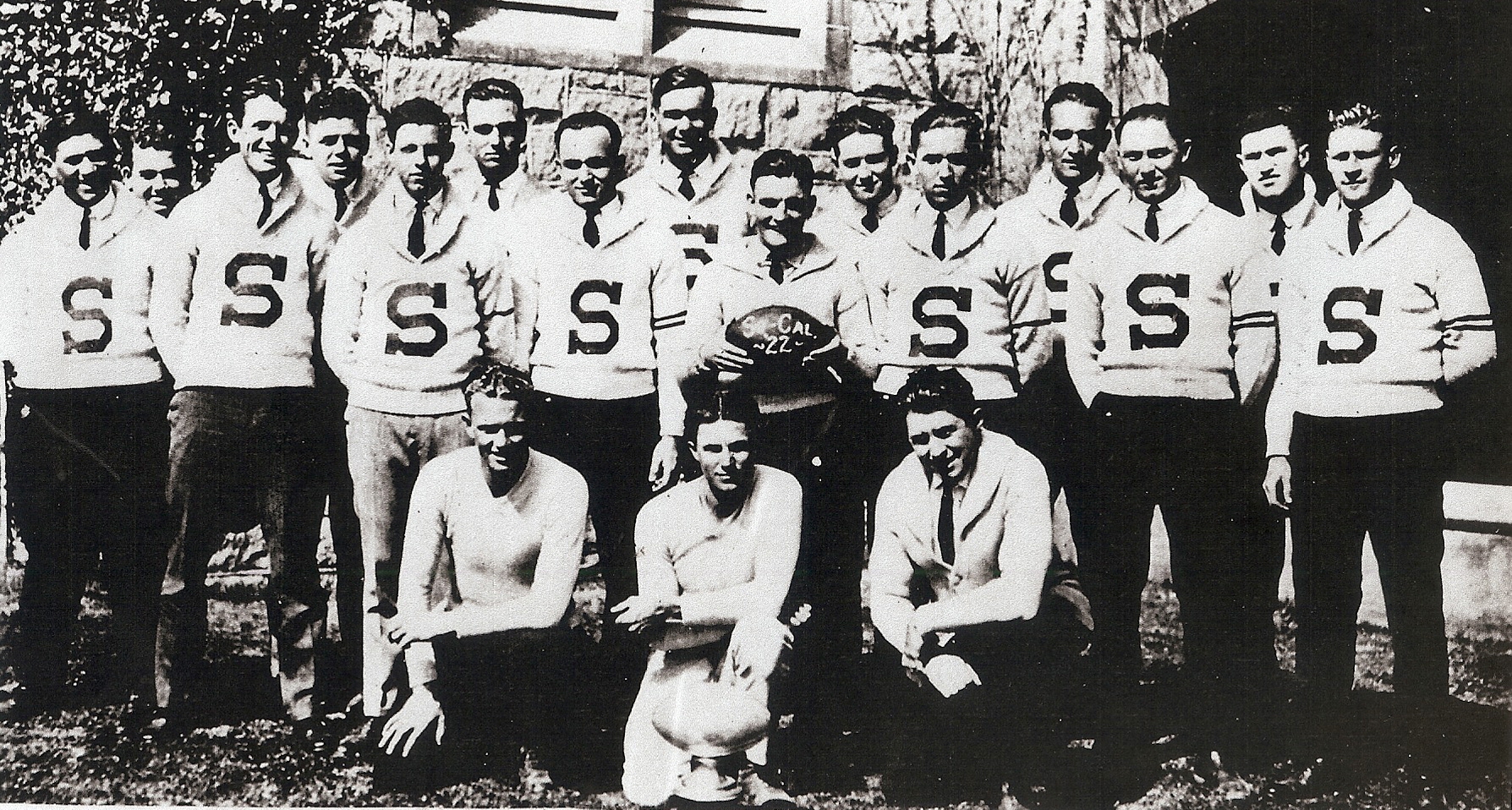
Southern California champions posed for a team picture on campus. Front row: coaches Walter Davis, John Perry, and Claude Hippler, from left. Back, in order of appearance, from left: Coney Galindo, Jimmie West, Morris McKain, Frank O’Toole, Rex Driver, Howard Williams, Kenny Zweiner, Pete Szalinski, Norton Langford, Ed Ruffa, Harold Fitzpatrick, Ed Giddings, Al Schevings, Jonathan Fox, Bob Perry.
HOW MANY GAMES?
Don King’s Caver Conquest listed 14 games on San Diego High’s schedule, as did the first Evening TribunePrep Football Record Book, published in 1965.
According to The San Diego Union of November 30, 1922, the Cavemen had played 17 games and, after meeting Santa Ana, Gardena and Bakersfield, would finish the season with a stunning total of 20, their record being 14-5-1.
NFL teams don’t play that many, unless they’re a wildcard team that plays in the Super Bowl.
The line between scrimmages and games was blurred in The San Diego Union.
A midseason exercise with Sweetwater was loosely described as a game but also as a “practice.” Nonleague, not yet a part of the lexicon, would have been a better description.
The Cavemen played five “games” with teams from military institutions and seven “games” in 13 days from late September to early October.
Games with military squads were common for San Diego-area teams.
COEDS SHUN HILLTOPPERS
San Diego’s playoff with Santa Ana matched not-so-friendly rivals in a series that dated to 1905. The Cavemen claimed the Orange County school’s students and players were the poorest losers in the state.
“Besides ‘razzing’ the players on the street and at the hotel where the team was lodged, the girls at a public dance in Santa Ana refused to dance with the San Diego boys,” reported Alan McGrew.
According to historian Don King, “Santa Ana fans threw soda pop bottles and ripe fruit as Kenny Zweiner ran 65 yards with an intercepted pass for a touchdown.”
Coney Galindo raced 35 yards for another score in a 12-0 victory that elevated the Hilltoppers into the Southern California finals against Gardena.
The winners rushed for 112 yards, Galindo leading with 50 yards rushing, and completing a 17-yard pass.
ROCKY TOP
Perry remembered years later what it was like to practice on the “Rock Pile,” and to play on a dirt surface in City Stadium.
“We weren’t allowed to practice in the stadium, but had to go across the highway by the horse barns,” said Perry. “Before working out we’d try to get all the rocks we’d kicked up the previous day out of the way.”
The stadium layout would be sprinkled, then rolled before each game. “There wasn’t any grass and it was as hard as concrete,” remembered the coach.
SCHOOL DAYS, SCHOOL DAYS!
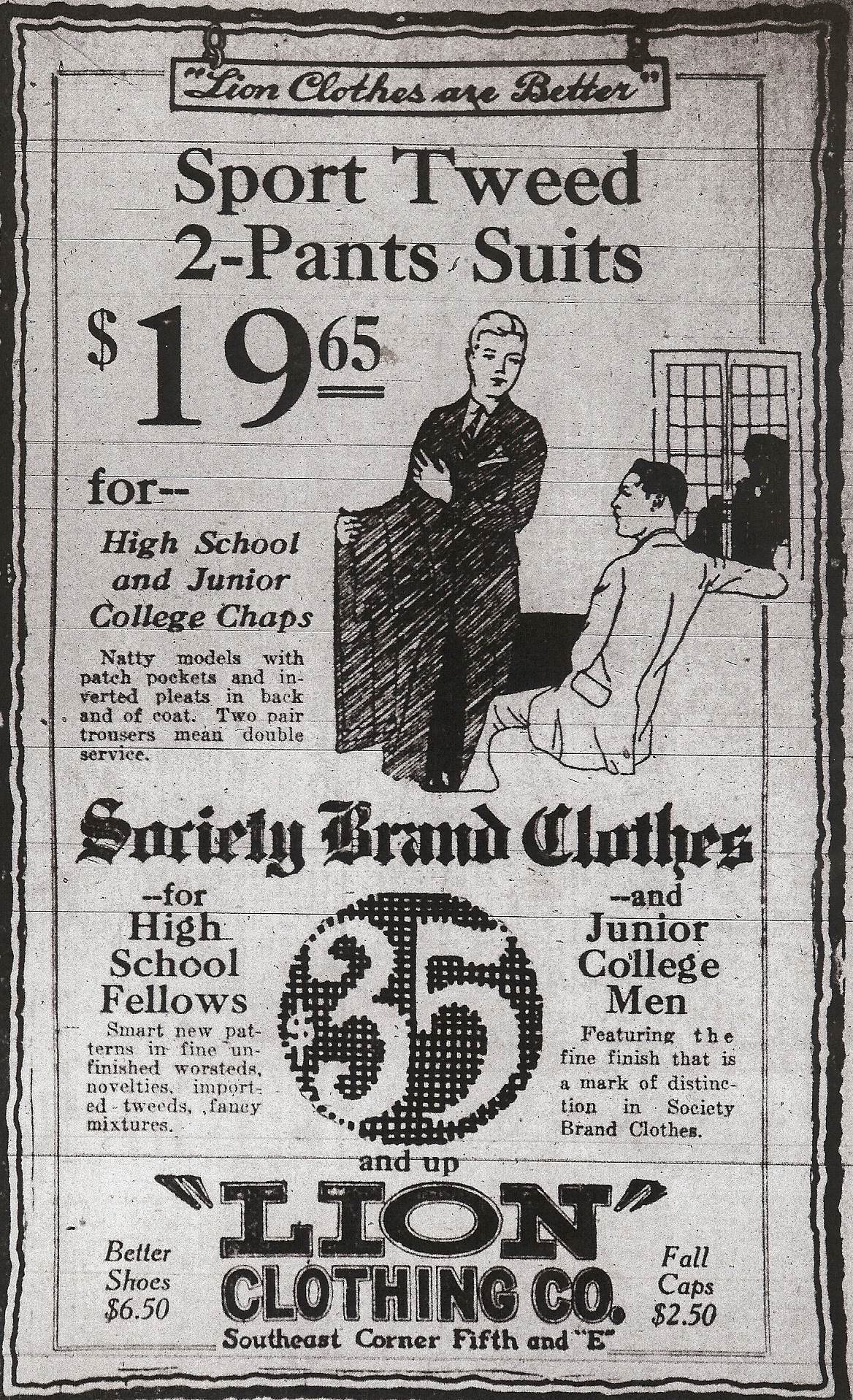
Back to School sale at Lion Clothing
San Diego High pupils paid student dues of .75, plus they were required to make a $4 deposit to assure return of textbooks at the end of the school year.
Students were required to purchase locker padlocks that were available from San Diego merchants.
Incoming freshmen received a 128-page “manual”, detailing all activities and regulations at the school.
National City School, renamed Sweetwater, moved to a new location on Highland Avenue at the South end of National City, serving approximately 325 students from Chula Vista and to as far south as San Ysidro.
Construction of Grossmont’s permanent campus on the hill overlooking El Cajon Valley was almost complete, with 350 students listed as having enrolled.
Two-pant tweed sports suits were available for $19.65, Shoes for $6.50, and caps for $2.50 at Lion Clothing Co., Fifth Avenue at E Street.
THERE WERE PERKS
Prospective San Diego High players were feted in a banquet at the San Diego Hotel the night before the first practice.
Team leader Norton Langford addressed the players on the “value of close association and the necessity for no petty jealousy” (apparently a problem the last couple seasons, along with questions of soft scheduling and Perry’s not coaching “fundamentals”).
Langford said he hoped to “see a game up North” at the end of the season “for the state championship and with San Diego returning victorious.”
CART BEFORE HORSE
San Diego players favored a rematch in the state playoffs with Bakersfield, rather than participate in a so-called national championship game.
The Cavers received challenges from the Amarillo Golden Sandstorm of Texas, Twin Falls, Idaho, and a team in St. Louis. Coach John Perry postponed any decision until after the Gardena contest.
As National City School became Sweetwater, students awaited opening of new campus in January, 1922.
LOVE THAT GRASS
Gardena, which won at Bishop, 31-0, the week before, was accorded an edge by the San Diego media because it had played on the Bovard Field turf gridiron at USC.
Whatever advantage Gardena possessed disappeared in the fourth quarter, when the Cavemen trailing, 14-12, scored 19 points to win 31-14. Coney Galindo ran for three touchdowns and scored another on an intercepted pass.
HERE COME THE DRILLERS
San Diego accepted a challenge to play 9-0-1 Bakersfield in a state playoff, but only if the game was played in the City Stadium. In a telegram to Bakersfield officials, McGrew said the Cavemen were “not in condition for another trip.”
The Drillers agreed.
The journey south was easier on the visitors, who were reported to have “passed through Los Angeles” and were spending the night in Santa Ana after practicing at Whittier College.
Transported in two motor coaches, Bakersfield arrived in San Diego on the day of the game.
The Cavemen battled in vain before about 6,000 City Stadium fans who represented the largest turnout in school history, according to the Union, although the 1917 game drew a reported 10,000.
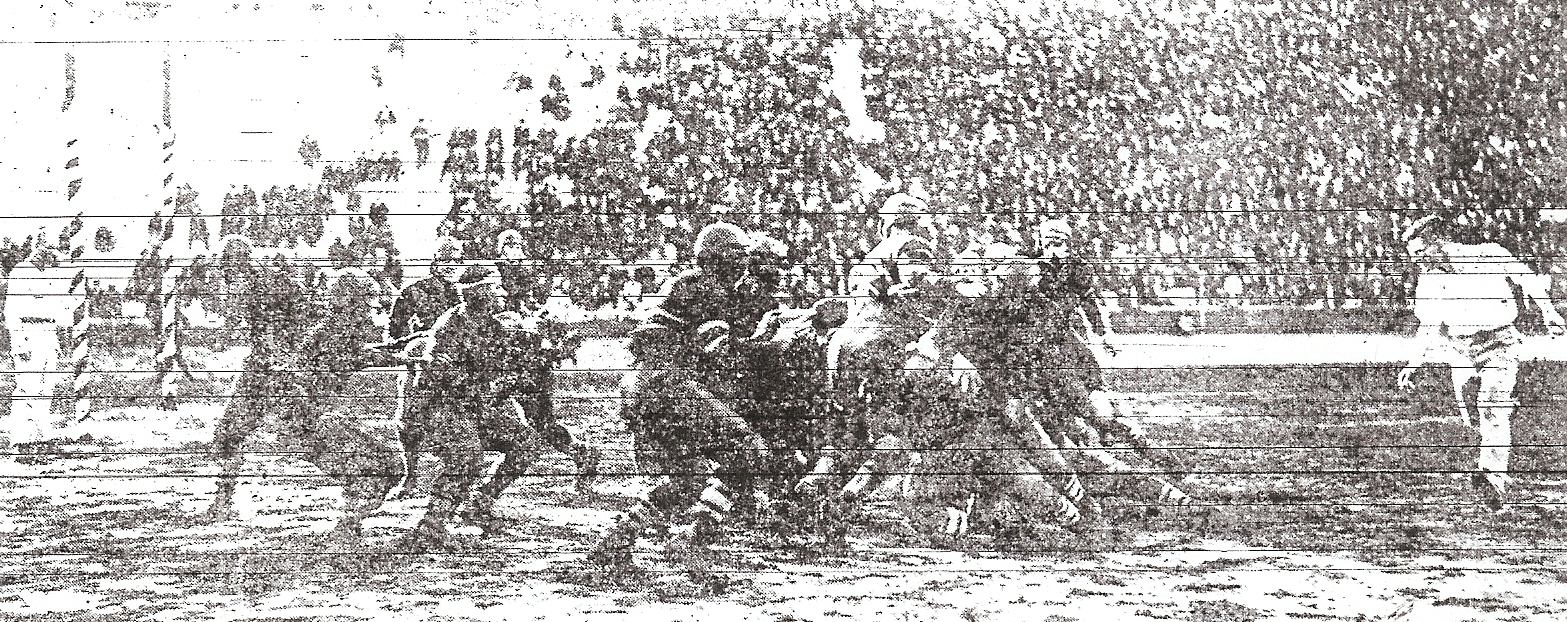
Part of the crowd of 6,000 watched action near San Diego goal line.
It was 17-0 before Ed Ruffa scored a touchdown in the final two minutes to send the Hilltoppers home 17-6 losers.
READ IT AND WEEP
That was the lede (first paragraph) on The San Diego Union account of the Cavemen’s 106-6 victory over Army-Navy. The writer also suggested that flags would be at half mast at the Pacific Beach academy.
Nothing out of the ordinary about that, but in the second paragraph it was noted that the Cadets fully expected to win and to qualify for the Southern California playoffs!
Coach Paul Jones, who exuded such confidence before the game, was slightly off the mark.
Contributing to the carnage was a rule of the day: Teams scoring touchdowns received the ensuing kickoff, i.e., Army-Navy kicked off after every San Diego touchdown.
SIGNS OF THE TIMES
Future World War II hero aviator Lt. James Doolittle left Jacksonville, Florida at 7:30 p.m. Pacific time and hoped to land at Rockwell Field, located on Coronado’s North Island, at about 4 p.m. the next afternoon.
The 18 1/2-hour flight included a fuel stop in San Antonio, Texas.
TRUE GRID
San Diego High dropped its ninth-grade, freshmen class when two junior highs, Roosevelt and Memorial, opened…the schools had grades of 7, 8, and 9…by contract with the CIF and Santa Ana, expenses were provided for 18 players when the Cavemen took the train north for the second of three semifinal playoff contests, but coach John Perry traveled a squad of 23… San Diego High was not the only team to play games on back-to-back days…Grossmont sustained a 40-7 loss to the Hilltoppers, then went out the next day and dropped a 7-6 decision to the sailors from the U.S.S. Rapahannock…when writers referred to a team concentrating on its ground game, it was described as “straight football”…passing, infrequently used, was just that, passing…The San Diego Union published the roster of San Diego High and players’ numbers before the game with the USC Freshmen…24 players were numbered from 1 to 25, with only jersey No. 2 omitted… …Escondido was greeting “a whole set of husky Indians from the backcountry,” according to the Union… County League teams Escondido, Sweetwater, and Grossmont were considered “backcountry”…”The Winning Play,” an article that appeared in Redbook magazine, was read to the team by San Diego coach John Perry before it took the field against Gardena…Sweater and Letter Day at Sweetwater was attended by the entire student body, which honored the County League team as Herb Hoskins awarded monograms to 15 players….
2013: Freeman Sets Scoring Pace
Royce Freeman of Imperial scored 43 touchdowns and 258 points in 12 games to lead the San Diego Section for the third year in a row and finished sixth in the state, according to unofficial statistics provided by Max Preps.
Freeman amassed 39 touchdowns and 3 two-point conversions for 240 points in 2011 and 36 touchdowns and 216 points in 2012.
Freeman scored 118 touchdowns in three seasons for Tigers.
Edgar Segura of Mendota in the Central Section was the 2013 state leader with 57 touchdowns and a total of 358 points.
Andrew Brown of Ripon Christian of the Sac-Joaquin Section, had 335 points, followed by Rashaad Penny of Norwalk, Southern Section, 320. Tre Watson of Corona Centennial, Southern Section, was fifth with 306.
Freeman also ended his career with the sixth highest single-season performance in the San Diego Section.
Evan Fisher of Julian scored 342 points in eight-man football in 2001, followed by Tyler Gaffney of Cathedral, 336 (’08); Dillon Baxter, Mission Bay, 324 (’09); Zay Shepard, Brawley, 276 (’04), Dionne Grigsby, San Pasqual Academy 8, 262 (’04), and Freeman.
San Diego Section 2013 leaders:
Player
Team
Games
TD
PAT
2Pt
FG
Pts
Royce Freeman
Imperial
12
43
0
0
0
258
Clayton Bowler
Holtville V
13
27
0
0
0
162
J.T. Barnes
Grossmont
12
13
64
0
2
150
Brandon Alexander
San Pasqual Academy 8
7
23
0
0
0
148
Thai Cottrell
Oceanside
13
22
7
1
0
141
Justin Santa Maria
Calvary Christian S.D. V
9
19
0
12
0
138
Riley Racciato
Classical V
10
23
0
0
0
138
Jose Ramirez
Calvary Christian Vista 8
7
20
0
4
0
128
Damonte Holiday
Hoover
11
21
0
0
0
126
Isiah Olave
Eastlake
12
21
0
0
0
126
Jimmie Hill
Mar Vista
10
21
0
0
0
126
Tim Clow
St. Joseph 8
8
19
0
5
0
124
Elijah Preston
St. Augustine
11
20
0
0
0
120
Isaiah Capoocia
El Capitan
12
19
0
0
0
114
James Harwell
San Marcos
14
7
53
0
6
113
Ray Lyons
Crawford
10
18
0
1
0
110
Bulla Graft
The Bishop’s
10
17
0
3
0
108
Chris Moliga
Cathedral
11
18
0
0
0
108
Tony Miro
Santa Fe Christian
10
18
0
0
0
108
Dan McManus
West Hills
12
6
29
0
14
107
Nareg Skakarian
St. Joseph 8
8
12
34
0
0
106
Damian Ramirez
Blythe Palo Verde
12
17
0
1
0
104
Jesse Brookins
Francis Parker
11
17
0
1
0
104
Ben Lomibao
Mount Miguel
10
17
0
0
0
102
Isiah Henne
San Marcos
14
17
0
0
0
102
Manny Rodriguez
Olympian
11
17
0
0
0
102
Carlos Campos
San Ysidro
10
15
8
0
0
98
2013-14: Saints Now 10-0 and on 24-0 Run
St. Augustine is 10-0 and has a 24-game winning streak after a 65-49 victory over the host team in the first annual Rancho Santa Margarita Tournament today, climaxing a 4-game run through the Orange County event.
The Saints beat Trabuco Hills, 62-61, Seattle Prep, 79-60, and Alta of Sandy, Utah, 63-56, in earlier games. Santa Margarita was 7-0 before taking on coach Mike Haupt’s North Park sharpshooters.
Trey Kell led the top-ranked San Diego Section team with 26 points. Eric Monroe and Danny Caya had 11 each and Martin Tombe 10.
The Saints, ninth in California and 30th in the country in Max Preps‘ ratings, now gear up for the Under Armour post-Christmas tournament and draw scoreboard blinking Chino Hills in their opening game at 2:15 p.m. on Dec. 26 in the Torrey Pines gym.
Chino Hills is 7-2 and averaging 79 points a game.
The Huskies most recently dropped a 65-63 decision to Etiwanda, ranked fourth in California and 10th in the country by Max Preps. Chino Hills also holds a 121-102 decision over tough Rancho Cucamonga. Both games were in the Inland Empire Classic at Ontario Colony.
St. Augustine has not lost since dropping a 62-59 decision to Cathedral on Jan. 24, 2012. The Saints won their last 14 in a run that took them to the State III championship and a final record of 29-4 in 2012-13.
2013: 38 Coaches Are Members of Club 100
La Jolla Country Day’s Jeff Hutzler, who stepped down recently, became the 37th coach in the San Diego Section to have a career total of at least 100 victories. Jack Mashin of Grossmont recorded 125 victories in the Southern Section.
Eleven active coaches have 100 or more (see complete list here):
Oceanside’s Carroll tops all.
John Carroll (234-74-6, .755), Ron Hamamoto (195-122-4, .614), Rob Gilster (183-112-5, .618), Willie Matson (166-117-6, .585), Sean Doyle (144-77, .652), John Morrison (140-60-3, .697); Gary Blevins (129-90-4, .587), Chris Hauser (115-54-2, .678), Matt Oliver (115-56-3, .670), Jerry Ralph (111-65-2, .629), and Mike Hastings (111-74-4, .598).
Hutzler, whose Torres finished 5-6 this season, posted a 101-37 record and .732 winning percentage from 2002-13, joined a select group that is led by Herb Meyer, who was 339-148-15 for a .690 percentage from 1959-2003 at Oceanside and El Camino.
Other 100-game winners include Bennie Edens (238), John Shacklett (229), Gil Warren (216), Ed Burke (215), Jim Arnaiz (213), Dick Haines (194), Carl Parrick (189), Mike Dolan (165), Bob Woodhouse (146), Chick Embrey (144);
Gene Edwards (136), Birt Slater (133), Bob McAlister (132), Steve Sutton (131), Craig Bell (130), Walter (Bud) Mayfield, (129), Ladimir (Jack) Mashin (125), Mike David (122), Gene Alim (120), John McFadden (120), John Bishop (117), Chris Hauser (115), Brad Griffith (112), Vic Player (111), George Ohnessorgen (103), and Dave Lay (102).
Carroll (.755) is first among all San Diego Section coaches, active or retired, in winning percentage and with at least 100 victories. Birt Slater (.747) is second to Carroll in percentage. Ohnessorgen (.745), Lay (.741), McFadden (.735), Hutzler (.732), Arnaiz (.726), Burke (.720), Warren (.707), Alim (.701), and Bishop (.701) round out the Top 11.
Ties are factored in as half games won and half games lost.
The highest winning percentage, minimum 40 games, in the history of high school football in San Diego is .856, earned in the Southern Section by Chula Vista’s Chet DeVore from 1951-55. San Diego’s Duane Maley is second with a Southern Section record of 97-19-3, .828.
Bill Bailey, who coached at Point Loma in 1942 and at San Diego from 1943-47, posted a career record of 40-8-1, .810.