2013: UT-San Diego’s All-Time, All-County Football Team
FIRST TEAM OFFENSE
Quarterback
Ezell Singleton
San Diego
1958
Running Backs
C. R. Roberts
Oceanside
1953
Tyler Gaffney
Cathedral Catholic
2008
Darrin Wagner
Lincoln
1987
Receivers
Patrick Rowe
Lincoln
1986
Art Powell
San Diego
1954
Line
Jack Harrington
Rancho Buena Vista
1988
Lincoln Kennedy
Morse
1988
Steve Riley
Castle Park
1968
Robbie Coffin
Mira Mesa
1983
Steve Vieria
Carlsbad
1999
Athletes
Deron Johnson
San Diego
1955
Charlie Powell
San Diego
1950
Reggie Bush
Helix
2002
Bill Fudge
El Capitan
1970
FIRST TEAM DEFENSE
Line
Ed Imo
Kearny
1973
La’Roi Glover
Point Loma
1991
Tamasi Amituani
Vista
1988
Arthur Smith
Lincoln
1963
Linebackers
Junior Seau
Oceanside
1986
Pisa Tinoisamoa
Vista
1998
Greg Slough
Point Loma
1964
Travis Hitt
Grossmont
1971
Secondary
Marcus Allen
Lincoln
1977
Willie Buchanon
Oceanside
1968
Monte Jackson
St. Augustine
1970
Eric Allen
Point Loma
1982
Athletes
Dave Grayson
Lincoln
1956
Dokie Williams
El Camino
1977
Darnay Scott
Kearny
1990
Kicker
Noel Prefontaine
El Camino
1991
SECOND TEAM OFFENSE
Quarterback
Sal Aunese
Vista
1985
Running backs
Dillon Baxter
Mission Bay
2010
Michael Hayes
San
1974
Markeith Ross
Rancho Buena Vista
1989
Receivers
Glenn Kozlowski
Carlsbad
1980
Harold (Brick) Muller
San Diego
1916
Line
Erik Magnuson
La Costa Canyon
2011
Pete Adams
University
1968
Pulu Poumele
Oceanside
1989
Volney Peters
Hoover
1947
Hobbs Adams
San Diego
1922
Athletes
Cleveland Jones
San Diego
1956
Teddy Lawrence
Morse
1990
Allan Clark
San Marcos
1973
Cotton Warburton
San Diego
1930
SECOND TEAM DEFENSE
Line
David Gates
Morse
1994
Jimmy Gunn
Lincoln
1965
Dan Saleaumua
Sweetwater
1981
Ty Morrison
Morse
1988
Linebackers
Ted Johnson
Carlsbad
1991
Frank Stephens
San Diego
1974
Donnie Edwards
Chula Vista
1990
Zeke Moreno
Castle Park
1996
Secondary
Leon Hall
Vista
2002
Bryant Westbrook
El Camino
1992
Chuck Cecil
Helix
1982
Willie West
San Diego
1955
Athletes
Nate Shaw
Lincoln
1962
Jose Perez
Oceanside
2002
Lenny McGill
Orange Glen
1988
Kicker
Scott Webb
Helix
1982
THIRD TEAM OFFENSE
Quarterback
Pete Gumina
San Diego
1955
Running backs
Roger Price
Vista
1985
Ricky Williams
Henry
1994
Rashaan Salaam
La Jolla Country Day
1991
Receivers
Bill McColl
Hoover
1947
Kenny Stills
La Costa Canyon
2009
Line
John Michaels
La Jolla
1990
Tom Dabasinskas
San Pasqual
1985
Tom Dahms
San Diego
1944
Calvert Fackrell
San Diego
1957
Sale Isaia
Oceanside
1989
Athletes
J.J. Stokes
Point Loma
1989
Bill Dunckel
Fallbrook 1986
1986
Touissant Tyler
El Camino
1976
Wally Henry
Lincoln
1973
THIRD TEAM DEFENSE
Line
Russell Tialavea
Oceanside
1985
Darrell Russell
St. Augustine
1993
Okland Salavea
Oceanside
1985
Dan Daris
Oceanside
1975
Linebackers
Barry McKeever
San Pasqual
1983
Jeff Staggs
Point Loma
1961
David Lewis
Lincoln
1972
Brandon Chillar
Carlsbad
1999
Secondary
John Lynch
Torrey Pines
1988
Jim Smith
Kearny
1963
Stefan McClure
Vista
2010
Ronnie Cortell
Sweetwater
1984
Athletes
Frank Green
Coronado
1929
Pesky Sprott
San Diego
1916
Jerome Price
University City
1989
Kicker
Nate Tandberg
Rancho Bernardo
1995
—–
Team chosen by:
Steve Brand, retired U-T staff writer;
Nick Canepa, U-T columnist;
Bill Center, U-T staff writer;
Jess Kearney, U-T deputy sports editor;
John Maffei, U-T staff writer;
Terry Monahan, U-T staff writer; and
Rick Smith, San Diego sports historian.
2013: Cathedral Holds Sway as Playoffs Near
With nine days until the first round of San Diego Section playoffs, Cathedral Catholic still is No. 1.
UT-San Diego’s CIF basketball ratings did not change from the previous week.
One through 10, no one moved up or down, although Army-Navy cleared up a nettling mark on its record.
The Warriors, 21-4 and ranked second, defeated La Jolla Country Day, 72-36, in a rematch of its upset, 44-43 loss to the Torreys Jan. 15.
St. Augustine defeated La Jolla 76-41 and Olympian 74-41 last week and commemorated a special moment in the Saints’ history.
OLD RIVALS MEET AGAIN
Tom Shaules, who set a County record of 60 points in a 102-38 win over Crawford in 1958, was honored at halftime of the Olympian contest, which the Saints led 56-16 after 16 minutes.
Among those who came to see Shaules was an old rival, San Diego High’s Arthur (Hambone) Williams, who was part of two hard-fought games with the Saints in 1958. Shaules’s team won the first game on the Saints’ floor, 62-56. Hambone and the Cavers won the rematch at San Diego, 65-57.
MAVERICKS GET RESPECT
La Costa Canyon battled state No. 4 Etiwanda before bowing 56-51. The Mavericks are fourth in San Diego but the highest-ranked County team as judged by Max-Preps, which has them 17th in Southern California. Cathedral is 19th.
First-place votes in parenthesis
Team+Record+Points+Last Week
1
Cathedral Catholic (9)
22-3
125
1
2
Army-Navy (2)
21-4
115
2
3
La Costa Canyon (2)
22-4
104
3
4
St. Augustine
19-4
95
4
5
San Marcos
23-3
68
5
5
Hoover
23-5
68
6
7
Mission Hills
21-4
52
7
8
El Camino
22-4
44
8
9
San Ysidro
20-7
20
9
10
Morse
20-7
7
10
Others receiving votes: Mt. Carmel (16-11, 4 points), Torrey Pines (16-9, 3), Westview (18-7 , 3), Mater Dei (20-5, 2), Santa Fe Christian (17-7, 2).
2013: Army-Navy Rises in Poll
Army-Navy, gathering steam behind the long, shot-blocking, 7-foot, 1 inch Cheikh N’Diaye and slick-shooting guard Devin Watson now is second in the UT-San Diego boys’ basketball poll.
N’Diaye had six blocked shots and 20 rebounds to with his 20 points and Watson scored 29 as the Warriors eased past Santa Fe Christian 64-53 in a Coastal League battle last week.
Earlier in the week Army-Navy defeated Horizon 71-54.
The Cadets still trail Cathedral Catholic in the poll, although they earned a 67-61 victory over the Dons last month.
Place
Team
Record
Points
Last Week
1
Cathedral Catholic (9)
20-3
124
1
2
Army-Navy (2)
19-4
114
3
3
La Costa Canyon (2)
15-4
104
4
4
St. Augustine
17-4
102
3
5
San Marcos
21-3
68
6
6
Hoover
21-5
64
7
7
Mission Hills
19-4
50
8
8
El Camino
20-4
32
5
8
San Ysidro
18-6
30
9
10
Morse
20-5
28
10
Also receiving votes: Torrey Pines (15-8, 6 points); Santa Fe Christian (16-6, 1); Westview (16-7, 1).
1957: Downey Gives Cavers Tummyache
San Diego had two teams in the Southern California finals and another poised to advance, but neither could get over the hurdle.
Three losses by the area’s best, based on enrollment size, made for a bitterly disappointing end to a difficult and unprecedented season, made uneven and often unimportant by the invasion of a virus known as the Asian Flu.
San Diego High won 11 consecutive games at the big table, then fell flat and lost in the championship, 24-7, to Downey. The Cavers also lost in the finals in 1925, ’33, and ’47.
Ramona, after sitting for three weeks with canceled or postponed games, was beaten by Bishop 33-0 in finals for the smallest schools, those with under 500 enrollment.
Visiting Santa Ana Mater Dei defeated Escondido, 20-14 after the Cougars had eliminated Calexico, 48-12.
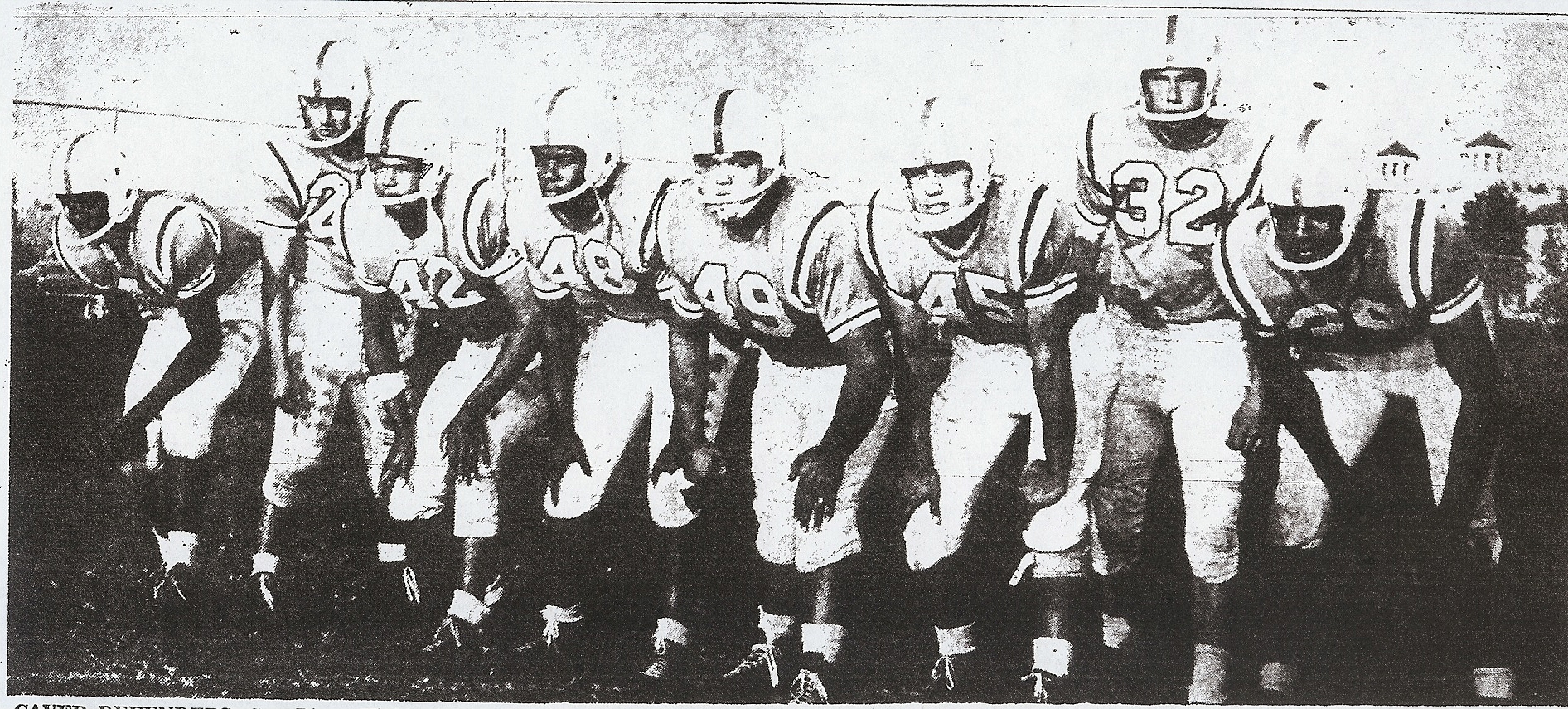
Defense was hallmark of Cavemen. from left: Neal Petties, Manuel Darisay, Mike Ritchey, Robert Fowler, Carlos Gutierrez, Calvert Fackrell, Larry Landon, George Coggins.
SLEIGHT OF HAND
Quarterback Pete Yoder of Downey almost faked San Diego High out of Aztec Bowl, where some 12,500 persons were on hand, including 22 busloads of red-clad partisans who ventured down U.S. 101 to support the visiting Vikings and arrived two-and-a-half hours before kickoff.
(The Downey supporters also were hungry, setting an Aztec Bowl record at the concession stands, according to San Diego State official Spence Gartz).
Downey had knocked out San Diego, 35-21, in the first round of the 1956 playoffs, when the Vikings were on a fast track to a legendary championship game that would pit Downey’s Randy Meadows against Anaheim’s famed Mickey Flynn.
San Diego was favored in the rematch.
After starting the season with a loss and a tie, Downey kicked in with 11 straight victories.
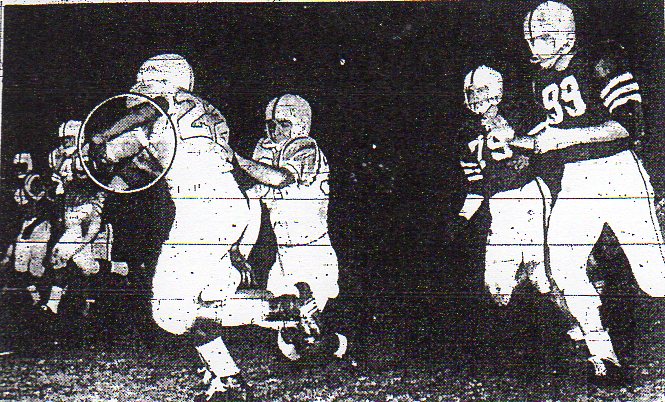
Art Buchanan was in the open field for one of the few times, but Dallas Moon, hidden by Caver Robert Felix and the Vikings’ Roger Malstead (79) and Jim Quinn (99) hounded San Diego runners all night.
CAVERS GO BELLY UP
Yoder flawlessly ran the so-called belly series, in which the quarterback attempts to confuse the defense by appearing to hand off to a ball carrier, then withdraws the ball and hands off to another or runs or passes.
The Vikings rushed for 293 yards, including 194 in the second half. San Diego ran only six offensive plays in the third quarter and just 16 in the second half. Downey was successful on one of two onside kickoffs after intermission.
San Diego narrowed the score to 18-7 with 8:45 remaining in the game, then did not see the ball again until 15 seconds were left as the Vikings played keep-away.
The Cavers never figured out the Downey offense.
Cavers coach Duane Maley, who was thinking about retirement and moving into administration, was shocked but not at a loss for words.
“Our line didn’t hold up,” Maley said to Jerry Magee of The San Diego Union.“We made too many mistakes and they didn’t make any. We’re not that bad and they’re not that good.”
The Cavemen had swept the City Prep League, then outpointed Sweetwater, 31-7, Montebello, 27-7, and Whittier, 20-6, to gain their sixth trip to the finals 41 years.
HONORS
San Diego tackle Calvert Fackrell was a first-team all-CIF Southern Section choice. End and teammate Neal Petties and quarterback Ezell Singleton were on the second team.
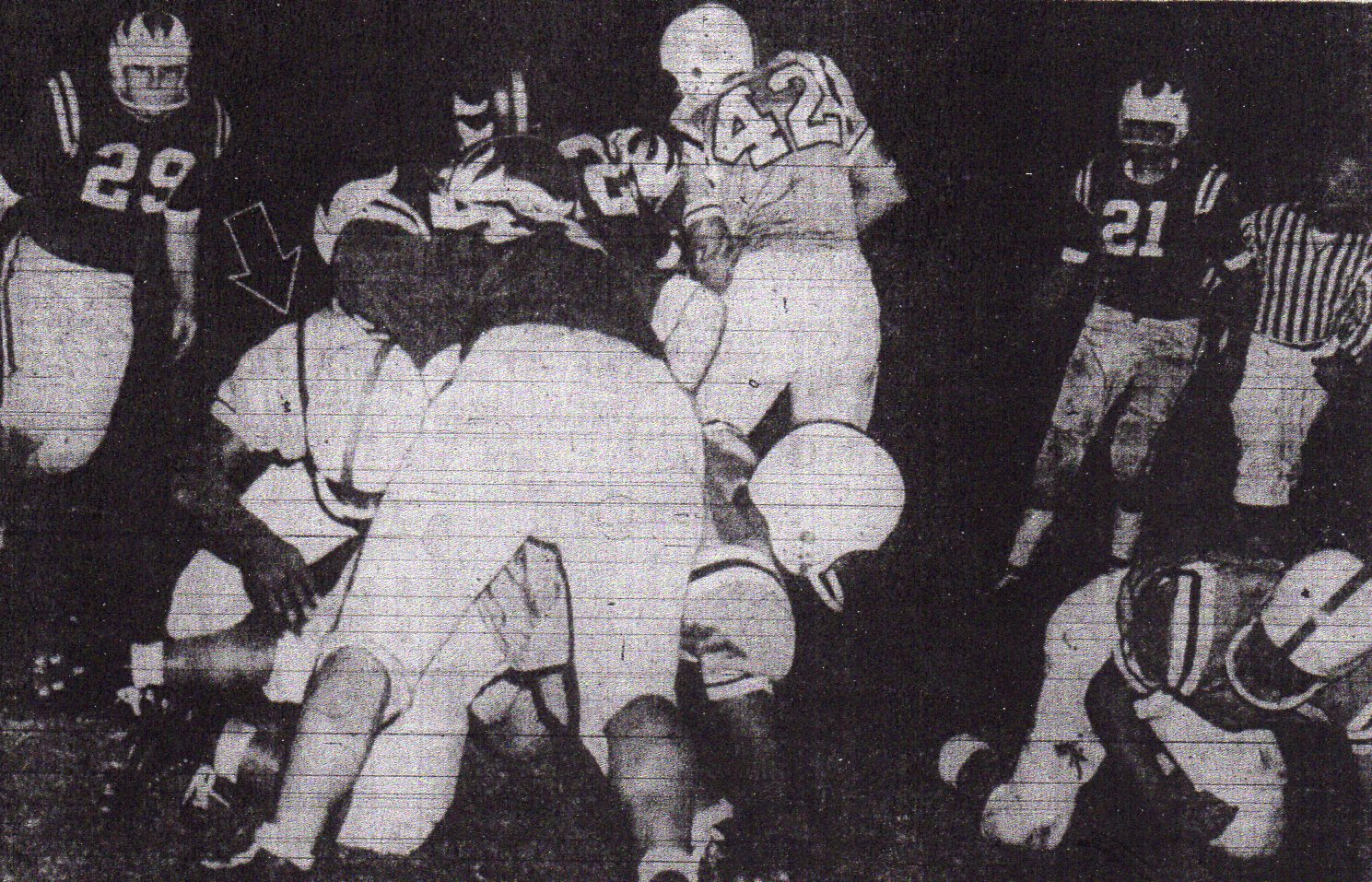
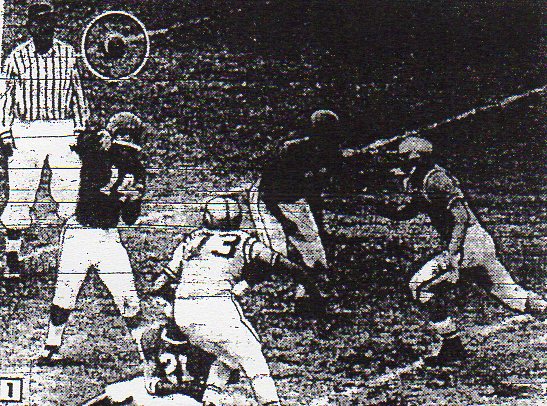
San Diego’s Mike Kellough (arrow), scored one-yard touchdown in Cavers’ 31-7 playoff victory over Sweetwater. Red Devils’ Bill Hill (44) is blocked by San Diego’s Willie McCloud Albert Belmontez (29) and Joe Meeker (21) of Sweetwater observe, while San Diego’s Iva Tucker (right, on ground) gets up-close look and Roy Pharis (42) surveys backdrop.
Teen magazine named Fackrell, Lincoln quarterback Russ Boehmke and Coronado halfback Hal Tobin to its all-America team. Boehmke and Tobin received honorable mention on the Wigwam Wisemen of America all-star squad. Seven teams were selected with Jim Josephson of San Jose the only Californian on the first squad.
Tobin was the Southern Section lower division co-player of the year with Santa Ana’s Henry Enriquez. Center Mike Heyn of Coronado and back Gordon Frank of Escondido were on the second team.
NOT THAT BISHOP
Ramona’s opponent in the smallest schools finals was not the private institution in La Jolla, which was years from fielding a football team.
The Bulldogs took on a team located at the foot of the Eastern High Sierras in a small community not unlike Ramona’s, although sitting a couple thousand feet higher.
Bishop bused more than seven hours and 355 miles south, but it was the host Bulldogs who lacked energy. The visiting Broncos scored in every quarter. Ramona twice advanced to the visitors’ 20-yard line but gave up the ball.
Ramona may not have recovered from it first playoff trip, to Needles, where the Bulldogs topped the host Mustangs, 20-18.
Ramona to Needles is about 180 miles as the crow flies, but approximately 307 miles via major highways U.S. 395 and U.S. 66 after a 20-mile jaunt from the the Bulldogs mountain community on State 67.
There were other, shorter distances on rural highways but those might not have gotten the Bulldogs there any sooner.
P.D. Jernigan, later known later as Pete during a 10-season career mostly spent the baseball AAA Pacific Coast League, was a contributor to Mount Miguel’s surprising, first-year record of 5-3.
MONARCHS RUN AND RUN
Escondido outgained Mater Dei, 364 yards to 359, but the Monarchs, guided by future NFL coach Dick Coury, rushed for 340 yards and, after building a 20-7 halftime advantage, held off the Cougars before 6,500 persons at Escondido.
The visitors came on the field in a military double time and ran their plays with soldierly precision. Fullback Henry Enriquez kept the Cougars at a distance by rushing for 171 yards in 26 carries and scored on a 32-yard run.
The Monarchs topped Claremont, 20-14, for the Southern Group title and San Marino beat Pomona Catholic, 26-13, for the Northern Group championship, both divisions for small schools.
SAINTS FINALLY FIND THEIR NICHE
St. Augustine joined the City Prep League after decades on the outside.
The school opened in 1922 and played its first game in 1924, then meandered through the years with a “Have-Team-Give-Us-A-Game” mantra.
The Saints were in the Southern Prep League from 1941-43 but their games did not count in the standings.
St. Augustine was a member of the Los Angeles-area Southland Catholic League from 1945-50. Travel was costly for the small, private school, which teetered on athletic insolvency.
The Rev. John R. Aherne joined the school faculty in 1942 and was named principal in 1952. The 6-foot, 5-inch Aherne became a towering figure in the community.
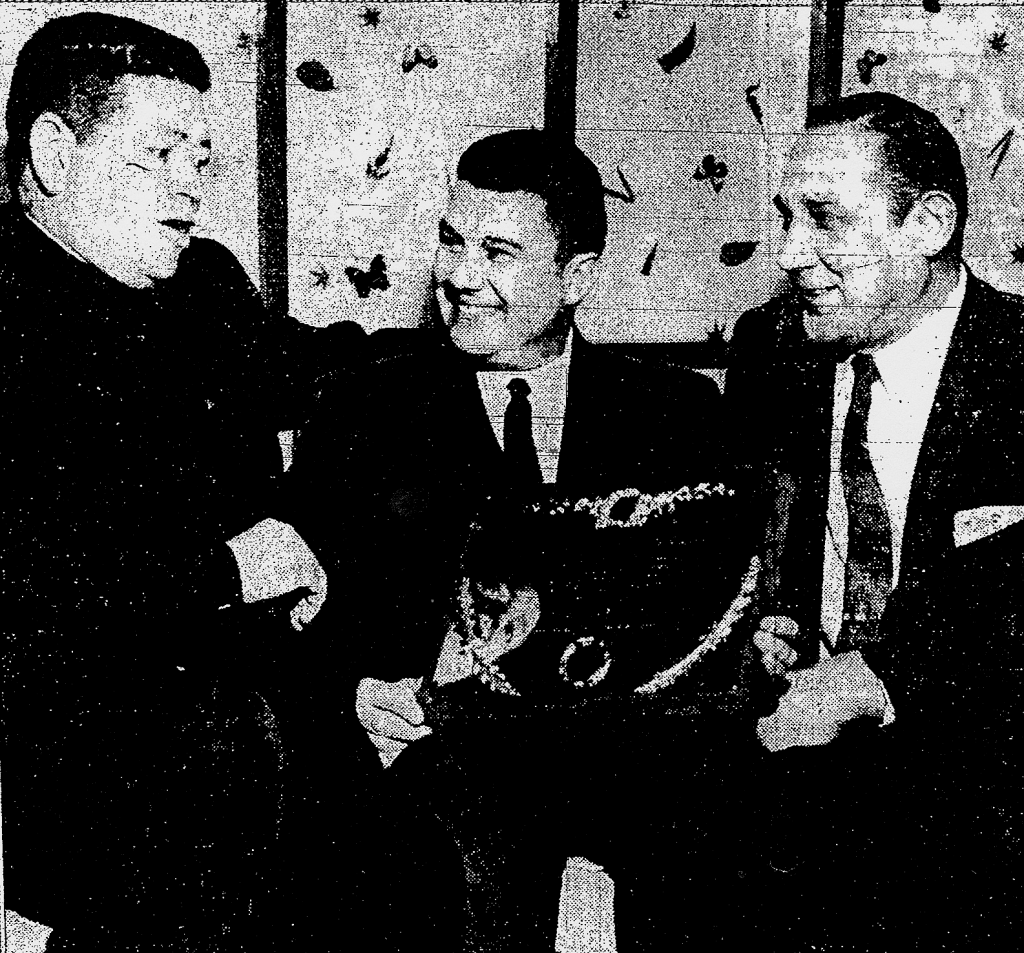
Aherne (left), with Bob Breitbard, and Notre Dame athletic director Moose Krause, led St. Augustine.
Aherne lobbied the media, enjoyed power lunches with civic big shots at the Grant Grille downtown and Lubach’s on Harbor Drive, and was the driving force behind St. Augustine’s “Appreciation Night” which was first held in 1955 and became an event so large in scope that principal speakers included major college coaches and some of the country’s leading sports figures.
City schools, uneasy about St. Augustine’s ability to recruit in their school districts, possible conflicting eligibility issues, and that the Saints represented the Catholic faith, finally let them into the club.
In its 33rd year of football St. Augustine at last had some local partners.
Russ Boehmke completed 16×25 passes for 207 yards and ran 43 yards for a touchdown in Lincoln’s 20-7 win over Point Loma.
THREE NEWCOMERS IN THE VILLAGE
Crawford opened on 55th Street in East San Diego, taking a huge chunk of Hoover’s enrollment.
Carlsbad finally broke off from Oceanside and went out on its own, but students still attended classes in the building at Oceanside High. There no longer was an Oceanside-Carlsbad High.
Helping itself to Helix and Grossmont expatriates, Mount Miguel rose in Spring Valley, in the shadow of the 2,559-foot Mount San Miguel.
Crawford and Carlsbad essentially played junior varsity opponents. The teams’ varsities met and Carlsbad defeated Crawford 20-13, on John Penrod’s 85-yard pass interception return.
OLE!
Mount Miguel’s Matadors had some impressive firsts. Rocky Barsotti scored a touchdown the first time Mount Miguel had the ball in the Metropolitan League carnival.
Wayne Summers returned the opening kickoff 80 yards for a touchdown and the Bullfighters dispatched Mar Vista 20-6 in their first-ever game.
Coach Tom Welbaum, who left Helix to Dick Gorrie when the Mount Miguel position opened, directed the new school to an impressive, 5-3 start. Included were victories over big brothers Grossmont, 32-14, and Helix, 21-19.
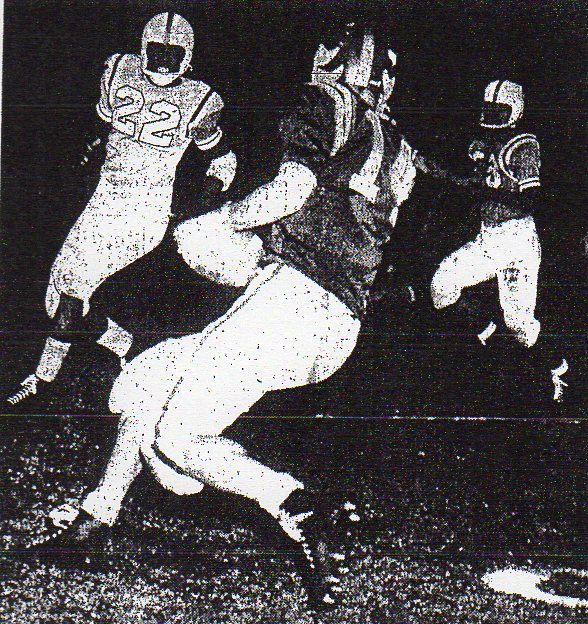
Sweetwater’s Bob Jordan intercepted pass by San Diego’s Ezell Singleton and looked to avoid Cavers defender Art Buchanan (22).
AVOCADO COACHES WAVE WHITE FLAG
There was no question that coach Bob (Chick) Embrey’s Escondido Cougars were a landslide choice to win the Avocado League.
Oceanside’s John Simcox described the Cougars as “sure winners”.
“Escondido could lose its eleven starters and still have a club which could take the league,” said Mar Vista’s Art Filson.
The Cougars are “twice as good” as anyone else, said Vista’s Harry Johnston.
Pessimist Embrey tried to downplay his club’s prospects, but wasn’t convincing: “I thought it might be our year to really go, but in addition to…injuries (17 players reportedly out for awhile), our line hasn’t been coming around.”
The Cougars were undefeated in league play (6-0) and outscored its brethren 239-52 en route to a 9-1 campaign. A 47-6 win over Fallbrook gave Escondido a sendoff of 18 consecutive league wins.
HIGH-STEPPING HAL
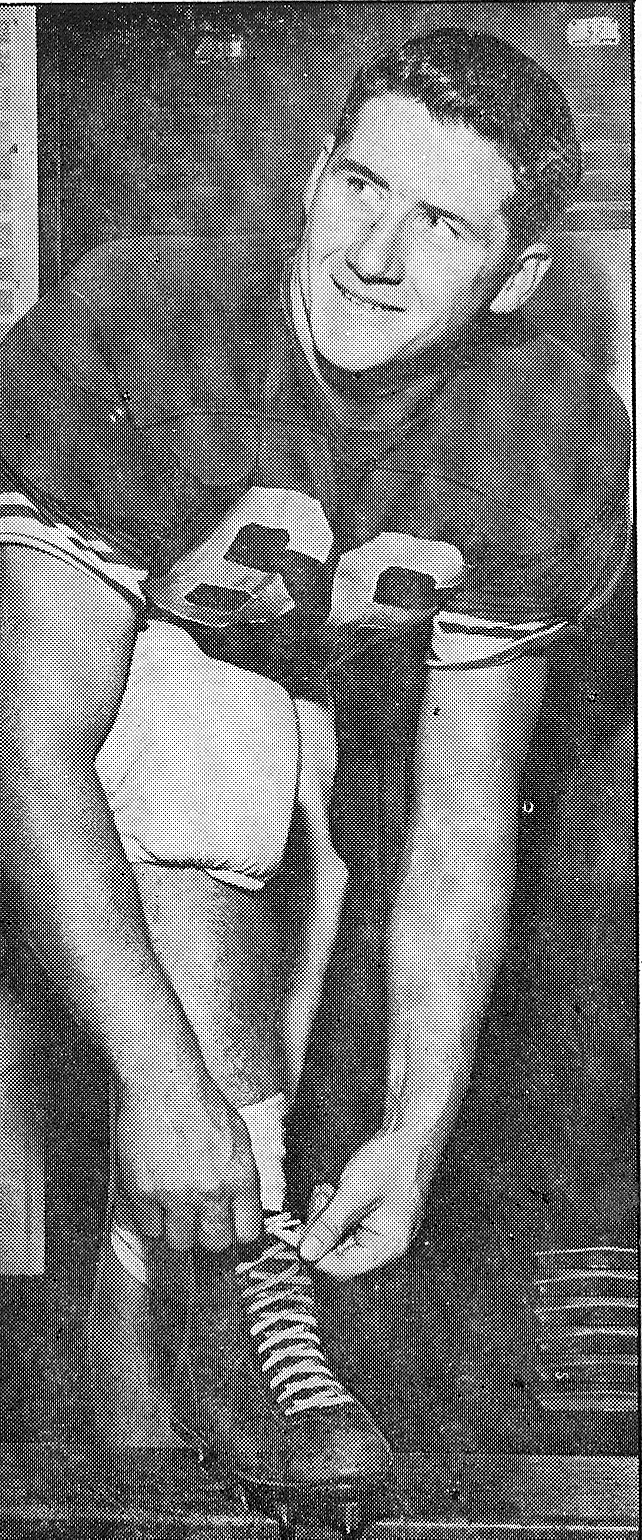
Coronado’s Hal Tobin (below) was the leading scorer in Southern California with 144 points in nine games, although Escondido held Tobin to 51 yards in 18 carries and one touchdown when the Cougars routed the Islanders 49-18 in the Avocado League’s biggest game.
Tobin, who would continue on to play at USC, finished with 1,029 yards in 127 carries for an 8.5-yard average in leading the undermanned Islanders to a 5-4 record.
Tobin was unique in pursuit of points after touchdowns. He ran for the point by lining up 8 yards behind the center and taking a direct snap.
Tobin kept Islanders afloat.
STEP RIGHT UP!
Writer Jerry Magee of The San Diego Union let it all hang out in the lead on his story for the City Schools’ carnival: “Some 300 strutting girls…eight bands, music, pageantry, and football derring do–and all for the price of a single admission!”
Magee described a “sideshow hawker in a checked vest” employing such a spiel to describe the 19th annual event, which drew 20,000 to Balboa Stadium. On the same night the Metropolitan League carnival was viewed by an overflow crowd of 12,500 in Aztec Bowl.
The East’s Kearny, Point Loma, Lincoln, and San Diego outscored the West, 24-0, as each squad scored a touchdown in the City League extravaganza. El Cajon, Mount Miguel, and Helix of the East topped Grossmont, Chula Vista, and Sweetwater of the West 13-6 in the suburbans’ fourth annual carnival.
SIGN OF THE TIMES
The state division of highways announced plans for a four-lane road from San Diego to Yuma, Arizona.
“When the freeway is completed you will be able to drive from San Diego to Yuma without encountering a stoplight or intersecting road,” said Jacob Dakema, district highway engineer.
The trip would obviously be faster but also shorter, said Dakema. The Highway 80 route covers 178 miles. The interstate drive will be 173 miles.
The freeway will be part of the Interstate Highway System, inaugurated in 1956 by President Eisenhower partly as a means of quicker transportation and mobilization of troops in event of a crisis in the Cold War with the Soviet Union.
THE KEARNY COMET
Ed Buchanan of Kearny led the CPL with 86 points in eight games and scored 53 consecutive points for the Komets, including the last touchdown in a 13-13 tie with Point Loma. He scored all of his team’s points in a 26-13 win over St. Augustine and 13-6 triumph over Hoover, and the first seven points in a 44-20 win over Mission Bay.
Buchanan kept Kearny in the game every week.
The 165-pound, :09.6 100-yard dasher passed 50 yards to Kenny Griffin for the second touchdown against Mission Bay, then returned a punt 75 yards for the third touchdown.
Buchanan, who rushed 24 times for 209 yards against St. Augustine, had two additional touchdowns against the Saints nullified by penalties.
Buchanan went on to an outstanding career at San Diego Junior College, was a nine-season player in the Canadian Football League, and was named to the Saskatchewan Roughriders all-time team.
YUMANS IMPRESSED
San Diego did not have benefit of the new highway, as it bused to Arizona over the circuitous U.S. 80.
Quarterback Ezell Singleton completed 14 of 16 passes (the two incompletes were drops) as the Cavers wowed an overflow crowd of 9,000 and defeated the Yuma Criminals 40-0, with a demonstration of ball control.
Four of the Cavers’ six touchdowns came on drives of 60, 79, 65, and 75 yards. Highlight of the game, however, was a point after touchdown.
The play began with Singleton taking the snap from center, but Singleton soon was trapped by a horde of defenders. The quarterback lateraled the ball to Bobby Anderson, over Anderson’s head. The elusive halfback recovered and weaved his way 25 yards into the end zone.
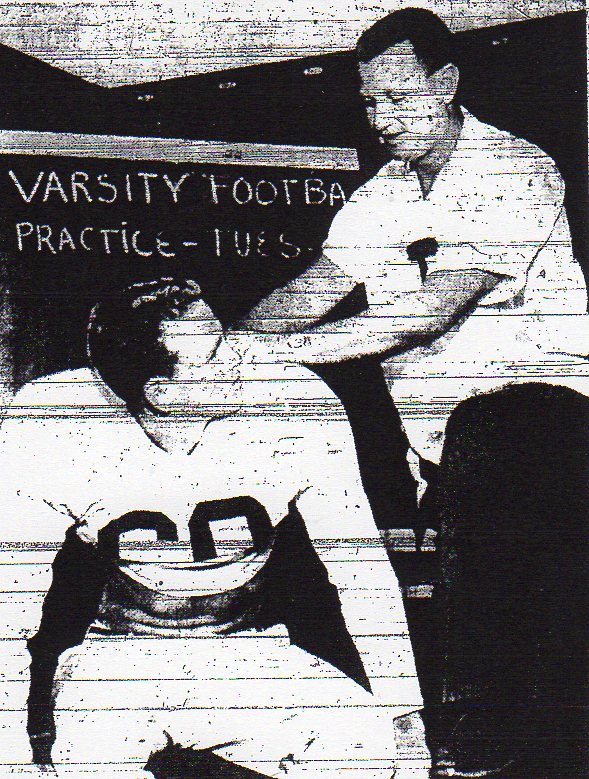
Point Loma coach Bennie Edens apparently also was the team’s part-time trainer, administering to end Ted Faris.
REALIGNMENT
Escondido, twice the size of other Avocado League schools with an enrollment of almost 1,400, will return to the Metropolitan League in 1958. The Cougars were in the Metro from 1933-42 as one of the original members. They were part of a CIF-designated Group 12 affiliate from 1943-45.
Escondido returned to the Metro in 1946 and became a charter member of the Avocado League in 1954.
City Prep League bosses met for five hours and adjourned with a plan to realign in 1958 with two divisions in basketball and baseball. Football would continue with one round-robin schedule. La Jolla would continue to be a member, but its games would not count in football.
A new high school, James Madison in Clairemont, reportedly would open in 1958 with its teams competing on a junior varsity level for one year. Madison would bring to 10 the number of CPL schools.
Lincoln, St. Augustine, Hoover, San Diego, and Point Loma would form one division and Kearny, Mission Bay, La Jolla, Crawford, and Madison would be in the other.
Realignment would come in the city with advent of the Eastern and Western Leagues but not until 1959. Madison would not open until 1962. And La Jolla returned to league standings in 1958 after two seasons in which its games did not count.
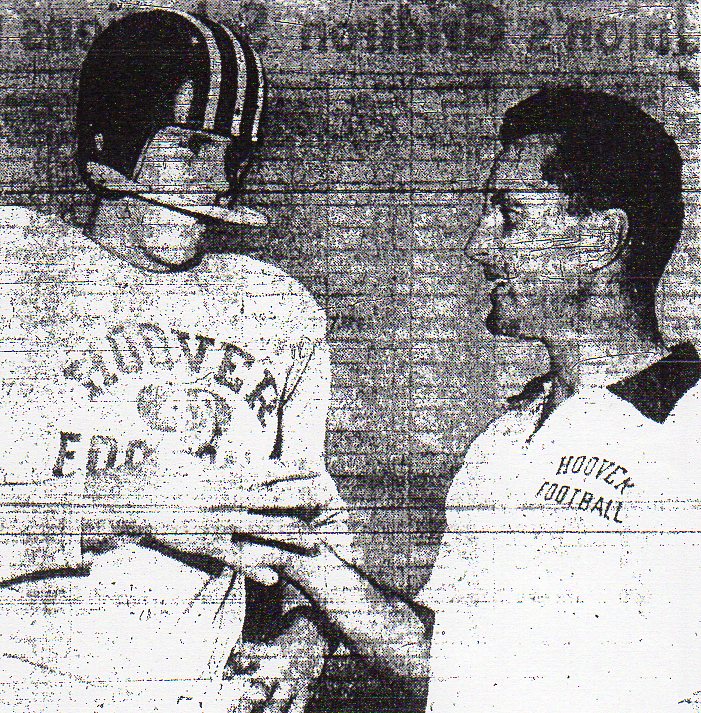
Hoover coach Roy Engle declared tackle Don Loshonkohl had “the biggest hands I’ve ever seen.”
REVENUE AND LIGHTS
Lincoln vice principal George Parry attended the re-leaguing meeting and pointed out that the issue of facilities never came up and that only three of the nine CPL schools had lights: La Jolla, Hoover, and San Diego/Balboa Stadium.
Parry revealed that Lincoln realized about $2,000 as its share of gate receipts for a night game in Balboa Stadium with St. Augustine. Lincoln’s share for an afternoon contest with visiting Kearny was about $200, Parry said, stressing the need for more fields with lights.
THE GAMBLER
Shan Deniston always thought the odds were in his favor.
The new Lincoln coach faced a fourth down and three yards to go at Lincoln’s eight-yard line in a game in which the Hornets trailed at Point Loma 7-6 early in the fourth quarter.
Fullback Dick Carey wedged for the first down and Lincoln went on to complete a 99-yard drive, scoring on quarterback Russ Boehmke’s 43-yard dash. Lincoln won, 20-7.
Deniston tested his luck again in Balboa Stadium against San Diego.
After stopping the Cavers on Lincoln’s 5, 20, 16, and 4-yard lines in the first half, the Hornets were on their 36-yard line with fourth-and-two. Less than a minute remained in the half.
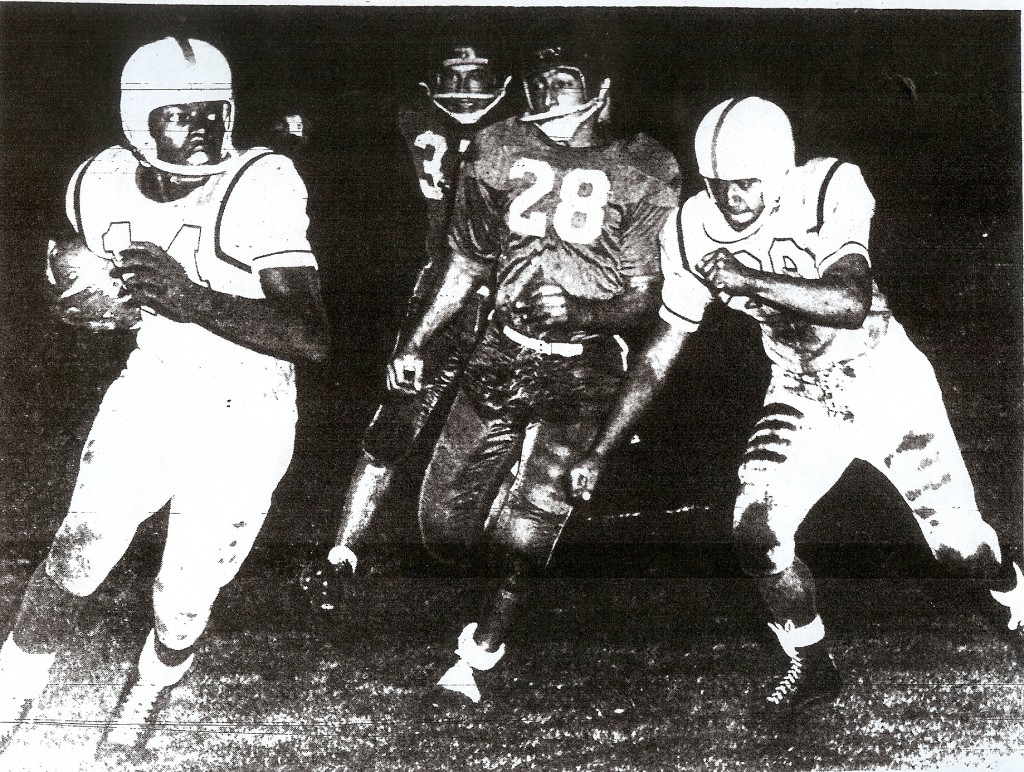
Cavers’ Bobby Anderson, aided by Manuel Darisay’s block, pulled away from Lincoln’s Jerry Puerile and Gene Sickles.
Lincoln passed incomplete and San Diego took over. On the next play Bobby Anderson zigzagged through the Hornets’ defense to score with 35 seconds left in the half. San Diego won, 13-7.
Hoover’s Roy Engle strangely rolled the dice against Mount Miguel.
Art Samuel and John Erickson had combined on a 50-yard touchdown pass play to put the Cardinals ahead 21-14 with a minute to play.
Hoover then stunned its home crowd by attempting an on-side kickoff. The Cardinals recovered and quickly scored again in a 28-14 victory.
SANGUINARY FLOW
“We’ve tasted the tiger’s blood and like the taste,” said Chula Vista coach Bob Geyer after the Spartans surprised Helix’ defending Metropolitan League champion, 32-19, and went on to a 28-6 win over Mount Miguel and 52-19 victory over El Cajon Valley before a 20-13 loss to Sweetwater in the title-deciding final game.
1957 or 1954?
Only the first names changed. Hoover’s Jim Pfister, Sam Sharamitaro, and Jim Young all had brothers, Bill, Al, and Ken, respectively, who played for the Cardinals in 1954.
10 OKAY ONCE
San Miguel School in National City, its numbers shrunk after a 65-0 loss to Ramona, defeated North Hollywood Harvard Military, 13-7, the following week, playing the last half with just 10 players.
The school, which would eventually merge with The Bishop’s in La Jolla in the early 1970’s, pulled the pin on the season, forfeiting its final game to Army-Navy.
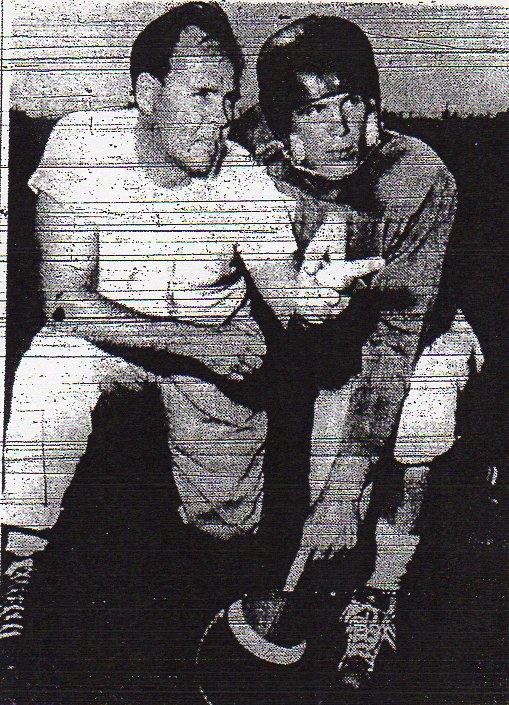
San Diego High coach Duane Maley and quarterback Ezell Singleton were architects of 11-1 season..
QUICK KICKS
Ramona defeated Claremont-Webb, 6-0, to end a 25-game winning streak for the Gauls…the growing CIF Southern Section, now numbered 270 schools…Sweetwater set a school scoring record in a 59-0 victory over El Cajon Valley, bettering a 57-0 romp over Oceanside in 1926, the last season the Red Devils were in the CIF playoffs…Sweetwater’s 8-2 record represented its most wins since the 1941 squad went 8-0…official San Diego city population was 494,201 on the June 1 start of fiscal year…a new rule restricted city football coaching staffs to 4, for varsity and JV…Grossmont coach Ken Maynard was direct, predicting that his team “is certainly going to better its sorry showing of a year ago.”…the Foothillers improved from 1-7 to 4-4…Lincoln’s Russ Boehmke passed for 271 yards against Kearny, completing 11 of 17 attempts and touchdown passes of 32, 29, 19, and 50 yards, plus running 16 yards for a touchdown in a 33-13 victory…Chula Vista and St. Augustine had their wrists slapped by CIF Southern Section commissioner Ken Fagans for scrimmaging before the permitted date…Kearny coach Don Henson coached from the press box in the first half of a 13-13 tie with Point Loma…Lincoln and St. Augustine scored five touchdowns in the last seven minutes, the Saints winning 25-18…attendance for the 25th San Diego-Hoover game was a disappointing 6,000…Mount Miguel was 2-0 and feeling its oats when the Matadors took on Sweetwater…”They’re hot but we’re going to cool them down a bit,” said Tom Parker, whose Red Devils shut down the Lemon Grove team, 18-0…St. Augustine’s JV defeated Lincoln,7-6, when Raul Martinez reached back into the mists of time and drop-kicked the winning point after touchdown…San Diego was behind for the first time all season when Point Loma led 13-7 into the fourth quarter, but Willie McCloud ran 32 yards for a score and Ezell Singleton ran five yards for a touchdown with 46 seconds remaining and the Cavers pulled out a 21-13 victory…the San Diego-Sweetwater playoff was considered a home game for both teams, although the Balboa Stadium site was on the San Diego campus…a coin flip determined after the game that the Cavers would be visitors for the quarterfinals against Montebello…that game was played at East Los Angeles Junior College, as was the semifinal game versus Whittier…San Diego’s yell leaders were reinforced by one cheerleader from every other school in the CPL when the Hillers played Downey…Lincoln rushed for 361 yards in an opening-game, 46-13 rout of Chula Vista…San Diego and Hoover teams came together at the North Park Lions Club’s annual dinner honoring the Cavers and Cardinals at the Imig Manor (later known as Lafayette Hotel) on El Cajon Boulevard….
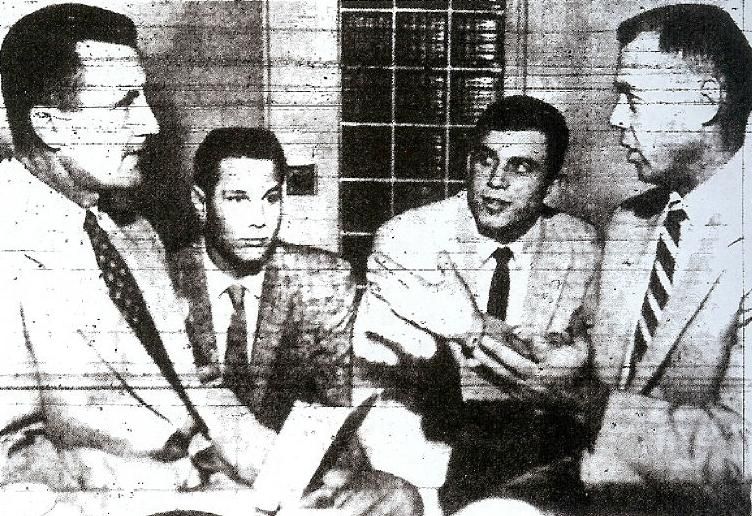
From left: Hoover coach Roy Engle, Cardinals’ All-City center Dave Vorpahl, San Diego’s all-Southern California tackle Calvert Fackrell, and Cavers’ coach Duane Maley confer at annual event.
1957: Different Kind of Opponent
A silent killer loomed.
Discovered in February in a Southern China province, a virus that became known as the Asian Flu hit area teams with full force several months later.
The germ spread to Singapore, then was transported by U.S. Naval personnel, reaching the shores of the Pacific Coast in June.
The virus spread across the country in the summer and fall and claimed the lives of almost 70,000 Americans and almost 2 million worldwide.
There were no reported deaths in San Diego football circles, but the germ’s affect was felt throughout the season.
El Cajon Valley coach Glenn Otterson was first to go public.
First mention of flu on the sports pages of local newspapers came September 29, when 10 El Cajon Valley High players and 500 students missed classes, according to football coach Glenn Otterson.
Sick players and canceled and postponed games were noted almost daily in October.
–Ramona was reduced to a squad of 10 and forced to cancel its opening game at Imperial, then was idled again when Claremont-Webb withdrew (the teams met later).
The Bulldogs’ game the next week at Lancaster Edwards Air Force Base Desert also was called off. Ramona finally was ready for its league opener, but Brown Military Academy couldn’t field a team.
–Three games involving Avocado League teams were scratched within 48 hours. Escondido, expecting a crowd of 6,000 when it stepped up in competition to take on a Metropolitan League power, was forced to pull out of a game with Sweetwater. San Dieguito had to find a later date with Vista, but Vista and Sweetwater got together and played.
–With 7 starters out and only 22 of 45 roster players available, Helix officials discussed the possibility of not going to Oxnard. The Highlanders decided to head North and were beaten, 52-6.
Medical symbol became as common as team symbols.
–Claremont, in Eastern Los Angeles County, was down to 10 players and canceled with Sweetwater, which was able to fill the date against Brawley, which needed an opponent after Holtville came down with the illness.
–Claremont later was on the receiving end as Army-Navy’s team was racked with the flu.
–Chula Vista scheduled Upland after Chino withdrew.
–West Covina bailed on El Cajon Valley, which got a game with Fullerton, but that game was canceled because of rain.
–Lincoln coach Shan Deniston and Mission Bay’s Harry Anderson were slowed by flu symptoms.
–Deniston called off practice when four starters were out. Tackle Tony Dement was struck with a different ailment. Dement was forced to undergo surgery after a mosquito bite on his leg became infected.
–Twenty-three games in Southern California were canceled on Oct. 12.
–Crawford and Carlsbad, first-year teams, met in what essentially was the schools’ only varsity contest. Crawford’s first-team backfield, featuring Hoover transfer Arnold Tripp, stayed home with the flu. and the Colts missed a chance at an undefeated season, losing, 20-13.
Colts coach Walt Harvey picked up a bug on Crawford’s crowded, sweaty bus ride home and spent the next 10 days in bed.
Lincoln coach Shan Deniston, with quarterback Russ Boehmke, was slowed by symptoms.
–Eighty-nine St. Augustine players, comprising freshman, junior varsity and varsity, were inoculated at the same time with painful flu shots, which often left the patient with a very sore arm and, in some cases, flu-like symptoms.
–Tiny San Miguel School in National City defeated host Studio City Harvard Military 13-7 and finished the game with 10 players. The Knights postponed their next game against Army-Navy.
–Literally hundreds of other players missed school or games. The virus affected every school in the area.
–A sign of a return to normalcy came in November, when the Asian Flu no longer was considered a threat to patrons in crowded movie theaters. Attendance at San Diego film venues had dropped almost 25 per cent in October.
2013: Playoffs Picture Coming Into Focus
Polls are great, but what do they mean come playoff time?
First things first:
Cathedral hung on to first place in the UT-San Diego basketball poll, but for the first time since the 2013 calendar the Dons were not unanimous choices.
Cathedral received 8 first-place votes after an uneven week in which it was surprised by Army-Navy 67-61 and needed an overtime before subduing St. Augustine 62-59.
Cathedral, Army-Navy, and El Camino each received first-place votes.
Teams are in the second round of league play, with playoffs scheduled to begin Feb. 19.
After roughly 20 games, division playoff favorites are shaping up.
Coming out of the backstretch toward the turn for home:
I–El Camino. The Wildcats are under the radar on a state level, ranking 39th in the computer-based view of CalPreps, but rate a slight edge locally over Mission Hills.
II–San Diego Section’s most loaded division. La Costa Canyon, San Marcos, and Hoover stand out. Morse and San Ysidro are demanding respect. La Costa is fifth, Hoover 10th, San Marcos 12th, and Morse 20th in CalPreps.
III–Cathedral is 3-0 against St. Augustie this season and is third in its division and 19th overall in California. St. Augustine is fifth in D-3. Unless a New York Jets-Balitmore Colts, Super Bowl III upset occurs, these two teams will meet in the Section finals.
IV–But for a confounding loss to La Jolla Country Day (9-8), Army-Navy (17-4) would be San Diego’s No. 1-ranked team. The Warriors are seventh in the state in D-4 but could make a deep playoff run.
V–Dialing Tri-City Christian, 18-1 and 12th as seen by CalPreps.
First-place votes in parenthesis:
Place
Team
Record
Points
Last Week
1
Cathedral Catholic (8)
19-3
119
1
2
Army-Navy (2)
17-4
106
6
3
St. Augustine
15-4
103
2
4
La Costa Canyon (2)
18-4
101
3
5
El Camino (1)
20-2
95
4
6
San Marcos
20-3
59
T8
7
Hoover
19-5
55
5
8
Mission Hills
17-4
39
7
9
San Ysidro
16-6
19
T8
10
Morse
19-5
10
NR
Also receiving votes: Santa Fe Christian, 15-6 (6 points); Torrey Pines, 13-8 (6); Tri-City Christian, 18-1 (2); Westview, 15-6 (2).