Rick Jackson, who guided the Madison Warhawks to a 12-2 record, two classic postseason victories, plus a third almost as riveting, has the leading won-loss record among San Diego County coaches with at least 100 career victories.
Jackson is 120-36-4 in 12 seasons at Madison for a .768 percentage, including state championships in 2012 and 2016.
Madison earned a Division II-AA title this year with a remarkable postseason.
–The Warhawks overcame a 31-7 halftime deficit and defeated St. Augustine, 35-31, for the San Diego Section D-I championship.
–They fought back after lagging by 19 points in the fourth quarter and knocked off Calabasas, 60-53, in overtime in the Southern California regional.
–Then the team from northeast Clairemont won a taut, 21-17 struggle against San Jose Valley Christian for state honors.
Oceanside’s John Carroll, who retired after the 2014 campaign, is second to Jackson with a 26-season career record of 248-75-6 for a .763 percentage.
Chula Vista’s Chet DeVore and San Diego’s Duane Maley have the highest all-time records for coaches with a minimum 50 games. DeVore was 44-7-1 (.856) from 1951-55, Maley 97-19-3 (.828) from 1948-59.
Monte Vista’s Ron Hamamoto and Valley Center’s Rob Gilster are the leading active coaches in victories, Hamamoto with 210, Gilster with 207.
Herb Meyer of Oceanside and El Camino is the all-time leader with 339 games won from 1959-2003. Carroll is second with 248 from 1989 -2014.
Poway’s Damian Gonzalez (107) this season became the 42nd coach in County history to reach 100 wins.
Other active coaches with at least 100 victories are Mission Bay’s Willie Matson (184), Cathedral’s Sean Doyle (177), Christian’s Matt Oliver (148), Mission Hills’ Chris Hauser (142), Mira Mesa’s Gary Blevins (140), Point Loma’s Mike Hastings (133), and El Camino’s Jerry Ralph (126).
The see the entire list, go to Coach 100Club in the drop down menu of the “Football” link.
1955: Principal Up to his Neck in Playoffs
A twist in the CIF Southern Section playoffs this year resulted in the Coronado principal twisting in the wind.
Escondido and Coronado had tied for second place in the Avocado League. making either school eligible for the league’s runner-up berth in the Southern Division (small schools) postseason.
So far, so good.
But Escondido coach Walt West was confused.
The Cougars were on the CIF’s playoff schedule as opposing Tustin, winner of the Orange League.
West thought the Cougars’ season was over and had asked for team uniforms to be turned in immediately following a final, regular-season game loss to league champ Oceanside.
“I had assumed that inasmuch as Coronado had beaten us (19-7) they would be in the playoff,” said West.
After speaking with Escondido principal Bill Radne, who also believed Coronado would represent the league, writer Dave Gallup of The San Diego Union contacted Coronado principal Wilfrid Seaman for comment.
CORONADO WANTS OUT
Seaman, in a less contentious moment, had stuck his neck out.
Seaman told Gallup that he had “talked the matter over” with his coaches and they had agreed that further play was undesirable for Coronado.
“After all we’re in need of getting our basketball under way and we’re just not big enough to support both sports at once,” said Seaman.
Seaman apparently had notified the CIF but didn’t tell Escondido.
Seaman’s position changed, quickly, when the Islanders’ boss learned that he had been hung in effigy by a segment of the student body, backed by peevish citizens, according to Gallup.
The Islanders’ honcho asked for a league meeting, with Coronado now being considered a playoff participant.
All league members, except champion Oceanside, attended a session at Fallbrook, where a coin flip determined the Avocado’s second playoff representative.
Conveniently, Escondido won the toss, played, and lost to visiting Tustin, 26-20.
THE REAL REASON
Why were Seaman and his coaches so eager to dump on football and get on with basketball?
Three important players on coach John Kovac’s Islanders squad that had gone to the Southern Section small schools finals in 1954-55 were footballers Willie Dickey, Charlie Love, and Herman Wright.
The Coronado brass felt it was essential to get the trio off the gridiron (Coronado was 4-3 under first-year coach Roger Rigdon) and onto the court as soon as possible.
The Islanders would mount a run to the small school’s title this season, posting a 27-1 record, and scoring a 60-54 win over superstar Billy Kilmer and Azusa Citrus, the team that that beaten them in the finals the previous year.
WE WANT IN
The postseason was growing in popularity and so were the complaints.
For many years, the Southern Section selected 8-10 league champions to its Major Division postseason. The Section passed a bylaw in 1952 that led to increased participation.
An extra team was added in 1953 and 16 teams, guaranteeing a full, four-week tournament with no byes, were invited in 1954.
The larger grouping, which would become the model for decades, included inclusion of some second-place teams, from selected leagues.
In addition to 12 league champions in the Central Group (large schools), the CIF this year said bids would go to runners-up from the Citrus Belt, Coast, and Pacific Leagues, and independent Santa Monica.
CIF TO BORDER TEAMS: DROP DEAD!
The two major San Diego leagues were eighty-sixed.
Their only chance of getting in was if a runner-up from one of the anointed leagues lost its final regular-season game, but there were no guarantees.
That the announcement was made before most circuits, including the San Diego City and Metropolitan, had completed their seasons was received with a surly lack of enthusiasm.
“I think my kids were fired up, looking forward to a possible playoff game. Now the edge is off,” said Hoover coach Roy Engle.
“What was the hurry announcing the brackets?” Engle wondered. “The logical time would have been Sunday or Monday, after the season.”
CARDINALS STINK IT UP
Hoover mailed in a flat performance as Point Loma defeated the Cardinals, 26-0, and claimed second place in the CPL.
San Diego, which had lost coin flips for the CPL’s lone playoff berth in 1951 and ’52, was a shoo-in this year, but Chula Vista, favored to be the Metropolitan League entry, had not clinched its league title and was facing a showdown with Helix.
Chula Vista coach Chet DeVore was thinking what if.
“Should we get beat, losing the playoff berth, and the SCIF decides to pick a second team from the city (as it did with Hoover in 1954), then I’d be hot,” said the generally mild-mannered DeVore.
SAINTS NOT MARCHING IN
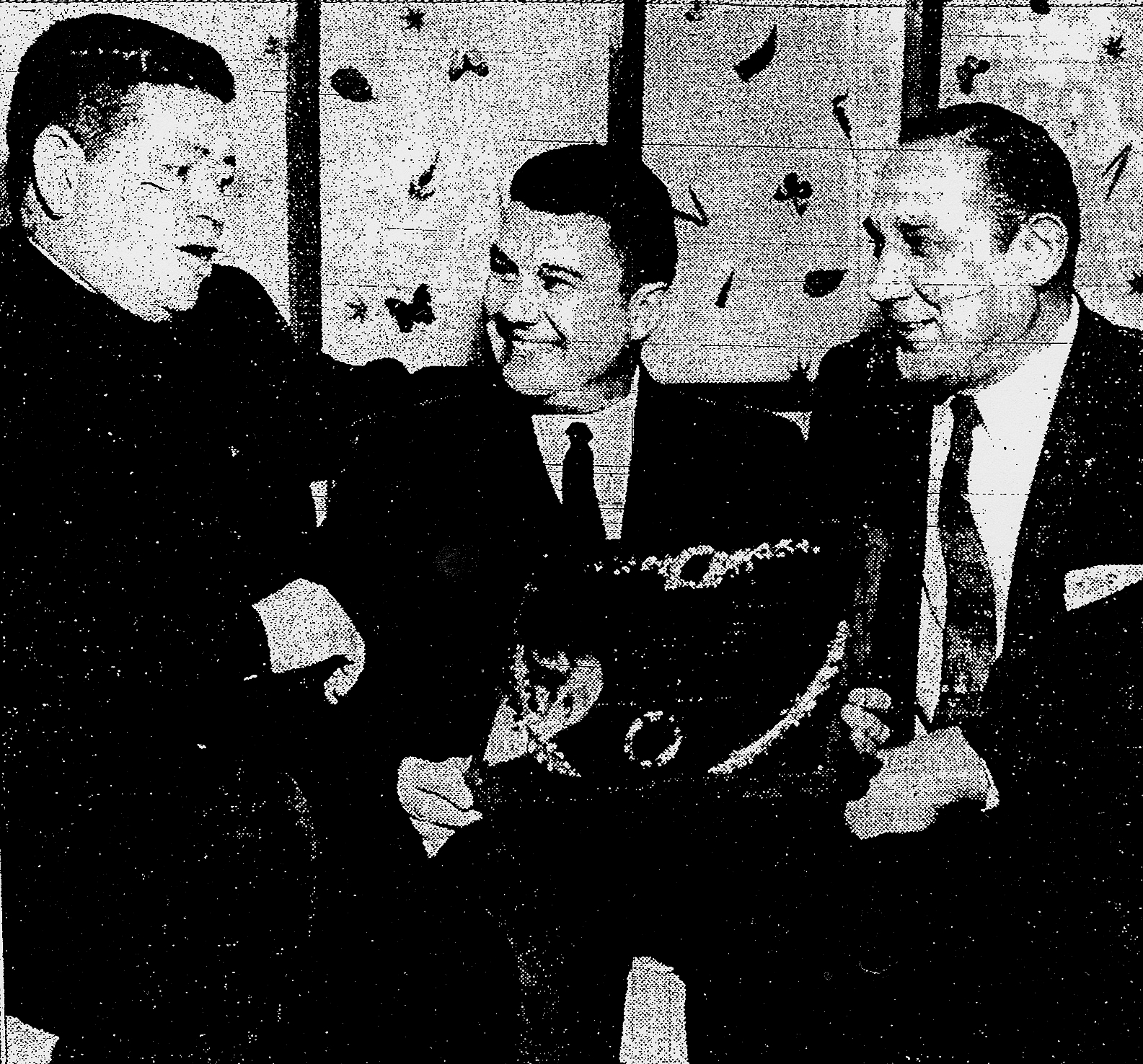
Aherne, with Bob Breitbard, and Notre Dame athletic director Moose Krause, held sway at St. Augustine’s Appreciation Night, event which was instrumental in getting the Saints into City Prep League in 1957.
The 6-foot, 5-inch, 250-pound principal at St. Augustine weighed in.
“Early this season we got a letter from the SCIF commissioner’s office,” said Fr. John Aherne. “It said St. Augustine would be eligible for the playoffs if we lost no more than two games.”
Aherne pointed out that the Saints lost to Metro powers Helix and Chula Vista and were tied by Lincoln. “What I have to think of the selections is not very nice,” said the vicar, still trying to get his school membership in a league.
ANOTHER POSSIBLE ISSUE
Could a glee club instructor or a wood shop teacher decide when Chula Vista was to meet San Diego in the first round?
Left halfback Dave Morrison, the Spartans’ best runner’; right half Ross Provence, guard Bill Stephens, and tackle Jeff Langston were listed as doubtful by coach Chet DeVore.
DeVore hoped the players could get as much recovery time as possible. He wanted to play on Friday.
But there would be a faculty vote, the coach cautioned.
“The Thanksgiving holiday starts Thursday and everyone may prefer to hold the game as soon as possible,” DeVore told Phil Collier of The Union. “If they want us to play Thursday that’s what we’ll do.”
With a presumed friendly nudge from principal Joe Rindone, the faculty voted to play San Diego on Friday.
Chula Vista quarterback Pete Kettela wedges between Grossmont defenders for touchdown in 46-0 rout. Spartan teammate Tom Nerat is interested observer.
TRUE GRID
Oceanside teachers and administrators were able to get an early start on the Thanksgiving holiday…the Pirates dropped a 6-0 playoff decision to visiting Brea-Olinda on Wednesday…undefeated Ramona, exited after a 14-7 loss to Banning of Riverside County and San Diego eliminated Chula Vista, 26-0…end Art Lawrence of Oceanside and guard Bob Anderson of Escondido were on the all-Southern California lower division first team…back Otis Foster of Oceanside was on the second team, and back Charlie Love of Coronado and center Tom Pointdexter of Mar Vista earned third-team honors….
1955: Chula Vista’s Winningest Era
Chet DeVore was taken aback, if not incredulous.
“I’m a basketball coach,” he told his boss. “I don’t have enough experience to coach football.”
That was DeVore’s reaction in 1951 when Chula Vista High principal Joe Rindone, asked DeVore to head the Spartans’ football program.
Few administrators have been so prescient.
Forty-four wins, seven losses, and one tie later, DeVore, like many before and after him who trained to be educators, forsook the sideline and went into the halls of administration.
Few coaches have left such a legacy.
DeVore was 42-3 in his last four-plus seasons.
That the Spartan leader’s coaching career ended with a 26-0 loss to eventual Southern California and national champion San Diego did not dim the luster.
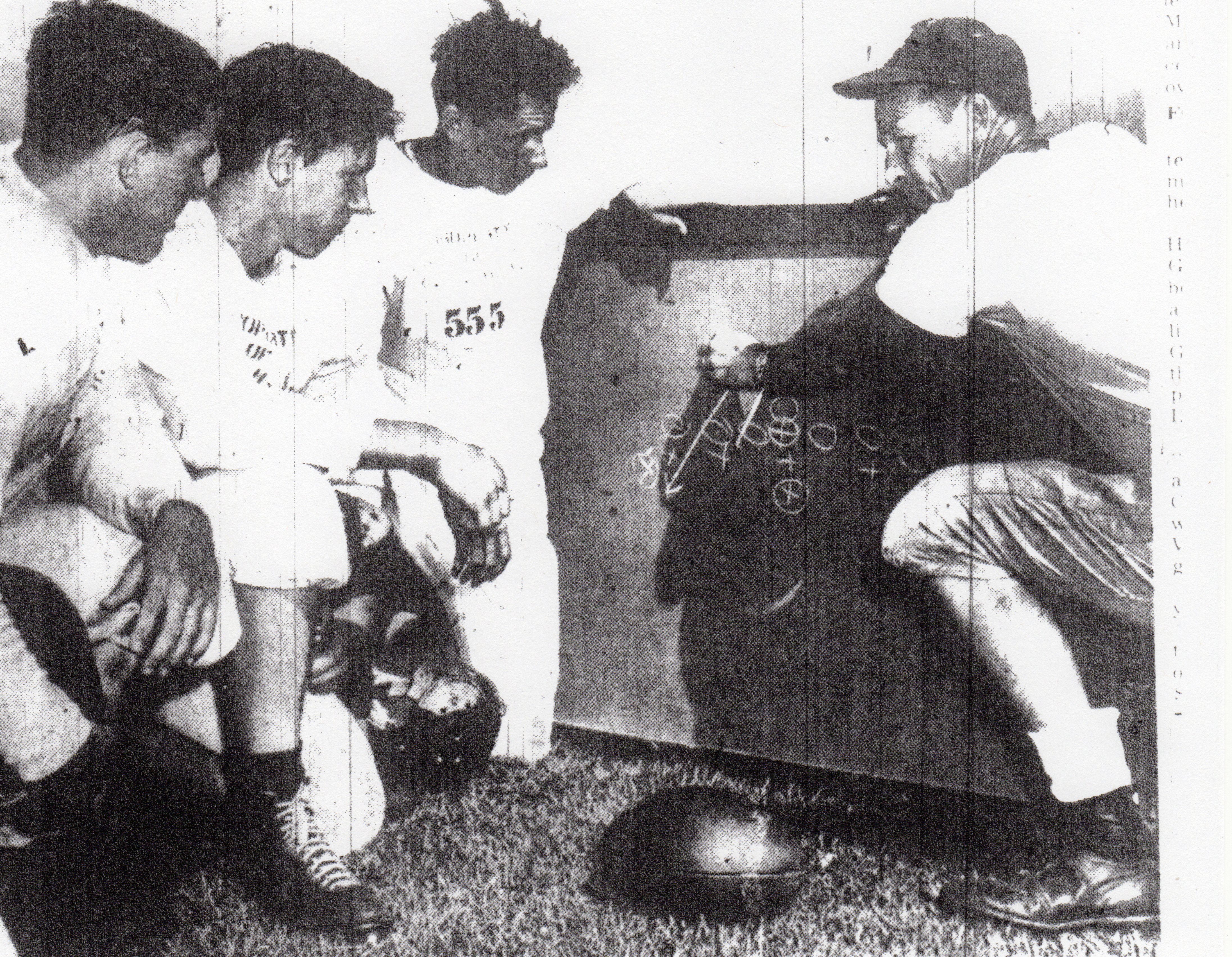
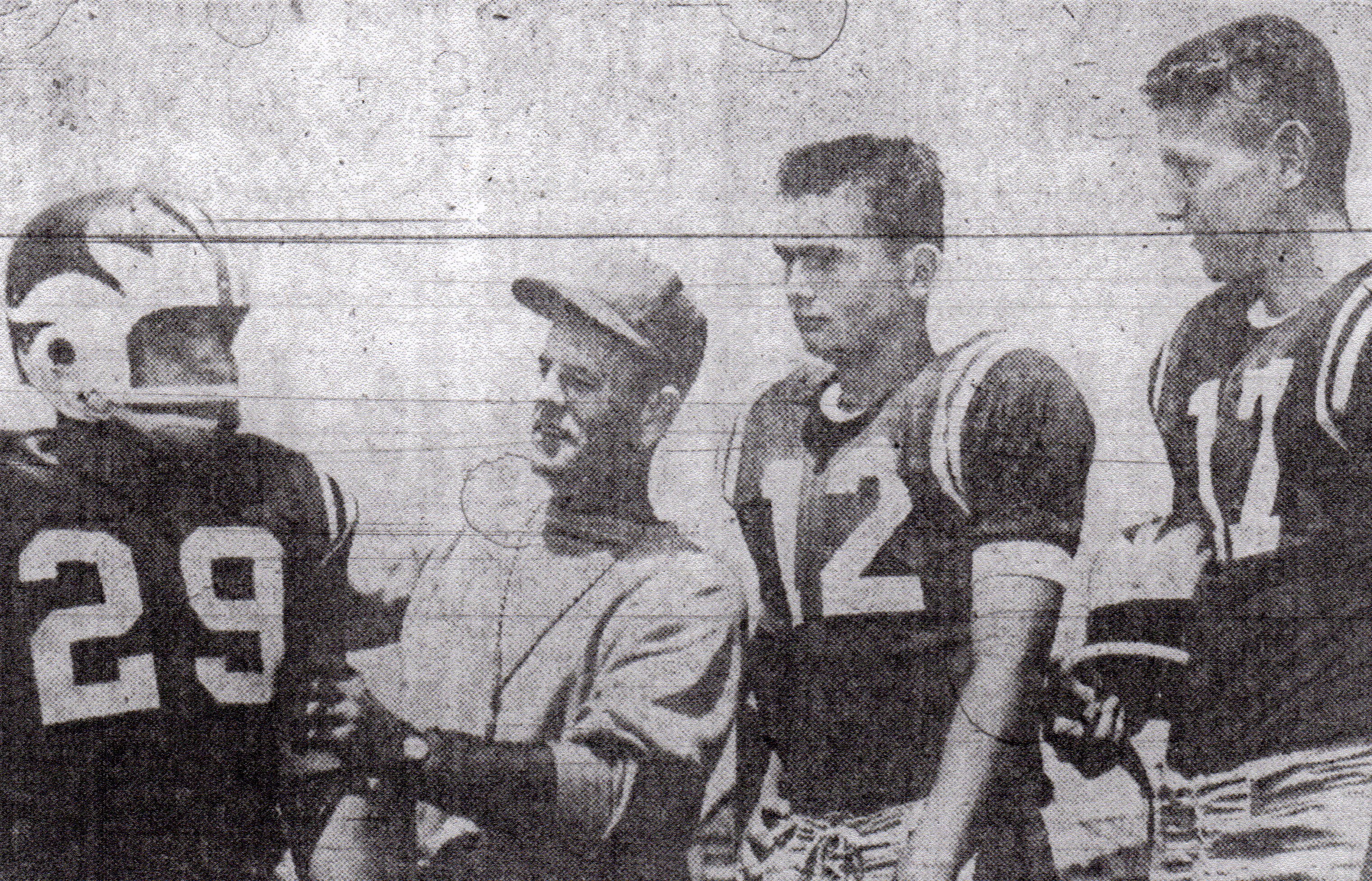
DeVore conducted on-field chalk talk with quarterbacks Terry Weatherford, Pete Kettela, and Jerry Glad (from left). Kettela was No. 1 signal caller and went on to long career as scout in NFL.
THIN MAN
DeVore played all of the sports at Chaffey High in Ontario but, as a skinny 120-pounder at graduation, he decided that football may not be his calling and concentrated on basketball in college.
DeVore was a member of the San Diego State team that won the National Association of Intercollegiate Athletics championship in Kansas City in 1941.
A desire to move on and coach basketball was put on hold after graduation in 1942, when DeVore enlisted in the Marine Corps and fought in the Pacific theater in World War II.
BATTLEFIELD HONOR
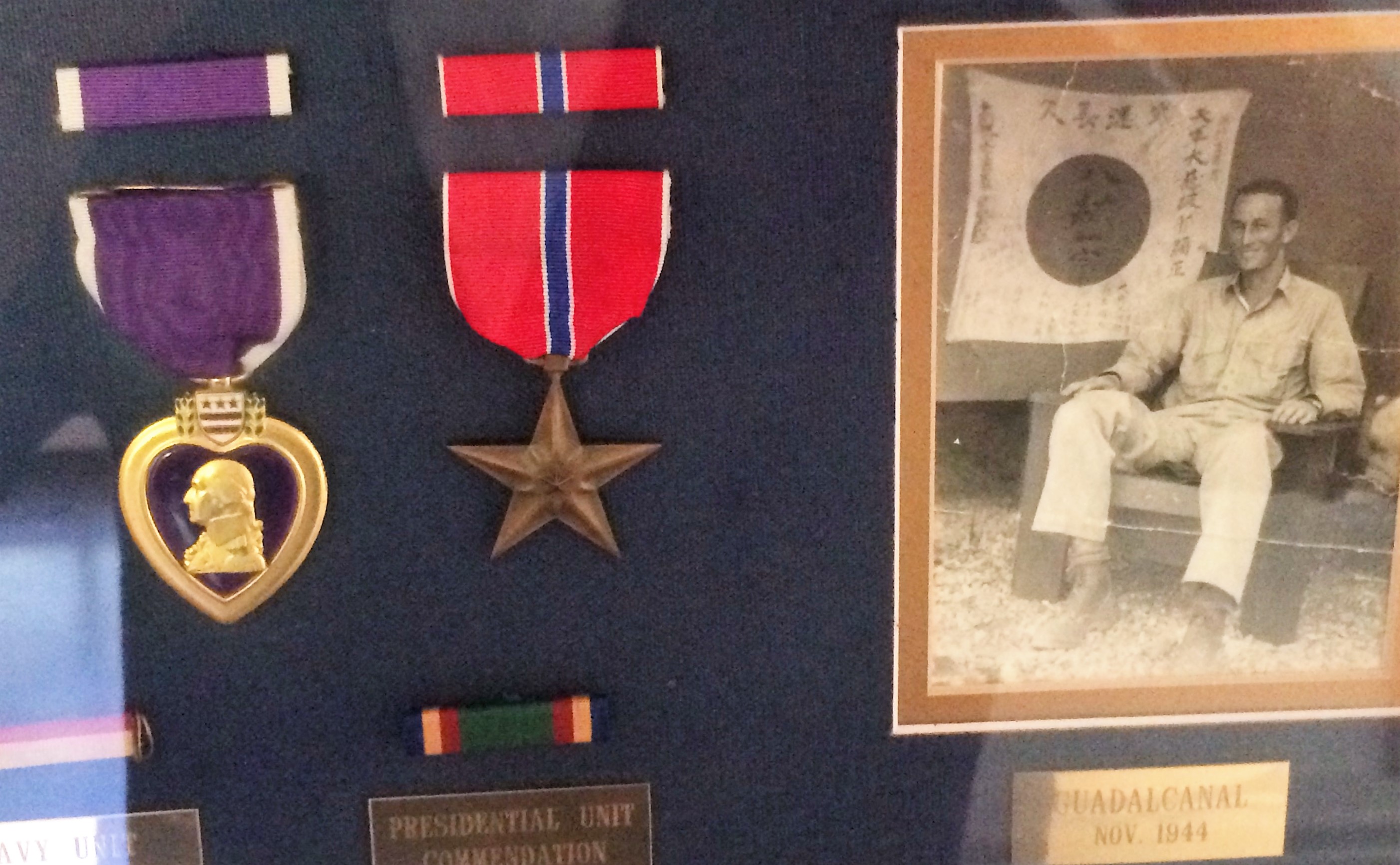
DeVore was awarded the bronze star at Okinawa and Purple Heart at Bougainville.
According to the Bronze Star citation, in part, “Capt. DeVore, as intelligence officer for the (Sixth Infantry) battalion, displayed exceptional ability and courageous conduct during the entire Okinawa campaign.
“On 27 April 1945 he personally trailed a large number of enemy troops in the dense, weeded country north of Tiara so efficiently that on 28 April 1945 he was able to lead the battalion to their (enemy’s) position.
“(DeVore’s) initiative and brave actions in this instance were responsible for the successful attack on the enemy in which approximately one-hundred and fifty of them were killed and the battalion suffered only minor casualties.
“On Oroku Peninsula and again on the Southern end of Okinawa (DeVore) efficiently established forward observation posts from which much valuable information was obtained, although (DeVore and his men) often were under heavy enemy fire.”
DeVore was awarded purple heart and bronze star in World War II. Courtesy, DeVore family.
Discharged from the Marine Corps in 1946, DeVore began teaching at Southwest Junior High in Nestor and a year later was appointed varsity basketball coach by Rindone at the new Chula Vista High.
The hoops mentor was 67-58 in six seasons, including two Metropolitan League championships, one tie for first, and a Southern California small schools title in 1950-51, the program’s third season.
SLOW START
Chula Vista was a combined 13-23-1 in its first four football seasons under Gordon Cox and Morris Shepard. When Shepard left to pursue advanced education at San Diego State, Rindone turned to DeVore.
DeVore told Jim Trinkle of The San Diego Union that he wasn’t underestimating his qualifications for the job when Rindone called.
“We won four, lost four, and tied one that first year and that was the best showing a Chula Vista team had made since the school opened in 1947.
“I can see now though that we might have won the championship that year if I had known some of the things I learned later.”
DeVore pointed out that “Anybody can tell you it’s suicide to change formations after the start of the season, but we did it in ‘fifty-one.
“We started out with the double wing, lost our first two games and then switched to the T. We finally got going late in the season and won our last three straight (Editor’s note: sandwiched around a 6-0 loss to 8-2 Coronado).”
Chula Vista won its 24th consecutive home game, 40-0 over La Jolla, which has seven defenders in photo but can’t stop Ross Provence from touchdown. Victor Graham is Viking closest to Spartan runner.
PLAYOFFS THEN CHAMPIONSHIPS
The Spartans program was rolling.
Chula Vista won its first Metropolitan League title in 1952, dropped a first-round playoff to Laguna Beach, and then won consecutive Southern California Southern Division (of two CIF small schools groups) championships.
Graduations claimed most of DeVore’s 1954 squad but Chula Vista had gotten into the habit of reloading instead of rebuilding.
The Spartans also were moving up in class.
They outscored eight straight opponents, 247-34, and were aligned in the 16-team Central Group (large schools) playoffs.
San Diego High was too much for the Spartans, but DeVore’s .856 winning percentage set a record for San Diego County coaches (minimum of 50 games).
The record still was intact well into the 21st century.
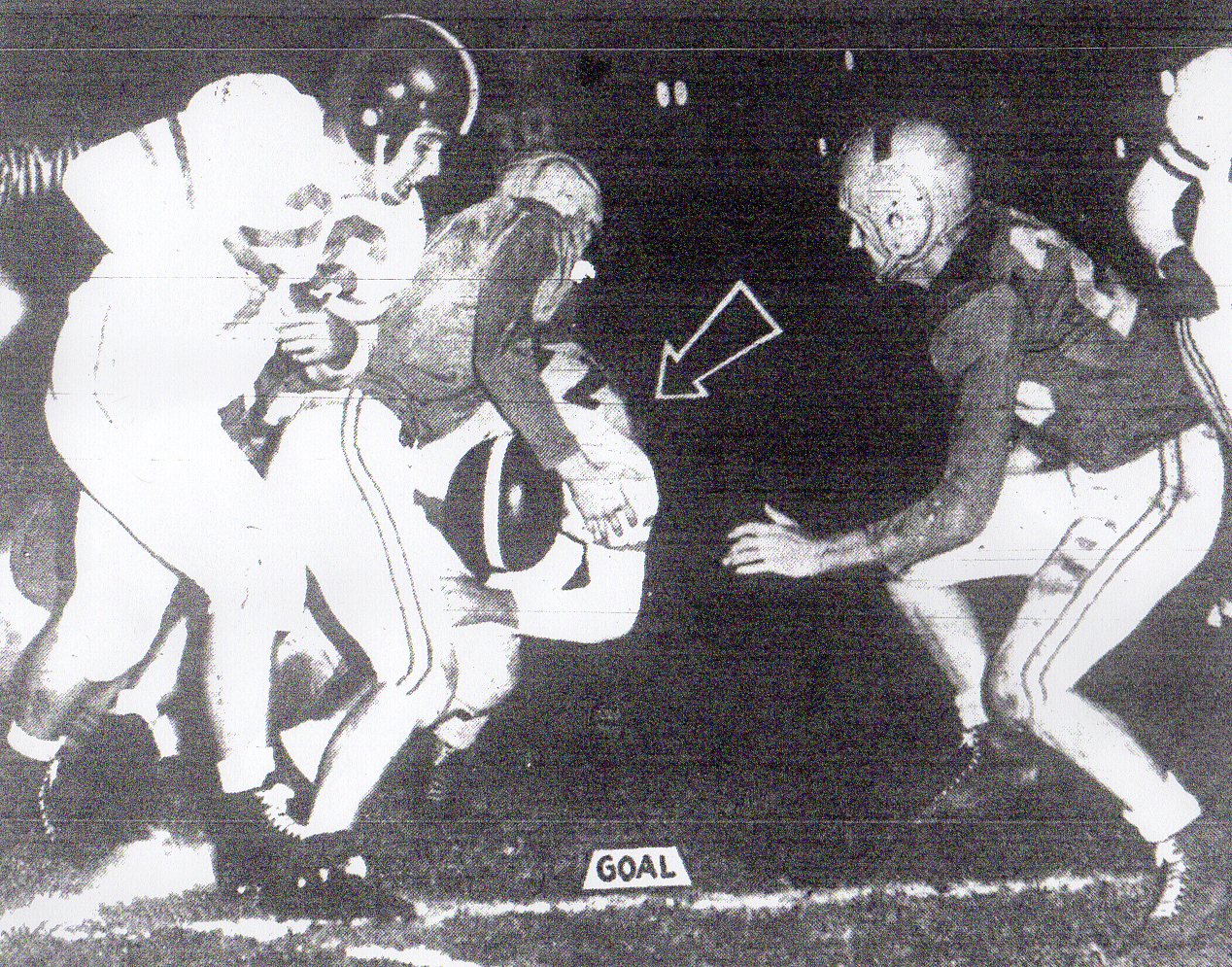
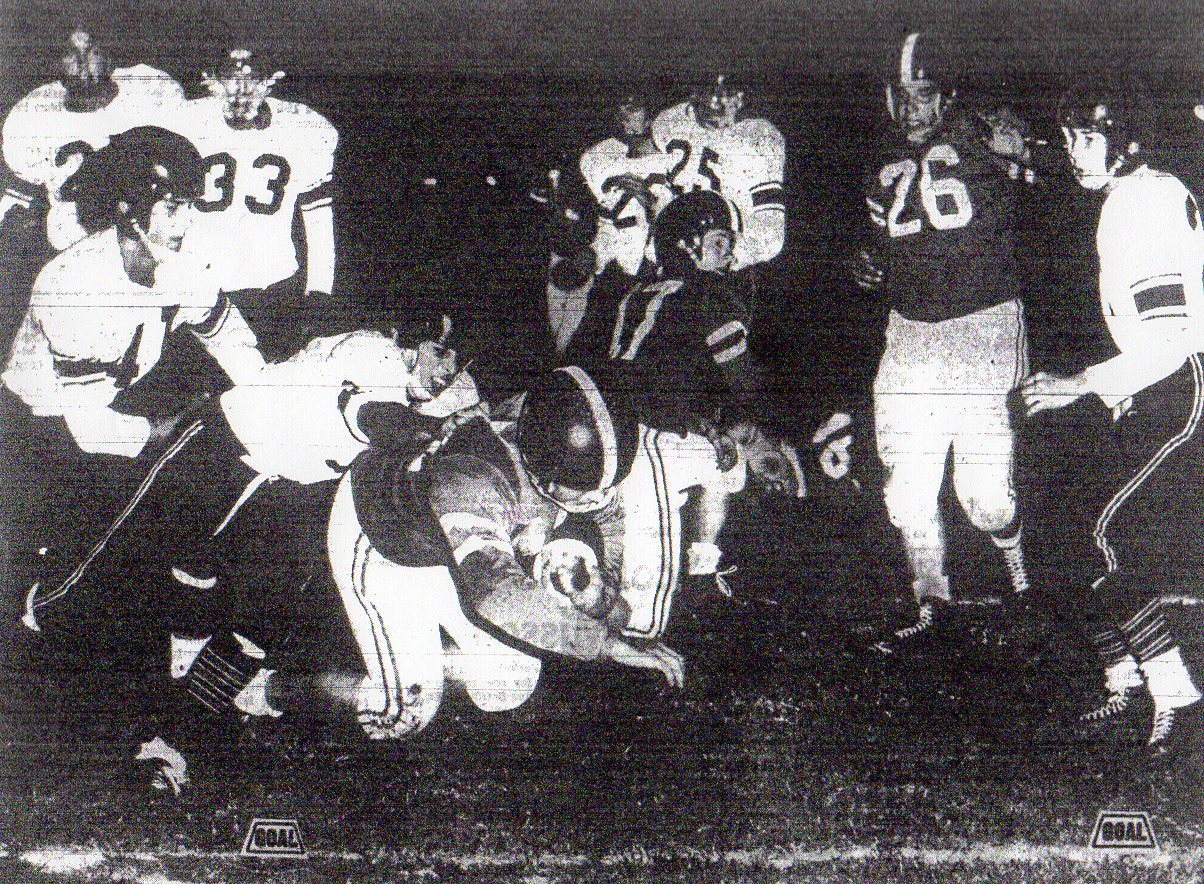
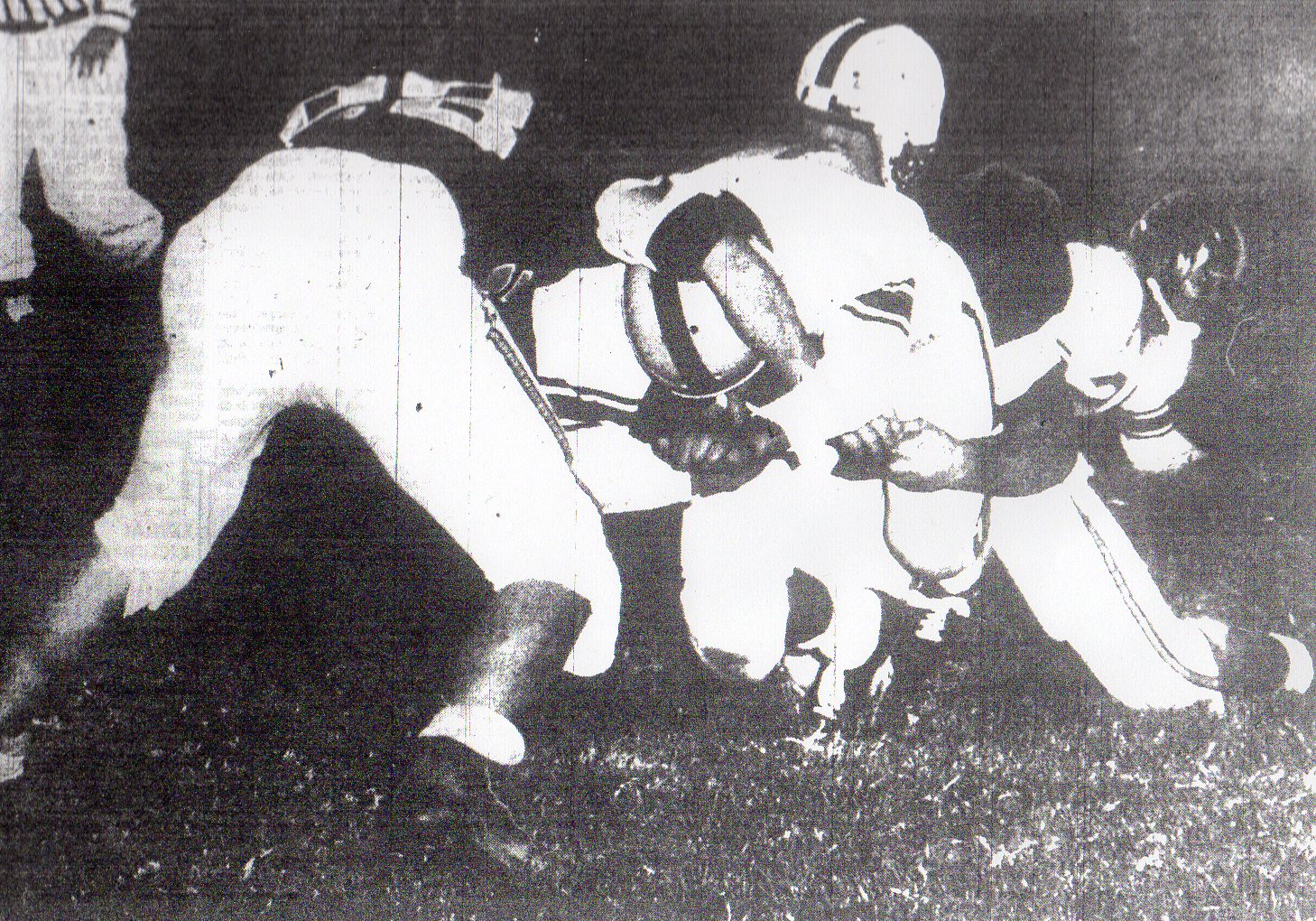
St. Augustine’s Alex Hurtado plows into El Cajon Valley defender Dick Magoffin while in grasp of unidentified Magoffin teammate. The Saints defeated Braves, 32-0.
NOT A FAN OF SAN DIEGO HIGH
Floyd Johnson, principal at Hoover since it opened in 1930, was retiring at the end of the school year.
Johnson, whose animus toward San Diego High was increasingly evident over the years, many of which included lopsided football losses, apparently tried to torpedo the Hillers’ chances in the playoffs.
Midway through the season defensive halfback David Grayson and end Luther Hayes moved with their families from the San Diego enrollment area to Lincoln’s.
Johnson, long a regarded figure among Southern Section administrators, complained that Grayson and Hayes should be immediately ineligible at San Diego, now that they lived near Lincoln. City Schools officials did not penalize the Cavers. The players stayed eligible.
Hayes played football and basketball for Lincoln in the 1954-55 school year, transferred to San Diego for track in ’55, and was back on the basketball floor at Lincoln for the ’55-56 campaign.
The story of the Hoover principal’s dislike for the Hillers was related to me by the late Walt Harvey, who played football at Hoover. Harvey also was Lincoln’s first coach.
Second-year Lincoln improved to 3-4-1 behind three-sport star and quarterback Robert Mendoza.
RAMONA, THE BULLDOGS, NOT OPERA
Residents of the mountain community east of San Diego didn’t expect much when Glenn Forsythe arrived in 1954.
The Bulldogs, mired with a sluggish history that included an all-time, 42-60-7 record since 1938, were about to experience stunning success.
Before he left for a journalism teaching position at Reedley Junior College in Central California in 1959, Forsythe was able to get local boys to ditch, or at least postpone, their farming chores and turn Ramona into a “football school.”
Fifty-four of the 96 boys enrolled turned out for football.
The Bulldogs won their first 15 games under Forsythe, 7-0 in 1954, and 8-0 this season. Their unbeaten run ended in a 14-7 loss to Banning in the Southern Section Southern Division playoffs.
Fullback Ernie Trumper was the Bulldogs’ main contributor with 15 touchdowns and 6 PAT.
Trumper was a small schools rarity, invited to play in the Breitbard College Prep All-Star game in 1956.
Forsythe’s Bulldogs became a juggernaut, posting an overall, 42-4 record through 1959.
The coach had previously served as an assistant coach for four seasons at Fallbrook and before that had a 44-10 record as head coach at six schools in Iowa.
HORNETS FRUSTRATED
Lincoln, behind quarterback Bob Mendoza, backs Joe (Grinder) Vinson and Leonard Elston and budding stars Bob Moss, Brad Griffith, Marvin Hudkins, and Leonard Burnett, was touted as a challenger for the City Prep League championship in preseason accounts.
Reality was another factor. The 49th Street team, in its second varsity season, finished 3-4-1.
San Diego reduced Lincoln’s rushing attack to minus 10 yards in a 19-0 victory and Hoover overcame the fog and a 20-14 halftime deficit to defeat the Hornets, 34-20.
Most galling defeat was at Point Loma. Lincoln was struck with a 15-yard penalty that put the ball on its one-yard line in the final seconds.
Chula Vista’s Anton Bush executed a block on Grossmont defender 65 yards beyond the line of scrimmage in Spartans’ 46-0 victory.
Point Loma scored a tying touchdown on the next play as the game ended, and kicked the PAT for a 7-6 victory.
The Hornets earlier took a 6-0 lead but were penalized when one of their linemen was flagged for moving before the PAT kick.
Lincoln’s vice principal, George Parry, hurdled a sideline fence when the game ended and charged referee Bill Raaka in the middle of the field.
No blows, but strong words were exchanged.
THE SEASONAL SHROUD
Fog made its annual late-November appearance and dominated Chula Vista’s 13-6, Metropolitan League title-clinching victory at Helix.
“We have learned that Chula Vista has scored but missed goal and now leads, 6-0,” was the announcement by Helix stadium public address Bob Divine, who doubled as the Highlanders’ basketball coach.
The Spartans had scored their touchdown several minutes before Divine’s pronouncement.
“I’ve never felt more helpless in my life,” said Chula Vista boss Chet DeVore.
”When the ball was on the Helix side of the field, I couldn’t tell you how many men we had out there, what down it was, or anything that was happening.”
DeVore was virtually clueless.
“In the first quarter, one of the kids I had taken out of the game told me we were down on the four-yard line. That was the only way I had of knowing what was going on.”
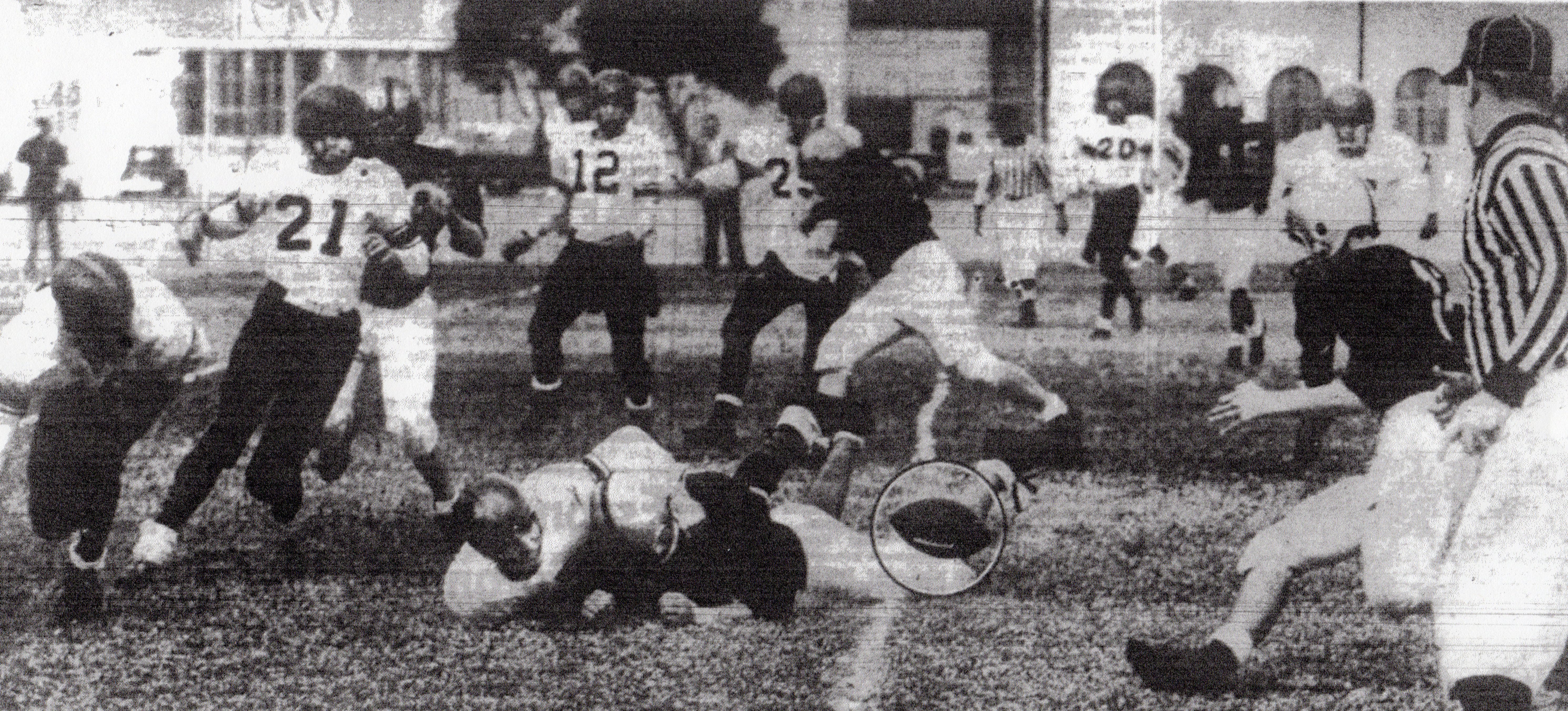
La Jolla’s Buster Mico, one of the 13 players in this photo, tackled Point Loma’s Chuck Moses. who fumbled, but teammate Roy Kennedy (right) recovered. La Jolla was leaving City Prep League football after big losses, including this 33-14 decision to host Pointers.
SIGN OF THE TIMES
La Jolla and Kearny announced they would leave the City Prep League for at least two years in football, because of declining enrollment and (not said), one-sided losses.
The rise of Mission Bay robbed La Jolla of a strong talent base in Pacific Beach and Mission Beach that was instrumental in the Vikings’ reaching the Southern California finals in baseball in 1953 and the semifinals in football in 1952.
Kearny also felt a pinch from Mission Bay and Federal housing population in Linda Vista was in decline. The large, residential Serra Mesa community to the East was in its infancy. Kearny had played for the City League football championship as recently as 1953.
SAINTS MAKE MOVE
With La Jolla and Kearny bailing, St. Augustine made a formal application for admittance into the City Prep League.
“We have seven hundred male students in the top three grades,” said Fr. John Aherne, school principal. “I feel certain we can field a representative team.”
The Saints had tried to find league representation several times over the years and they were getting closer. They would join the CPL in 1957.
St. Augustine’s last affiliation was with the Los Angeles-area Southland Catholic League from 1945-50.
Oceanside rolled with quarterback Otis foster.
THEY TRIED METRO
St. Augustine and La Jolla had made overtures to the Metropolitan League, but the Metro turned them down and announced that it would go to a round-robin league schedule in 1956 that promised to drastically curtail nonleague opposition.
Some teams would play six league games and others seven. The winner would be determined by won-loss percentage.
The five-team Metro would grow to six with the addition of Mount Miguel in 1957.
SOUTHERN PREP SHAKEUP
Rancho del Campo and San Miguel School joined Julian, Ramona, Brown Military, and Mountain Empire.
Army-Navy left and would pursue independent status.
FARM HANDS
Of the 65 players who turned out for football there was not a single letterman on hand at El Cajon Valley, the third school to open in the East County, siphoning off more than 1,000 students from enrollment-bulging Grossmont.
There were a couple unique players, senior center Don McGoffin and his junior tackle brother Dick.
The Magoffins left school after practice each day and returned home 20 miles distant to milk cows, feed chickens, and perform other duties on the ranch they shared with their parents.
“They don’t mind,”said Braves coach Glenn Otterson. “I talked it over with their parents, who said it was okay for them to play football, as long they got their chores done.”
Chula Vista’s Jerry West is tackled for loss by San Diego’s Willie West.
TRUE GRID
The all-Southern California squad defeated the Los Angeles City team, 23-0, before 6,500 in Balboa Stadium in the Breitbard College Prep game in August…Hoover’s John Adams was one of the winners’ most productive with 84 yards in 10 carries…Bellflower was coached by Walt Hackett, a San Diego Chargers assistant coach from 1962-66…Point Loma’s rookie head coach, Bennie Edens, had been on the coaching staff of Don Giddings’ since 1949 and was the Pointers’ baseball coach from 1951-54…Tom Carter, new mentor at St. Augustine, played football at Los Angeles Cathedral, was a quarterback at Notre Dame, and coached at Cincinnati’s Bishop Elder and at Santa Ana Mater Dei…La Jolla coach Frank Smith said his squad had only six players who weighed at least 150 pounds…Evening Tribune writer Jerry Brucker noted that La Jolla had brothers Clyde and Doug Crockett, but probably also could use Davey…
2016 Week 16: Country Day Plays NFL Schedule
La Jolla Country Day will set a San Diego Section record tomorrow evening when it plays visiting Oakland McClymonds in the State Division V-A finals at 6 p.m.
The championship will mark the 16th game, the length of a regular NFL season, for the Torreys since the since the start of the season.
Madison and Santa Fe Christian were the first teams to play 15 games in 2013.
‘Day, unlike previous state finalists, did not have a bye in the first round of the San Diego Section playoffs, having to play 4 games instead of 3.
The Torreys (12-3) were seeded fifth in their division in San Diego after finishing third in the Coastal League and on the short end of decisive losses to The Bishop’s, 37-21, and Santa Fe Christian, 49-21.
Cal-Hi Sports, which uses the eye test to rate teams and make predictions, and CalPreps.com, which is computer generated, see strength in the San Diego Section’s four entries this weekend.
DIVISION I-AA
Cal-Hi Sports, which is located in Stockton, the same city as St. Mary’s High, goes with its local team over Cathedral.
Cal-Hi predicted a 35-28 victory for St. Mary’s. CalPreps chose Cathedral by a score of 34-33.
Despite favoring the Dons, CalPreps’ computer gives St. Mary’s a 73.0 rating to Cathedral’s 68.2.
Cathedral’s rating is the highest of any local team in one of the upper divisions since San Diego Section teams began competing in 2007.
The Tyler Gaffney-led Cathedral team of 2008 defeated St. Mary’s, 37-34, in D-III and had a CalPreps rating of 55.2 to 43.2.
DIVISION II-AA
Both experts pick 12-2 Madison (57.2) over 13-1 San Jose Valley Christian of the Central Coast Section (55.4), 29-21 by Cal-Hi and 27-21 by CalPreps.
DIVISION III-A
Cal-Hi picks 13-2 Oakdale (44.9) of the Sac-Joaquin Section, 28-21, over 14-0 The Bishop’s (48.5). CalPreps picks The Bishop’s, 28-27. Oakdale, near Stockton, travels 430 miles to meet the Knights at La Jolla High.
DIVISION V-A
McClymonds, the school that turned out basketball icon Bill Russell and baseball Hall of Famer Frank Robinson, among many others, will bus 482 miles to meet La Jolla Country Day on the Torreys’ home field.
12-3 ‘Day (27.0) is picked to defeat 12-1 Mack (29.9) by a 55-48 score by Cal-Hi. CalPreps selected the Warriors, 35-28.
Cathedral now is fifth in the state Top 25. Madison finally got off the bubble and now is 23rd after its 60-53, overtime win over Calabasas in the Southern California final last week. Rancho Bernardo (11-1) is on the bubble.
QUICK KICKS
There were no state playoffs from 1927-2007…San Diego High dropped a 17-6 decision to Bakersfield in Balboa Stadium in a state semifinal game in 1922…Oceanside’s 2007 state D-II champion had a 57.8 rating and 57.9 in D-I in 2009…Helix calculated at 64.8 when it topped Loomis del Oro, 35-24, in D-II in 2009…Oceanside had a 62.9 rating when it lost to Folsom, 68-7, in D-I in 2014…Madison’s D-III champion in 2013 had a grad of 43.7…the principal at Stlockton St. Mary’s is Pete Morelli, longtime NFL game referee….
1958: Cinderella Was a Red Devil
An apparent CIF playoff loss by another San Diego-area team loomed when Sweetwater took possession after an Anaheim punt late in the third quarter, trailing in a first-round game, 7-0.
What followed was legend.
What Red Devils quarterback Wayne Sevier remembered, before he passed away in 1999, was “twenty-four plays, eighty-three yards, seven first downs, six measurements, and a flea flicker on fourth and twenty-four.”
What halfback Gilbert Warren remembered years later was the pregame warm-up: “We were on the field when they came out. Their line of players never stopped coming. They must have dressed eighty guys.”
Coach Tom Parker sized up 1958 season with Albert Belmontez, Leslie Pearson, and Wayne Sevier (from left).
What Sweetwater coach Tom Parker told Phil Collier of The San Diego Union after the game: “Anaheim tried to wear us down by platooning. We only have 5 capable substitutes. The amazing thing about the touchdown drive is that the kids didn’t panic.”
What was obvious was the Red Devils were outnumbered and severely lacking in pedigree. Anaheim annually was one of the outstanding teams in Southern California.
The Colonists’ innovative coach, Clare Van Hoorbeke (190-49-10 from 1950-72), may indeed have dressed out players from his varsity and junior varsity. And maybe the sophomores squad.
Perhaps Van Hoorbeke was hoping to invoke some intimidation before an expected victory by the Sunset League power which was 2-0-1 in the postseason against San Diego teams since 1953.
HISTORY NOT ON THEIR SIDE
Warren (second from left) was among essential players with Leslie Pearson, Jerry Hotham, and Art Graham (from left).
Sweetwater had been to the playoffs multiple times in the medieval CIF period of 1922-’26, and then waited 31 years before the 1957 club qualified again and made a quick exit in a 31-7, first-round loss to San Diego.
Anaheim was making its sixth appearance in the eight years since Van Hoorbeke became coach.
But the Red Devils, with pluck and grit, advanced to the next round after a 7-7 tie.
Sweetwater won on a CIF rules tie breaker, having a 14-8 advantage in first downs, similar to 1955, when San Diego moved on after a 20-20 tie with Anaheim.
By Parker’s count, Sweetwater ran 69 plays to Anaheim’s 32, but it played from behind after Rick Sheffler roused the 8,000 La Palma Stadium patrons with a 78-yard touchdown run near the end of the first half.
Quarterback Wayne Sevier, here in a 33-7 win over Mount Miguel, was the Red Devils’ tough, savvy leader.
FROM THE GAME REPORTS
A collection of sportswriters’ notes from The San Diego Union, Anaheim Bulletin, and San Diego Evening Tribune:
The score remained 7-0 until Warren pierced Anaheim’s eight-man line for nine yards to Sweetwater’s 29 on the last play of the third quarter.
As Phil Collier of the Union described, the Red Devils went back to their running game, moving to Anaheim’s 15, but a holding penalty pushed the visitors back to the 30.
At this point, with about five minutes remaining, “The National City club unloaded their secret weapon,” reported the Anaheim Bulletin.
On fourth down and 24 Sevier pitched a handoff to Mike Fogelsong and took off downfield.
The 190-pound Fogelsong was known as the “’Frisco Freight”. An administrative mixup forced Fogelsong to sit out the 1957 season after he transferred from a school in San Francisco.
Fogelsong rolled to his right and then threw a pass across the field to Sevier, who made a leaping catch at the Colonists’ six-yard line.
Game officials signaled for the down marker and chain. The Red Devils made a first down, by inches.
Warren ran three yards to the three, but on the next play Sweetwater was penalized for off-side (false start) and sent back the 8.
Sevier threw incomplete and on third down passed again to Leslie Pearson in the end zone.
Another incompletion but Anaheim’s Glen Herbel was cited for pass interference.
First down, Sweetwater.
Jerry Hotham wedged into the end zone from the one on the next play for a touchdown with about two minutes remaining in the game. Warren held for the point after and Sevier booted the conversion for a tie at 7-7.
Sweetwater held the ball for at least 10 minutes, negotiated at least 80 yards in an unheard of 24 plays, made at least six first downs, with officials’ measurements on almost every one.
Wayne Sevier’s recollection wasn’t exact, but as Gil Warren said of his old friend, “Wayne’s memory was great. He even remembered a pass I dropped.”
Sweetwater was not out of the woods.
Anaheim threatened by advancing from its 34 to Sweetwater’s 28 but quarterback Dennis Vollom’s fourth down pass to the end zone was incomplete.
Ball game.
Mike Fogelsong, a 190-pounder known as the “Frisco Freight”, having transferred from a school in San Francisco, rushed for 70 yards in 10 carries and scored on a 16-yard run in Sweetwater’s 27-7, quarterfinals win over Santa Maria.
CENTRAL COAST POWER
Sweetwater won a coin flip and was awarded a home game for the quarterfinals against the San Luis Obispo League champion Santa Maria Saints, 10-1, with only a 26-14 loss to Bakersfield in their opening game.
Sweetwater principal Allen Campbell correctly called tails in a three-way telephonic hookup with the principal from Santa Maria and CIF commissioner Ken Fagans, the hookup originating at Fagans’ office in Los Angeles.
Santa Maria, which had surprised Santa Barbara, 35-19, in the first round and which boasted 144-point scorer Manuel Jones, was a slight favorite and took a 7-0 lead in the second quarter.
The slow-starting Red Devils stormed back to win, 27-7, as Warren gained 71 yards in 11 carries, caught 4 passes for 51 yards, intercepted a pass, and punted three times for a 33-yard average.
Santa Monica finally halted Fogelsong and Red Devils on foggy night.
VIKINGS SAIL TO WIN
Sweetwater was given another home game for the semifinals against 10-0-1 Santa Monica, a tradition-laden powerhouse that had been the home team for its first two postseason victories.
The Red Devils now were hailed as the Cinderella team of the playoffs, a surprising survivor to the Round of 4, especially in light of San Diego’s early departure in a 26-18 loss to Long Beach Poly.
Principal Campbell ordered temporary bleachers at Hudgins Field and almost 7,000 persons jammed the National City campus.
Santa Monica quickly moved to put an end to Sweetwater’s fairy tale hopes.
The Vikings raced to a 28-7 halftime lead and were ahead, 34-7, in the third quarter as writer Phil Collier described a “grass-level fog” that enveloped the field.
The beach city squad kept the Red Devils at a distance, winning, 34-20, amid the echoes of the Vikings’ cheering squad.
“Push ‘em back! Push ‘em back! Push ‘em back to TJ, to TJ!” exhorted the Santa Monica yell leaders.
Tijuana, in Baja California, Mexico, was about 14 miles south of the Sweetwater campus.
ANOTHER BIG GAME
Sweetwater’s drive to the Metropolitan League championship went through Escondido, where the host Cougars had won 22 straight regular-season games and shown no falloff after exiting the weaker Avocado League.
Ralph Inzunza’s fourth-quarter pass interception and five-yard return at 7:15 and with his team trailing, 14-9, positioned Sweetwater for a six-play, 71-yard touchdown drive that overcame the Cougars, 16-14, before an overflow crowd of 5,500 persons.
Gilbert Warren led the Red Devils with 70 yards in 13 carries, caught 4 passes for 81 yards, punted four times for a 31.5 average, and returned an intercepted pass 51 yards with 3:04 left in the game to preserve the victory.
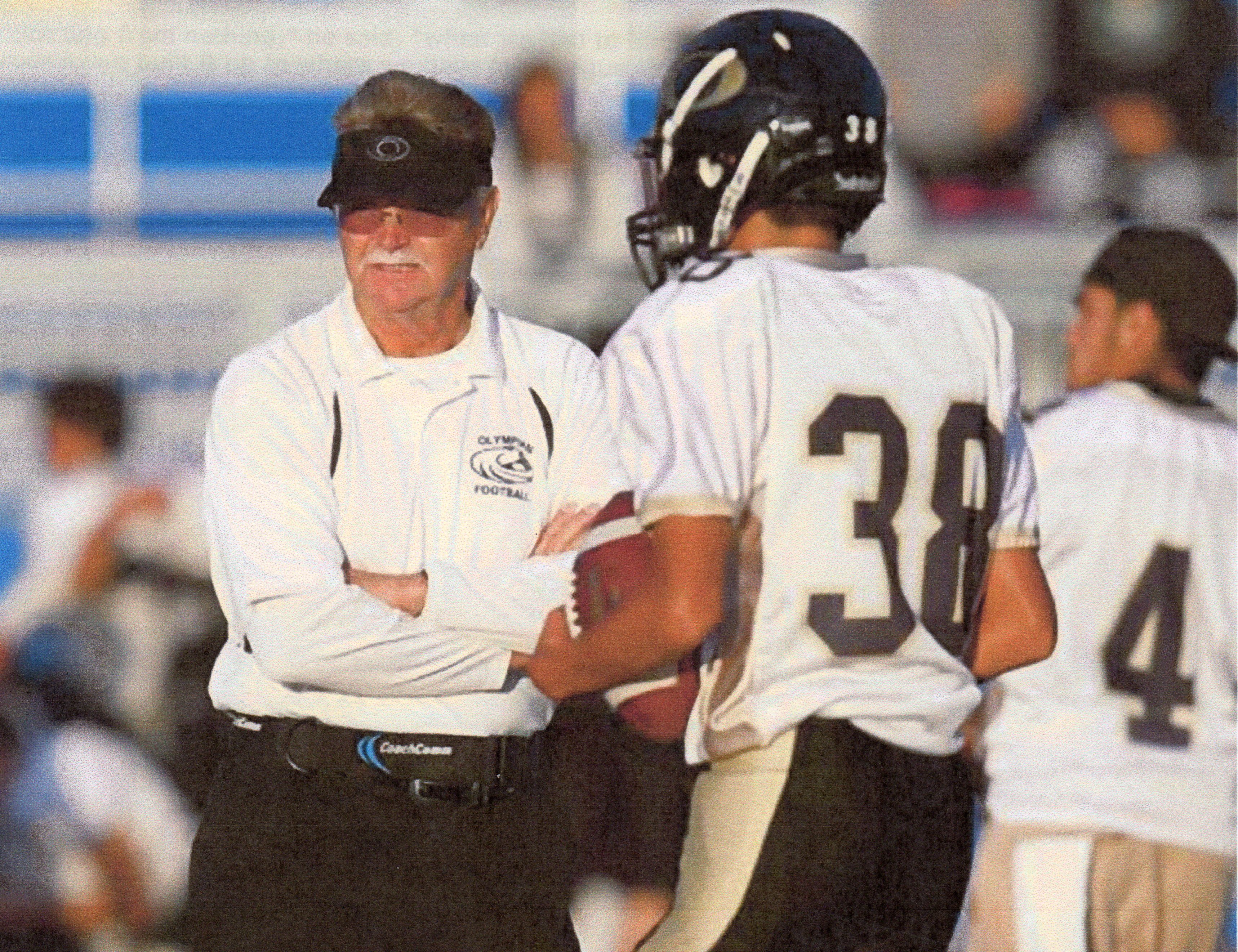
Warren concluded remarkable coaching career at Olympian 2012.
FUTURE COACHES
Wayne Sevier and Gil Warren and Red Devils teammate Joe Meeker played on coach Don Coryell’s first San Diego State teams in 1961-62 and each was bent on a coaching career.
Sevier was head coach at Sweetwater in 1965-66 and a special teams coach for the St. Louis Cardinals, Chargers, Redskins, and Los Angeles Rams in a 25-year NFL career.
Warren coached 28 seasons at high schools in the South Bay, winning championships in 1968, ’94, and ’96 at Castle Park. Warren’s 216 career victories ranked fifth all-time in San Diego County.
TRUE GRID
Sweetwater had 14 first downs to Santa Monica’s 13 and outgained Vikings, 290-218, although the visitors had 206 yards rushing to the hosts’ 96…Mike Fogelsong gained 71 yards in 15 carries against Anaheim…the stats were as close as the score…the Red Devils rushed for 162 yards and passed for 50…Anaheim had 186 yards rushing and 25 passing, Sweetwater holding a 212-211 advantage…Tom Parker was 38-24-4 as head coach from 1954-60…”Tommie” Parker was a halfback at Hoover in 1942, played at San Diego State, and also served as trainer for the annual summer College Prep All-Star game in San Diego…Sweetwater’s 21-7 victory was Claremont’s first regular-season loss in four years…the Red Devils voted to work out Thanksgiving Day instead of taking a holiday before the Anaheim game…Parker was almost prescient before the contest with the Colonists: “We have a chance against this club, a good chance, if we play to our maximum potential. Anything less than that won’t be good enough”….Wayne Sevier, Mike Fogelsong, Gil Warren, Joe Meeker, Max Freetley, Leslie Pearson, Ron Grimes, David Hoffman, Larry LeGrand, Jim Arnout, Jerry Hotham, and Albert Belmontez were Sweetwater’s regulars…the “capable” replacements Art Graham, Richard Clifton, David Nenow, Ralph Inzunza, and Jim Feeler, rounded out the Red Devils’ essential 17-man playing roster…
Unsung Red Devils included Richard Clifton, Art Graham, Dave Hoffman, and Ralph Inzunza (from left) when not cracking the books.
2016 Week 15: Cathedral Unanimous in Final Grid Poll
Cathedral, Madison, Mater Dei, and The Bishop’s comprise four of the final Top 10 selections in the weekly Union-Tribune poll and will begin quests for state championships this week.
Cathedral was a unanimous choice as No. 1, earning first-place votes from all 27 panelists.
La Jolla Country Day, which finished out of the Top 10 but received points in the poll, and Horizon also are in the state playoffs.
It’s great that San Diego Section teams can continue on after the local championships, but it’s a stretch that Horizon, which gave up 75, 63, and 66 points on three successive weeks in the regular season, is part of the possible elite.
That Horizon revived itself and won its last four games and won the San Diego Division V with a 7-6 record is testimony to the Panthers’ ability to regroup.
Horizon climbed to the top of its San Diego Section division despite the distraction caused by the school’s losing its lease at the old Hale Junior High site in Clairemont and will be relocating next school year.
First-place votes in parenthesis.
Points on 10-9-8-7-6-5-4-3-2-1 basis.
Rank
Team
W-L
Points
Last Week
1.
Cathedral (27)
13-0
270
1
2.
Madison
12-1
234
5
3.
Helix
10-3
221
3
4.
Mater Dei
12-1
188
4
5.
Rancho Bernardo
11-1
148
2
6.
St. Augustine
10-3
146
6
7.
The Bishop’s
13-0
99
10
8.
Torrey Pines
8-3
36
7
9.
Mission Hills
7-5
35
NR
10
Poway
10-2
34
8
Others receiving votes: Olympian (8-5, 29 points), Grossmont (9-2; 27) La Jolla Country Day (11-3; 14), Christian (12-1; 9), Oceanside (8-3; 7), Valley Center (10-2, 4), Valhalla (8-3, 1).
Twenty-seven sportswriters, sportscasters, and other representatives comprise the voting panel:
John Maffei, Union-Tribune. Terry Monahan, Don Norcross, Tom Saxe, Rick Hoff, Jim Lindgren, Union-Tribune contributors. Paul Rudi, Brandon Stone, Rick Willis (KUSI Chl. 51). Michael Bower, Pomerado News. Lisa Lane, Fox 5 News. Montell Allen, MBA Sports-SDFNL Magazine. Brandon Stone, Rick Willis, KUSI, Channel 51. Adam Clark, Ted Mendenhall, Taylor Quellman, The Mighty 1090. Steve (Biff) Dolan, Mountain Radio 107.9 FM. Bob Petinak, 1360 Radio. Bill Dickens, Adam Paul, Chris Davis, eastcountysports.com. Bodie DeSilva, sandiegopreps.com. Drew Smith, sdcoastalsports.com. Raymond Brown, sdfootball.net. Rick Smith, partletonsports.com. Steve Brand, San Diego Hall of Champions. Jerry Schniepp, John Labeta, CIF San Diego Section. John (Coach) Kentera, Prep Talent Evaluator.
SOUTHERN CALIFORNIA MATCHUPS
Concord De LaSalle (11-1) and Bellflower St. John Bosco (12-2) have byes gthis sweek and will play for the state Open Division championship in Sacramento next week.
Thefre are twelve other division titles to be determined. Those divisions with AA designations are considered to be strongest.
DIVISION I-AA
Cathedral, sixth in Cal-Hi Sports‘ Top 25 and 13-0, gets a home game in one of the playoffs most enticing matchups, against 13-0 Harbor City Narbonne, ranked fifth by Cal-Hi Sports and the Los Angeles City Section champion.
Winner will meet the survivor of the Northern 1AA contest matching Stockton St. Mary’s (13-1) and Oakley Freedom (11-1). St. Mary’s only loss was 55-16 to St. John Bosco and Oakley dropped a 42-7 decision to De La Salle.
II-AA
Madison, a Cal-Hi bubble team with 11 wins and losses to Vista Murietta and Cathedral, has a home game against 14-0 Calabasas, a Los Angeles Times-ranked squad from the Southern Section.
Madison or Calabasas will get either San Jose Valley Christian (12-1) or Santa Rosa Cardinal Newman (12-1) . Valley Christian’s only loss was 13-10 in overtime to Mountain View St. Francis. Newmie was a 49-32 loser to St. Mary’s.
III-AA
Mater Dei, 12-1 with only a 51-42 loss to L.,A. Hawkins, travels to Antelope Valley Junior College to play Lancaster Paraclete (10-4). Atherton Menlo-Atherton (11-2) or Manteca (12-1) will come out of the North.
III-A
The Bishop’s (13-0) is the road at Cerritos Valley Christian (12-2). Winner plays Sutter (13-0) or Sacramento Christian Brothers (12-2).
V-A
La Jolla Country Day (10-3) is home to El Monte Arroyo (12-1) with the winner moving on to meet Oakland McClymonds (12-1) or East Nicolaus (13-0).
VI-A
Horizon (7-6) travels 286 miles for its game against 13-0 Strathmore. A survivor of a play-in game between Stockton Brookside Christian and Biggs will play Vallejo St. Patrick-St. Vincent for the Northern title.
Strathmore is a community of about 2,800 persons near Tulare, about 19 miles East of Highway 99. Horizon has about 5 1/2-hour ride to its game.