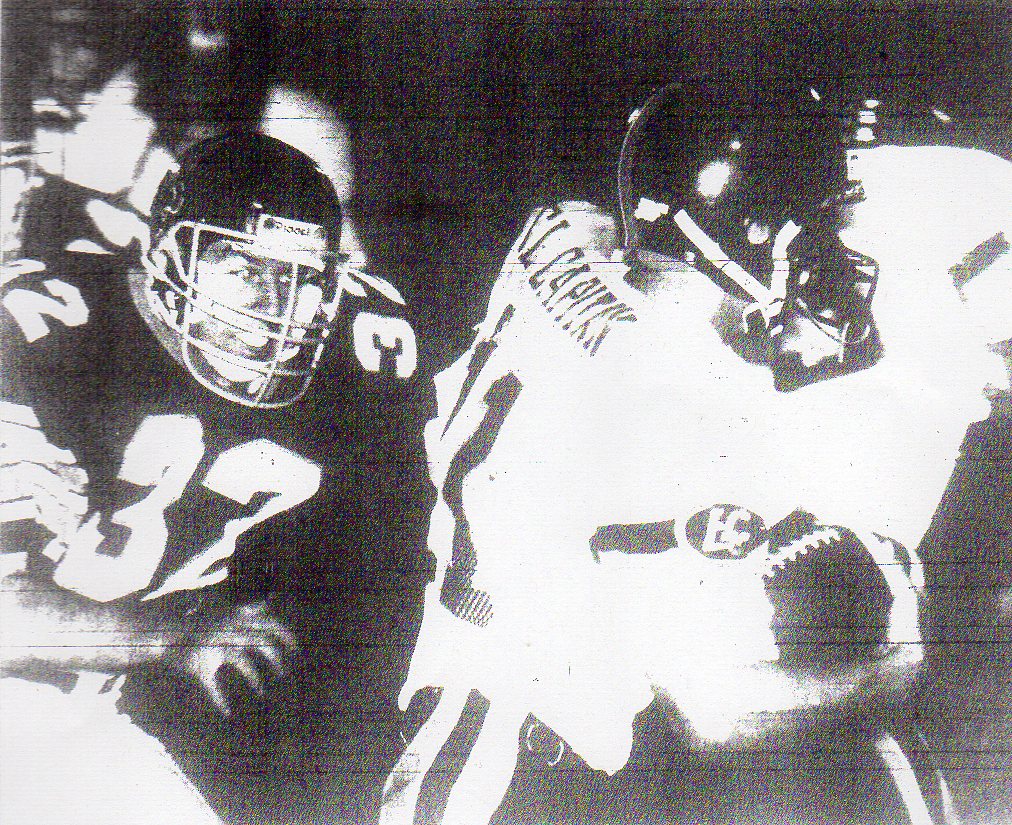
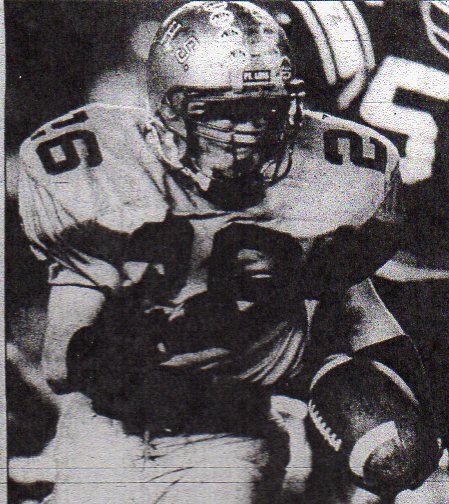
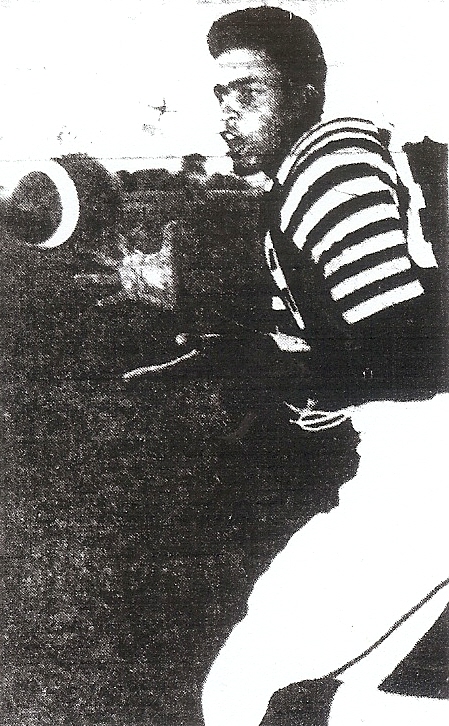
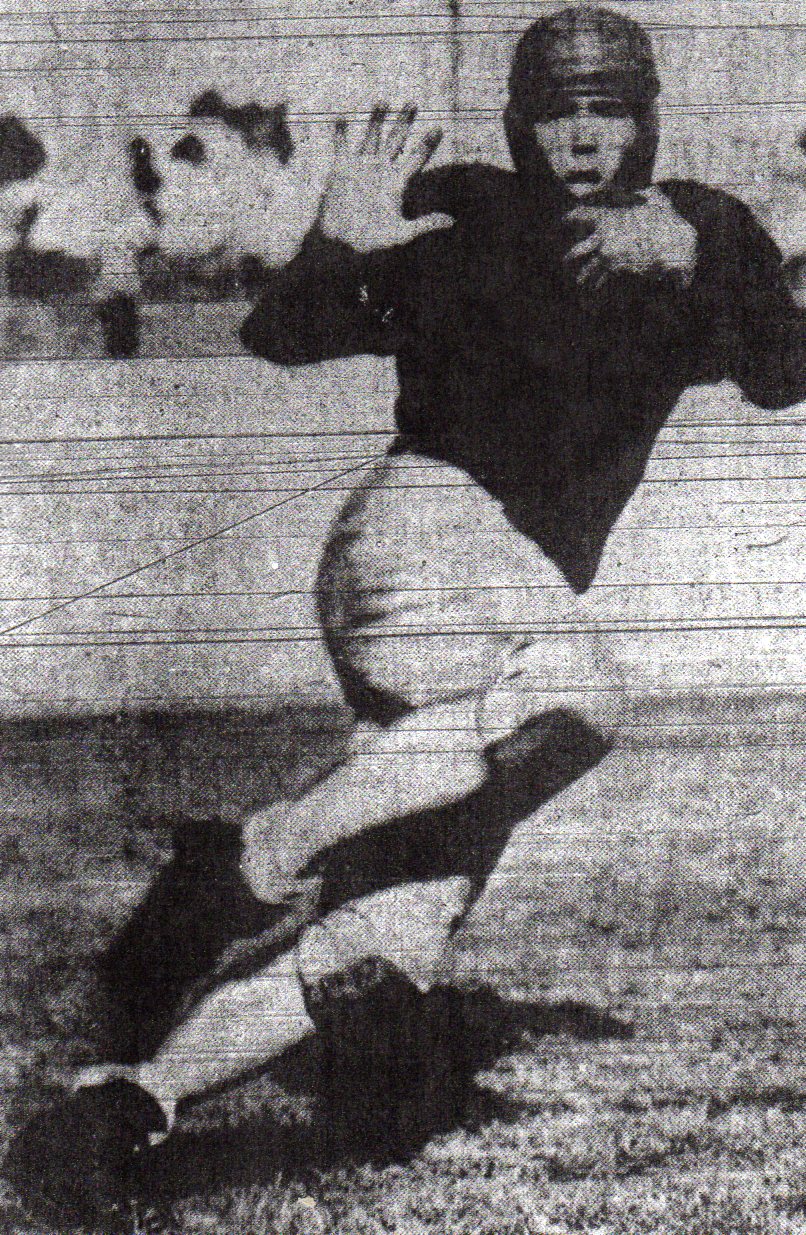
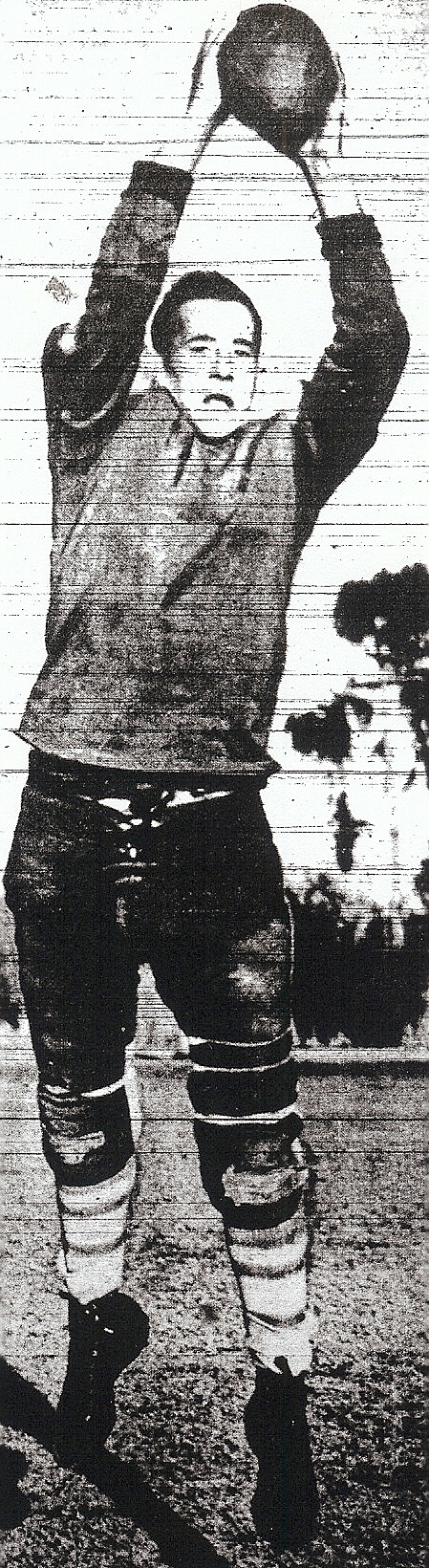
Fullback Eddie Silva, who passed away recently in San Diego, where he was born, was the leading scorer in the County in 1949 and Point Loma won a championship.
Silva and Marshall (Scooter) Malcolm were touchdown twins for coach Don Giddings’ squad, which posted a 9-1-1 record and rolled to the Southern California minor division championship.
Silva scored 13 touchdowns and 78 points in 11 games. Malcolm added 11 touchdowns as the Pointers raced through the Metropolitan League, stopping only for a 13-13 tie with rival La Jolla.
Point Loma then swept through the playoffs, defeating San Dieguito, 48-7, San Jacinto, 42-12, and Bonita, 27-13. Silva scored 4 touchdowns in the three playoff games.
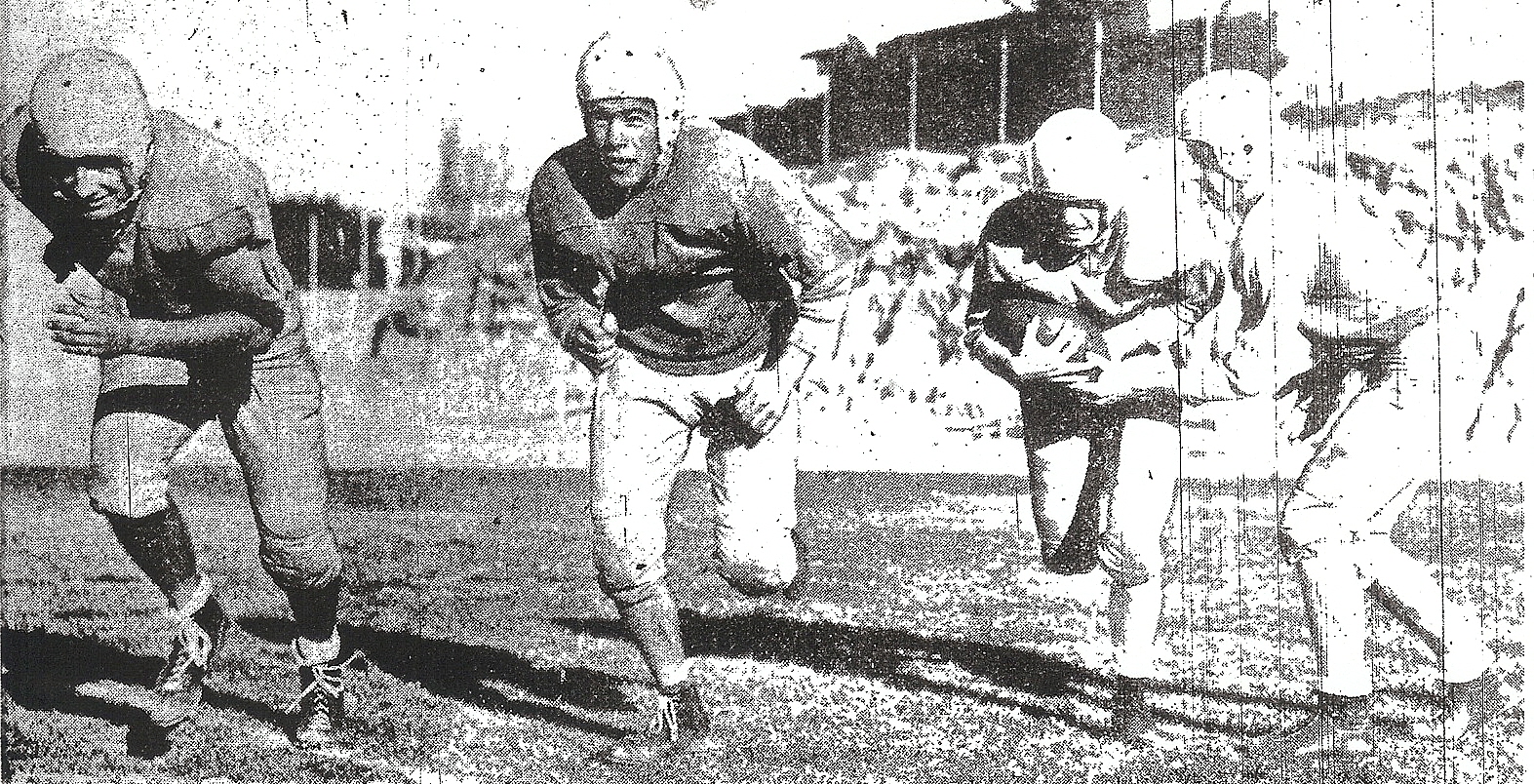
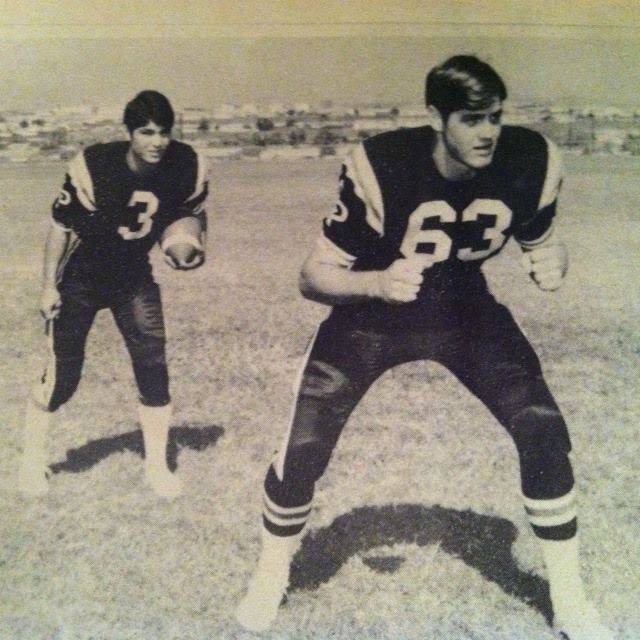
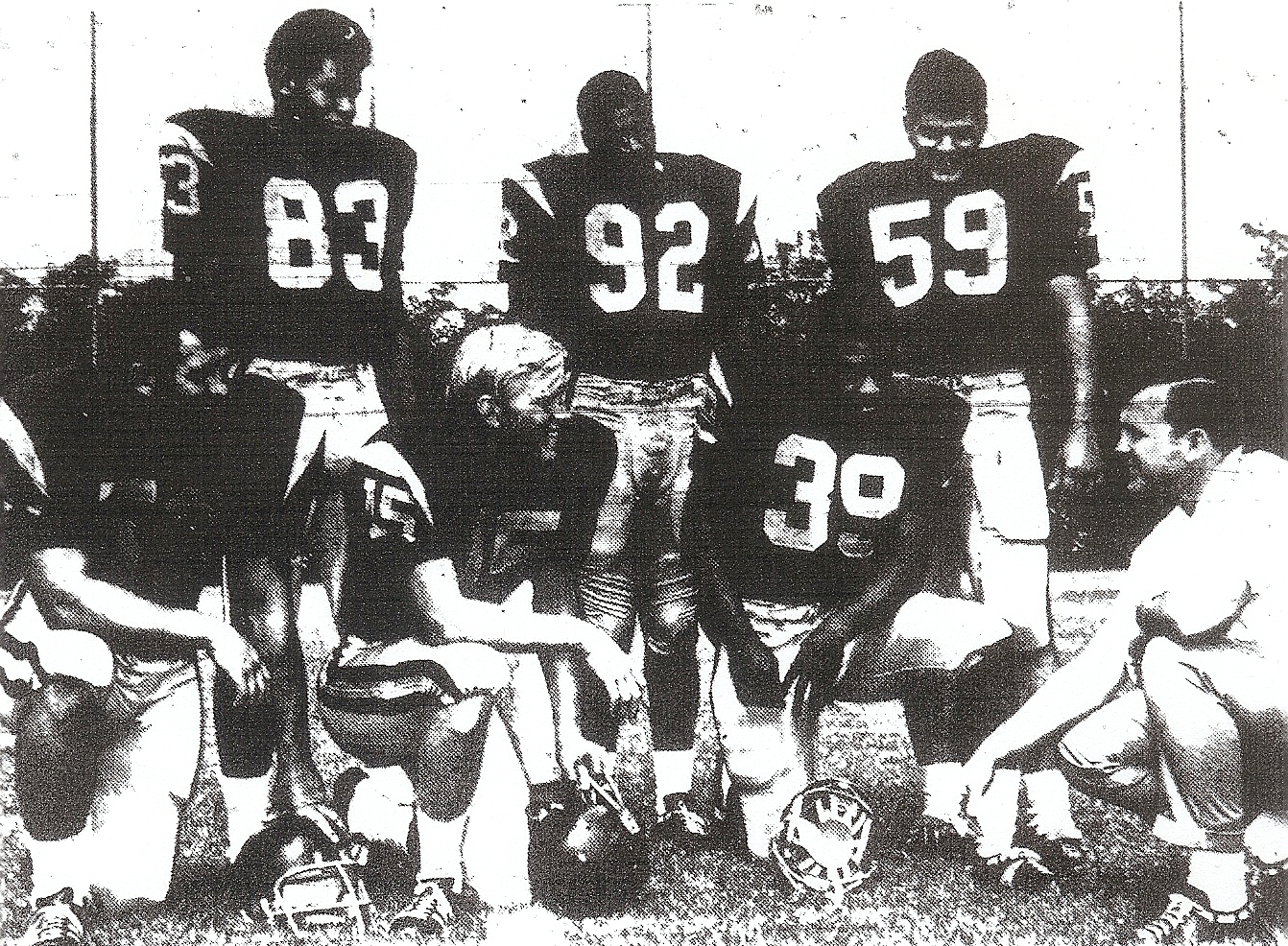
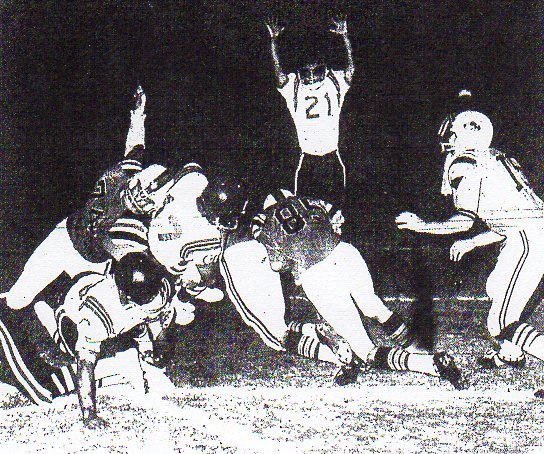
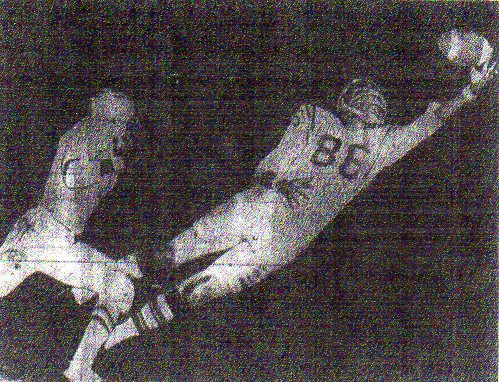
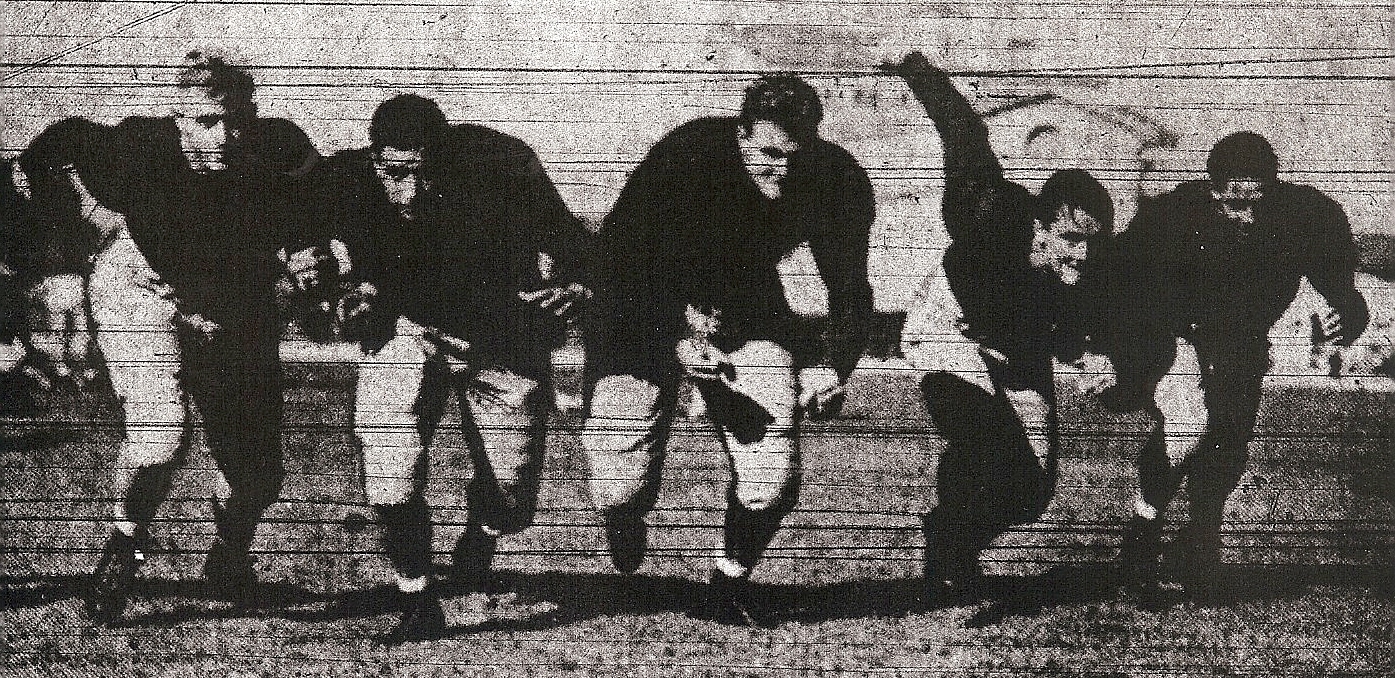
Point Loma scored 330 points, with Ed Perreria, Silva, Marshall Malcolm, and Jim Dible (from left) providing impetus.
The Pointers’ only loss was 28-13 in the season opener to San Diego. Silva scored one touchdown and passed to Malcolm for the other in that game.
Silva scored twice as Point Loma beat Oceanside, 26-6, in its Metro League opening game and his 50-yard dash opened the scoring for the Pointers in a 47-7 win over Kearny.
After a 27-0 victory over Coronado, Giddings spoke of his deep, talented team’s two-platoon system: “Each player can concentrate his talent on either the offensive or defensive phase of his position. For this reason, twenty-two first-string players are twice as happy and fresh as eleven.”
Gene Earl of The San Diego Union offered an enthusiastic endorsement:
“The Pointer backfield of quarterback Jim Dible, backs Marshall Malcolm and Ed Perreira, and fullback Ed Silva, rolls like a well-oiled gyroscope, never a miss as they repeatedly reverse the pigskin three times from the single wing formation before stepping through the yawning holes opened by the Lomans’ forwards.”
Silva earned all-Metropolitan League and all-Southern California honors.
2014: McFadden’s .735 Third Highest
John McFadden’s announced decision to step down as head coach at Eastlake leaves nine active San Diego Section coaches with at least 100 victories.
McFadden became the Titans’ head coach in 2000 and posted a record of 120 wins, 42 losses, and 4 ties in 14 seasons.
McFadden’s .735 winning percentage is third only to the active John Carroll of Oceanside (234-74-6, .755) and the late Birt Slater of Kearny (134-41-9, .753).
Duane Maley of San Diego was 97-19-2, .826, from 1948-59, when County schools were in the Southern Section.
Other 100-game winners still listed as active heading into the 2014 season: Rob Gilster (183), Willie Matson (166), Sean Doyle (145), John Morrison (140), Gary Blevins (129), Chris Hauser (115), Matt Oliver (115), Jerry Ralph (111), and Mike Hastings (111).
McFadden’s teams won eight Mesa or South Bay League championships, tied for another, and earned two San Diego Section championships.
His replacement has not been announced but John Maffei of U-T San Diego reported that Lee Price, a longtime assistant at Eastlake, is McFadden’s likely successor.
Price was 6-5 and won the Harbor League championship at Coronado in 1992.
A complete list of 100-game winners can be accessed by linking to “Football” and Coach 100 Club on the drop down menu.
With training camps still weeks away, eight new head coaching appointments have been announced:
NAME
SCHOOL
REPLACED
Drew Westling
Chula Vista
Judd Rachow
Joe Kim
Clairemont
Ron Gladnick
Jon Goodman
Classical
Jon Burnes
John Roberts
El Camino
Pulu Poumele
Tyler Hales
La Jolla Country Day
Jeff Hutzler
Lance Christensen
Otay Ranch
Anthony Lacsina
Jason Patterson
Orange Glen
Kris Plash
Ron Gladnick
Torrey Pines
Scott Ashby
1969: Cavemen Prove Merit With CIF Title Share
The result of the Eastern League’s vote to determine its champion after a three-way tie for first was considered by some so egregious that even the coach of a potential playoff opponent led the shouting.
San Diego High was the selection of the league’s principals after the Cavemen finished with a 5-1 record, same as St. Augustine’s and Patrick Henry’s.
That the Cavemen were in the playoffs for the first time since 1960, following a 2-7 season in 1968, should have been enough for a collective doffing of headwear to Allan (Scotty) Harris.
Harris, a retired major and former coach of the San Diego Marine Corps Recruit Depot team, took over the Cavers’ program in 1968 and the team found its stride after a 2-3 start this season.
San Diego won the renamed City Conference playoffs and went on to tie County Conference titlist Escondido, 21-21, for the AA title, but not before critics, including Kearny coach Birt Slater, were heard, loudly.
REPRESENTATIVES SWAYED?
Pat Tormey, tackled by San Diego’s Charles Burks, and St. Augustine won the first meeting between Eastern League rivals but Cavers prevailed in playoffs.
One complaint was that San Diego’s closing run of victories over Crawford (57-6) and Hoover (56-7) gained too much currency with the league’s voting representatives.
Another was that the Eastern League schools, by choosing the Cavers, “were punishing St. Augustine” for unproven charges of misconduct.
St. Augustine virtually had to shoot its way into the City Prep League in 1957 and some schools still chafed at the Saints’ perceived advantages of recruiting and in eligibility.
The most vocal beef was that St. Augustine’s head-to-head victory over San Diego and the Saints’ superior team statistics were dismissed.
The issue even got the attention of the San Diego Section board of managers, made up of district superintendents or their appointees.
The CIF bosses had been fielding their own dose of criticism from coaches, fans, and media about another subject, the short, two-week football playoff.
The bosses finally extended the postseason one week for the first time this season, allowing the two conference champions to play in a winner-take-all, AA title contest.
The ruling body of the San Diego Section also hung with the Eastern League, citing Article 24 of the CIF bylaws.
The article states…“leagues shall determine their own champions in any way they see fit, provided their methods are not contrary to the rules of the San Diego Section.”
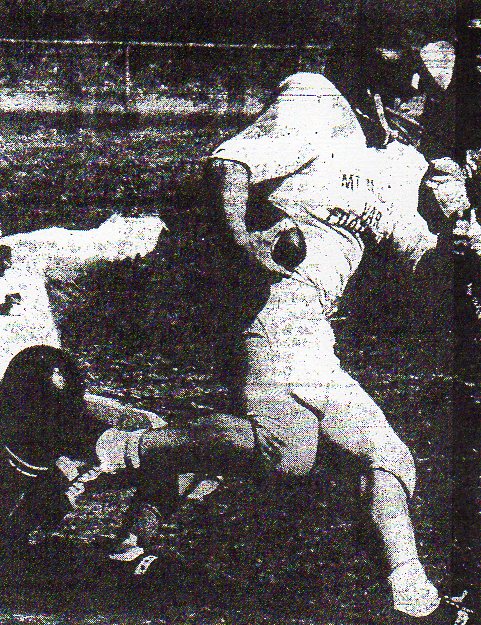
Mount Miguel moved Billy Joe Winchester from guard to fullback. The 200-pounder would set County record for discus throw in the spring.
THREE-WAY LOSSES
San Diego entered the playoffs with a 6-3 overall record and with a 21-14 victory over 6-3 Patrick Henry but with a 24-21 loss to St. Augustine, which was 8-1 and with a 7-0 loss to Henry.
The eight playoff teams, four in each conference, posted a combined record of 62-11.
Escondido (9-0) was the County’s top seed. Kearny (9-0) was the City’s top seed and would play a lower-seeded, at-large team, one that was to be added to the bracket after league winners were positioned.
SLATER CODE RED
Kearny suddenly was forced to the take on at-large St. Augustine in the first round.
Birt Slater fumed. He figured his first opponent would be San Diego, a team the Komets whipped, 21-7, early in the season.
“There is no question which team proved itself this season,” Slater told Bill Finley of the Evening Tribune. “It would (even) have made more sense to choose Patrick Henry than San Diego. At least (Henry) was good enough to beat San Diego.”
Slater compared the San Diego selection to a student who “flunks the first half of the semester, then passes the second half. You don’t give him an ‘A’.”
RURALS DISTRUSTFUL?
Slater veered direction. “The reason we have two separate playoffs (since 1967) is because the County has always distrusted us. This is why.”
The Kearny mentor, a former San Diego High assistant, was referring to a selection process the County felt always favored the city schools.
Birt Slater assailed tardy Eastern League.
Slater, never one to duck controversy, railed that the “democratic” league vote was faulty because “there’s too much self-interest.”
The coach’s solution was a “dictatorship”. He favored allowing CIF commissioner Don Clarkson to select the teams. “He’d be fair and this type of thing wouldn’t happen.”
Kearny was flushed out by St. Augustine, 14-6, and San Diego had the last laugh. The Cavers, behind the thrusts of Robert Jones, cousins Lee and Paul Davis, and Arnold Miller, rushed for 321 yards and ran St. Augustine into a 31-7 submission in the City final.
Four running backs! Shades of the Duane Maley Cavers of the ‘fifties.
The Eastern League had gotten it right.
SEA OF WHITE
Greg Durrant was a fledgling teenager and his parents helped guide Greg’s passion for football, taking the youngster to all 11 Castle Park games.
According to Durrant, citing the Castle Park Trumpet newspaper, the Trojans were the first high school team in the country to be outfitted with white shoes, joining the pros’ Joe Willie Namath and Fred (The Hammer) Williamson as history makers of this color footwear.
When Castle Park came out on the field for the pregame warmup before their kickoff against Morse, the Trojans were in all white.
“Morse thought Castle Park was wearing only socks,” remembered Durrant.
The Trojans scored a 24-0, opening game victory in a battle of 1968 conference champions, then ran off nine more victories in a row.
Quarterback Andy Sanchez and tackle Steve Riley were among Castle Park players shod in white shoes.
COUGARS CLAW BACK
Escondido fell behind, 27-14, in the second quarter but finally knocked out Castle Park, 35-33, in the County final at Aztec Bowl.
Escondido coach Chick Embrey called a quarterback sneak as the San Diego Section championship ended before 13,572 at San Diego Stadium. This after the Cougars had tied San Diego with 2:09 remaining.
“Sure, I’d be in favor of sudden death,” said Embrey, fearing the worst after a series of mishaps leading up to the last play, “but it’s unfair to say we were playing for a tie.”
The 21-21 deadlock was only the third in Embrey’s 14 seasons and 136 games as Escondido coach. San Diego had a 17-7 advantage in first downs.
“A” GETS SQUARED AWAY
For the first time since 1966 the Southern League was able to formulate a true playoff bracket.
The eight-team circuit (three would be added for other sports) was divided into two divisions, with each division’s winner meeting in a championship game.
La Jolla Country Day, San Miguel School, Army-Navy, and San Diego Military were in the Coastal Division and Borrego Springs, Mountain Empire, Julian, and Ramona comprised the Mountain Division.
Ramona (6-3) topped Army-Navy (3-5), 32-0, for the title.
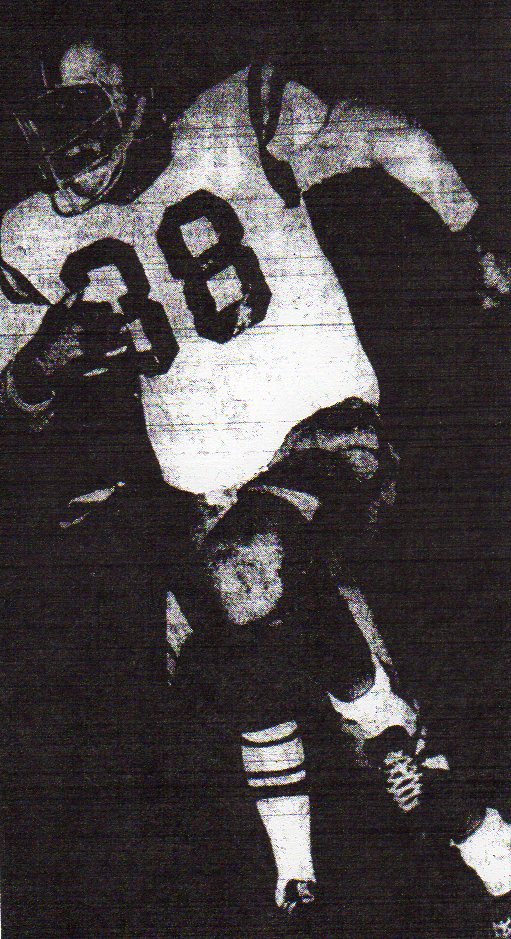
Dwight McDonald had future with Chargers in NFL.
FOR ONE OR FOR TWO?
That was a new and often anxious decision awaiting coaches.
Eleven years after the colleges, nine years following the American Football League, and 25 years before the NFL, the nation’s high schools, including the 48 football-playing squads in the San Diego Section, opted for the rule allowing the two-point conversion try following touchdowns.
Football scientists over the years determined that the 2-point option probably is successful 50 to 55 per cent of the time, depending on time and situations in the game.
Accordingly, San Diego Section teams attempted 22 two-point attempts and converted 12 on the first weekend of games. The success rate was 52.2 per cent.
PASSES MORE SUCCESSFUL
Teams were good on 7 of 10 passing attempts and 5 of 12 running attempts. None of the successful two-pointers played a direct role in the outcome of the game.
The traditional, one-point kick still was en vogue.
Mission Bay’s Mike Marquez, who scored touchdowns on runs of six and nine yards, booted two points after to give the Buccaneers a 14-13 victory over Mar Vista.
Assistant coach Joe Gibbs surveys San Diego’s contribution to the USC Trojans. Front from left: Greg Slough (Point Loma), John Young (Helix). Humphrey Covington (Lincoln). Back row, from left: Jimmy Gunn (Lincoln), Ron Clark (Morse), Richard Obereutter (Kearny).
MORE PLACEMENTS?
Kicking also was going to become more optimal, suggesting a long-delayed acknowledgement of the vintage and mostly unused field goal.
Goal posts were being widened from the existing 18 feet, 6 inches, to 23 feet, 4 inches, in compliance with National Collegiate Athletic Association guidelines.
Football cleats also would be reduced from 7/8-inch to ½-inch in an effort to decrease knee injuries. The goal posts and cleats would be implemented gradually but become mandatory by 1971.
‘SIXTIES FAVORITES
Kearny’s season came to an abrupt end but the Komets and Escondido, completed the first decade of the CIF San Diego Section as the preeminent teams from 1960-69:
TEAM
RECORD
COACH
Kearny
68-23-5
.719
Birt Slater
Escondido
67-29-3
.687
Bob (Chick) Embrey
Oceanside
64-26-5
.692
Herb Meyer
Helix
62-25-2
.701
Dick Gorrie, Warren Vinton, Al Hammerschmidt
Lincoln
61-27-4
.677
Shan Deniston, Earl Faison
University
56-29-5
.640
Robert (Bull) Trometter
Grossmont
55-25-1
.688
Ken Maynard, Sam Muscolino, Pat Carroll, Pat Roberts
St. Augustine
55-33-3
.636
Tom Carter, Ed Doherty, Joe DiTomaso
Point Loma
54-32-6
.607
Bennie Edens
Carlsbad
53-35-3
.592
Sveto (Swede) Krcmar
GROSSMONT ROLLS NINE
A state CIF decision near the end of the summer allowed the Grossmont League to count its preseason carnival as a scrimmage.
District schools now were allowed to schedule a ninth regular-season game. The ninth annual Grossmont League carnival, which spun off the original Metropolitan League carnival that began in 1956, attracted almost 12,000 persons to Aztec Bowl.
SOUR ON CARNIVAL
But the carnival “leaves most of the league’s coaches cold,” said the Evening Tribune’s Jack Williams. “I’d play my JV if I could get away with it,” said one coach.
A complaint that dated to the City Schools’ carnival in the 1940s was that teams often had to play full games the next day in order to fill nonleague schedules.
Coaches worried about the quick turnaround and carnival injuries and deplored the interruption of season preparation.
Bill Fudge terrorized East County gridirons for El Capitan and would be named to all-time County team in 2013.
CITY RESET?
A City Schools carnival comeback?
No, but it was under consideration because of the rising cost of athletic programs.
The City Schools carnival, a September fixture since the second carnival in 1940, was discontinued after the 1962 contest when schools asked for, and were granted, the option of scheduling a ninth game, according to Bill Center of The San Diego Union.
But a strong contributing factor to its demise was that the carnival also had become a hot potato for city honchos as rowdiness and violence in and around Balboa Stadium seemed to occur each year.
The carnival had been under the lights since its origin at the end of the 1939 season until moving to the afternoon in 1959. Program costs were such that numerous budget measures were on the table, including, but not confined to, the scary idea cutting of coaches’ game film and equipment.
STARS AND SONS
Castle Park standouts included future NFL first-round draft choice Steve Riley, a tackle out of USC, and future Metropolitan League coaches George Ohnessorgen and Andy Sanchez.
Another lineman was Coronado’s Ken Huff, who did not make the all-San Diego Section team but became a first-round selection after playing at North Carolina. Coronado’s quarterback was George Murphy, son of a former USC player and longtime NFL game official.
Fallbrook quarterback Eddie Feigner was the offspring of the world-famous fast-pitch softball star of the same name.
Point Loma tight end Peter McNab was the son of San Diego Gulls hockey coach Max McNabb and a future, 15-season NHL player.
Mar Vista quarterback and all-purpose Gene Alim, who went on to dominate the 1980’s as head coach at Sweetwater, may have intercepted as many as 12 passes from his safety position. Years later Alim was reported to have ended his career with a CIF record-tying total of 22.
Alim’s three field goals, from 15, 21, and 17 yards, were enough for Mar Vista to defeat Coronado, 9-7.
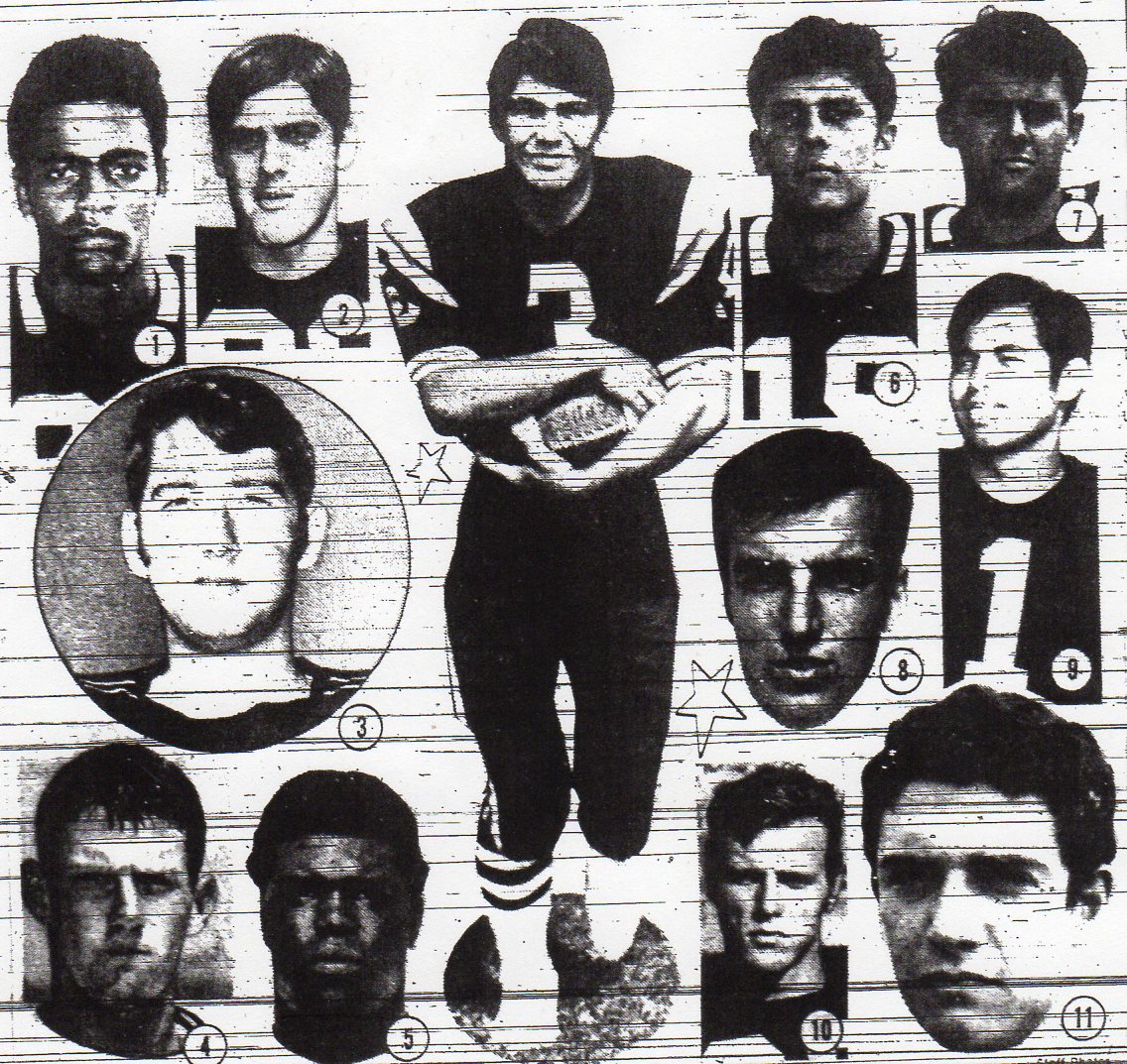
Castle Park’s Andy Sanchez (center) was the San Diego Section player of the year. Sanchez was joined on first team by (1) Dwight McDonald, Kearny; (2) Steve Riley, Castle Park; (3) Bob Emerson, Sweetwater; (4) Rex Holloway, Escondido; (5) Lew Williams, San Diego; (6) Ed Evilsizor, Kearny; (7) Bob Kostian, Kearny; (8) Paul Lawton, San Marcos; (9) Ray Sablan, Castle Park; (10) Bill Fudge, El Capitan, and (11) John D’Aquisto, St. Augustine.
Kearny wide receiver Dwight (Shaky) McDonald went on to play at U.S. International in San Diego.
McDonald’s senior season was across town at San Diego State. Dwight led the nation with 86 catches in 1974 and caught the eye of NFL scouts.
He signed as a rookie with the San Diego Chargers and played four years with the local pros.
David Plaut was the student representative from Patrick Henry High, reporting on Patriots games to the Union. Plaut followed a journalism path at Northwestern University and enjoyed an award-winning career as a writer and director for NFL Films in Mt. Laurel, New Jersey.
HIATUS FOR PALOMAR
The unwieldy Palomar League, featuring Marian in South County, Ramona in the East County, and Army-Navy and San Marcos in North County, shut down, to return in a subsequent year.
While Ramona and Army-Navy stayed together in the Southern League, in separate divisions, Marian found residence in the Metropolitan League and San Marcos in the Avocado.
Quarterback Ray Sablan signals touchdown as Castle Park’s George Ohnessorgen wedges between Escondido’s Dana McManus and Tom O’Rourke for score in Trojans’ 35-33 County Conference title game loss.
HENRY JOINED BY PARKER
The Patrick Henry Patriots played a complete varsity schedule in their second year and in the school’s first year with sophomore, junior, and senior classes.
The Francis Parker Lancers teed it up for the second time in the school’s 57-year history, playing a junior varsity schedule. The school, then located in Mission Hills, played an abbreviated schedule in 1924.
MIKE’S NO FAKE
Sweetwater’s Mike Faketty, a 6-foot, 2-inch, 220-pound tackle, recovered a fumble, sacked the quarterback twice, blocked a punt, was in on 11 tackles, and provided the essential block on a touchdown run.
“It was the finest game I’ve seen a linemen play in the four years I’ve been here,” said Red Devils coach David Lay.
Faketty’s fury was directed at Mount Miguel, a 30-0 loser to Sweetwater.
In the Red Devils star system, which awards outstanding performance, Faketty received five stars. “Nine or ten is the most we’ve had, in a whole year,” Lay told writer Jack Williams.
Pat Tormey’s pass was just beyond the reach of St. Augustine’s Tom Davis as San Diego’s Robert Davis defended. The Saints won, 24-21.
WELL TRAVELED
Marian’s new coach, Bill Craven, was at Buena Park High in 1968 after stops at Norwalk Excelsior, Artesia, San Juan Capistrano (now San Clemente), and Garden Grove Bolsa Grande.
Craven moved on again following the overmatched Crusaders’ 0-9 debut in the Metropolitan League.
QUICK KICKS
When you’re winning you can say almost anything, witness Grossmont coach Pat Roberts’ description of his linemen for Union writer Bill Center: “We’re so slow we’d drown in a car wash”…Hilltop’s A.J. (Art) Sisk resigned about a week before the season to take a job in the publishing business…Byron Meyers replaced Sisk, who was 29-24 in six seasons…coach Scotty Harris on San Diego High’s defense, to Bill Finley: “They don’t care about their lives. They just throw their bodies at the ball”… Helix coach Al Hammerschmidt estimated that quarterback Steve Coover threw almost 3,000 passes since the end of the 1968 season and before the start of September practice…La Jolla fans were cheering hurrah when Jim Harrah was on the field…the riffs in the Sweetwater offense were orchestrated by sophomore quarterback Steve Riif…Brad McRoberts went from being a quarterback at El Cajon Valley in 1968 to a tailback-linebacker at Santana this season…Mount Miguel coach Ben Cipranic listed nine assistant coaches on his staff, including Duane Freeman, a star on the 1960 team…after a 0-0 first quarter, Castle Park savaged Marian, 54-0, setting a school record for most points and amassing 524 yards in total yards…three Castle touchdowns were called back by penalties…Coronado’s 63-0 victory over Army-Navy represented the most points by the Islanders since a 73-6 win over La Jolla in 1929….
2014: Women Tracksters Star and Look to 2015
The names that figure to be shouted out in 2015 are Labrie-Smith and Johnson from Cathedral, Acolatse from Mission Hills, with maybe a raised voice by Mongiovi from West Hills.
All were underclass standouts among the women, who made the most noise on what was, at best, another average season by San Diego Section athletes, at least in comparison to most of the other nine CIF sections in California.
Junior Hanna Labrie-Smith was second in the state meet and set a Section record of :41.67 in the 300 hurdles and sophomore teammate Dani Johson ran :42.13 and blitzed wind-aided times of :13.81 and :13.99 in the 100 hurdles in the state meet. Johnson set a Section record with a non-wind :14.16 at the finals at Mt. Carmel.
Junior Suzie Acolatse turned in the fourth (:11.59) and seventh (:23.97) all-time fastest times in the 100 and 200. Junior Melissa Mongiovi logged :55.61 in the 400 but did not approach her personal best of :54.70 from 2013.
Madison’s Doton Ogundeji led the men and won the state shot put at 65 feet, 5 1/2 (fourth) but fouled at over 200 feet in the discus trials and did not qualify. Ogundeji’s accepted 194-5 is sixth all-time.
The edited best marks list for 2014 was compiled by Steve Brand, for more than 40 years an expert and fan of the sport.
MEN
100 (Fully Automatic)— Brandon Lucas (Poway) 10.63 (Tie No. 16 all-time), John Kendrick III (Morse) 10.69, Dosier (Monte Vista) 10.80, Dickens (Grossmont ) 10.82, Doan (St. Augustine) 10.84, Stinson (Helix) 10.85, Beck (Tri City Christian) 10.85, LeBlanc (University City) 10.88.
200— Lucas (Poway) 21.18 (No. 10 all-time), Doan (St. Augustine) 21.76, Carson (Olympian) 21.82, Dosier (Monte Vista) 21.95, Whiting (Lincoln) 21.97, Mudd (Poway) 21.98, Kendrick III (Morse) 21.99.
300IH— Nelson (Del Norte) 38.40, Johnson (Serra) 38.63, Lyndsey (Poway) 39.02, Lachica (Mira Costa) 39.26, Reed (Escondido) 39.38, Martinez (Sweetwater) 39.40, Johnson (Serra) 39.62, Grumbling (Oceanside) 39.6.
4x100R— Poway, 41.45, Steele Canyon, 42.31, Oceanside, 42.45, St. Augustine, 42.69, Granite Hills, 42.83 (42.1), La Costa Canyon, 42.95, Monte Vista, 42.99.
4x400R— Granite Hills, 3:18.71, Mt. Carmel, 3:19.04, Del Norte 3:19.20, Scripps Ranch 3:20.75, Steele Canyon 3:20.95, Poway 3:21.49, Westview 3:24.10.
400—Mongiovi (West Hills) 55.61, Scott (Westview) 56.36, Gould (La Costa Canyon) 56.49, McCarthy (Carlsbad) 56.54, Labrie-Smith (Cathedral) 56.7, Leonard (Poway) 57.41, Chadwick (La Costa Canyon) 57.50, Frank (Morse) 57.75.
800— Sammer (Rancho Bernardo) 2:12.18, Akins (Rancho Bernardo) 2:12.23, Pullum (Point Loma) 2:13.99, Roberson (La Jolla) 2:14.22, Kelly (University City) 2:14.42, Buckle (San Pasqual) 2:14.68, Bernd (Canyon Crest) 2:15.09.
1600—E. Abrahamson (La Costa Canyon) 4:50.02 (No. 10 all-time), Bernd (Canyon Crest) 4:53.05 (No. 14 all-time), Ortlieb (San Pasqual) 4:59.39, Kelly (University City) 5:00.64.
3200—E. Abrahamson (La Costa Canyon) 10:23.50 (No. 3 all-time), Ortlieb (San Pasqual) 10:46.46, LaSpada (La Jolla Country Day) 10:47.43, Johnson (Clairemont) 10:53.74, Garcia (Mt. Carmel) 10:57.51.
Long Jump— T. Dozier (Mount Miguel) 19-2 ½ (No. 11 all-time), Cromer (University City) 18-5, Kennedy (Serra) 18-4, Shuler (Julian) 18-2, Muhammad (La Jolla Country Day) 18-1, Hasselhuhn (Carlsbad) 18-1.
Triple Jump—Noiseaux (Eastlake) 38-9, Muhammad (La Jolla Country Day) 37-11 ½, Cole (Del Norte) 37-10, Kennedy (Serra) 37-9 ¾, Nash (Calvin Christian) 37-3.
Not exactly the stuff of Agatha Christie, but mystery surrounded “The Missing First Downs”.
La Jolla and Calexico engaged in a Southern California Lower Division playoff at La Jolla.
The game ended in a 6-6 tie, but The San Diego Union reported the next day that the Vikings “won”, 7-6, and advanced to a championship encounter.
As Union writer Mitch Angus noted, “An extra point tossed in for an edge in first downs made gave La Jolla High school a 7-6 victory over an invading Calexico High eleven in a bitter minor football playoff on the Jewel City gridiron.
“The Vikings scored 13 first downs to nine for the visitors to win the game on a CIF ruling,” wrote Angus.
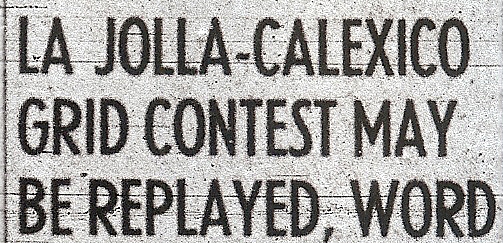
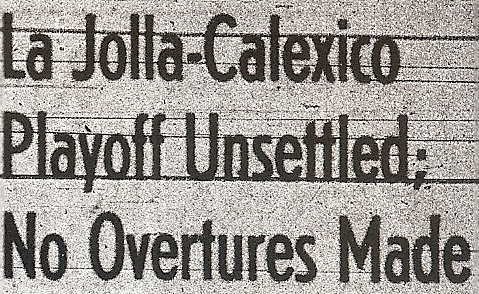
Headlines the next few days tell a story.
Calexico did not protest but asked CIF commissioner Seth Van Patten for clarification of the rule pertaining to tied playoff games.
Van Patten went to his rule book.
According to a Mr. Lawson, the principal at Calexico, the commissioner said that because no official record of first downs was kept the game either would be replayed in Calexico or go down as a tie.
The Union conducted a review and reported that in an unofficial count of five newspapermen and “other interested parties”, La Jolla was given the edge in four first down tabulations and one was even.
La Jolla principal Clarence Johnson was out of town and could not be reached for comment.
Days later the matter still was unsettled as thoughts turned to Christmas and basketball.
The game wouldn’t be replayed.
According to the Union, the head linesman assigned to the game was responsible and failed to keep a record of first downs.
The official in question was Joe Beerkle, the head coach at San Diego High.
Area coaches manned the other officiating positions. Grossmont’s Jack Mashin was referee, Morris Gross of San Diego State was back judge, and Sweetwater’s Cletis (Biff) Gardner was umpire.
The CIF Southern Section record book lists no lower division champion for 1938.
METROPOLITAN PLAYOFF OUT
There was talk of a postseason, Thanksgiving Day game for the Metropolitan League title after Point Loma and La Jolla tied for first with 5-1 records (La Jolla beat Point Loma, 22-7, and Coronado upset La Jolla, 6-0).
A decision not to play was made after principals from each school met with coaches.
Point Loma honcho Clarence Swenson stated, “We felt it might hinder the chances of the Metropolitan League entry in the CIF minor league playoff.”
Point Loma had won league titles in 1936 and 1937 but had declined invitations to participate in the postseason.
La Jolla later won a coin flip with the Pointers to determine the league’s playoff representative against Calexico.
FIVE TROJANS FROM SAN DIEGO
USC coach Howard Jones mined the recruiting fields in San Diego with great success during his tenure as the “Head Man” at USC from 1926-40.
Six players from San Diego were on Jones’s 1938 squad that upset undefeated Notre Dame, 13-0, then defeated a Duke team that had not been scored on, 9-0, in the 1939 Rose Bowl.
From left: blocking halfback Joe Shell (Hoover), end Sal Mena (San Diego), guard Ben Sohn (San Diego), fullback Roy Engle (Hoover), and quarterback Oliver Day (San Diego). Not pictured, back Ambrose Schindler.
WHAT DO YOU REALLY MEAN?
Coach-speak could be ponderous at best, or did sportswriters of the day just report quotes the way they wanted to hear them?
La Jolla boss Marvin Clark was quoted thusly when Clark spoke of the team’s prospects after 40 candidates turned out:
“Since we have no outstanding threat—no player capable of breaking away for touchdowns with enough frequency to be considered a menacing ball packer—we must work extra hard for our touchdowns, which means that we are not apt to be more than a good defensive (sic) team.
“The club is too small to be overly powerful, for our players will not average more than 150 pounds, and that means we will have to content ourselves with making trouble for the big fellows.
“We hope to have a good team but our prospects are not brilliant.”
La Jolla, 3-5 in 1937, improved to 8-1-1.
TOO MUCH HYPE
Al Walden, 145-pound La Jolla scatback, was leading scorer in County with 11 touchdowns, 12 PAT and 78 points.,
Coach Joe Beerkle moved from Point Loma to San Diego and one of his standout Pointers, halfback Paul (Red) Isom, followed Beerkle, accompanied by much hoopla.
The coach complimented Isom, sort of.
“They’re trying to put Red on the spot,” said Beerkle. “He’s no flashy, triple threat man. He’s good, however.”
Isom played through injuries and led the Cavemen with five touchdowns and 30 points.
Red guided the Cavers 70 yards to the winning touchdown in the final minutes as San Diego defeated Phoenix Union, 19-14, on the sixth annual Homecoming weekend. The school honored graduates from the class of 1891.
The Cavers had met the Arizona squad 12 times since 1923 but the series would be suspended because of travel concerns and not renewed until 1946.
FAREWELL, MOORS!
Alhambra won the Coast League championship after the Cavers missed a point after touchdown in a 6-6 tie, but the Moors were ending an affiliation with the Coast that began in 1925.
Games on the road with San Diego and Hoover usually were two-day trips, sometimes three.
Ground breaking for Mark Keppel High meant a new school would open on the east side of the city, cutting into the enrollment of the largest school in Southern California.
Alhambra would join the Foothill League, made up of mostly neighboring San Gabriel Valley schools, and the Coast League would be reduced to three teams, San Diego, Long Beach Poly, and San Diego Hoover.
3 LEAGUES MEET
A meeting in Long Beach among the 16 Bay League, Coast, and Foothill schools resulted in a realignment proposal that was adopted at a meeting at South Pasadena High in early 1939.
Representatives, including San Diego High vice principal Edward Taylor, agreed to guarantee five league games in 1939-40 for the six Foothill, seven Bay, and three Coast League squads in football, basketball and baseball.
San Diego would play Hoover, Poly, Whittier of the Foothill League, and Compton and Inglewood of the Bay.
The Bay League’s Long Beach Wilson and the Foothill League’s Alhambra and Glendale Hoover were scheduled to be San Diego Hoover opponents.
The intersectional games would count in the teams’ league standings and hopefully revitalize the struggling Coast League.
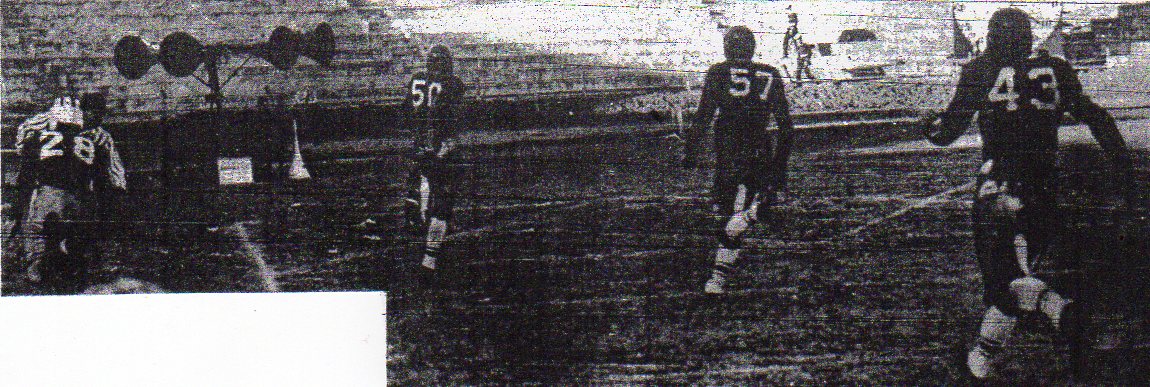
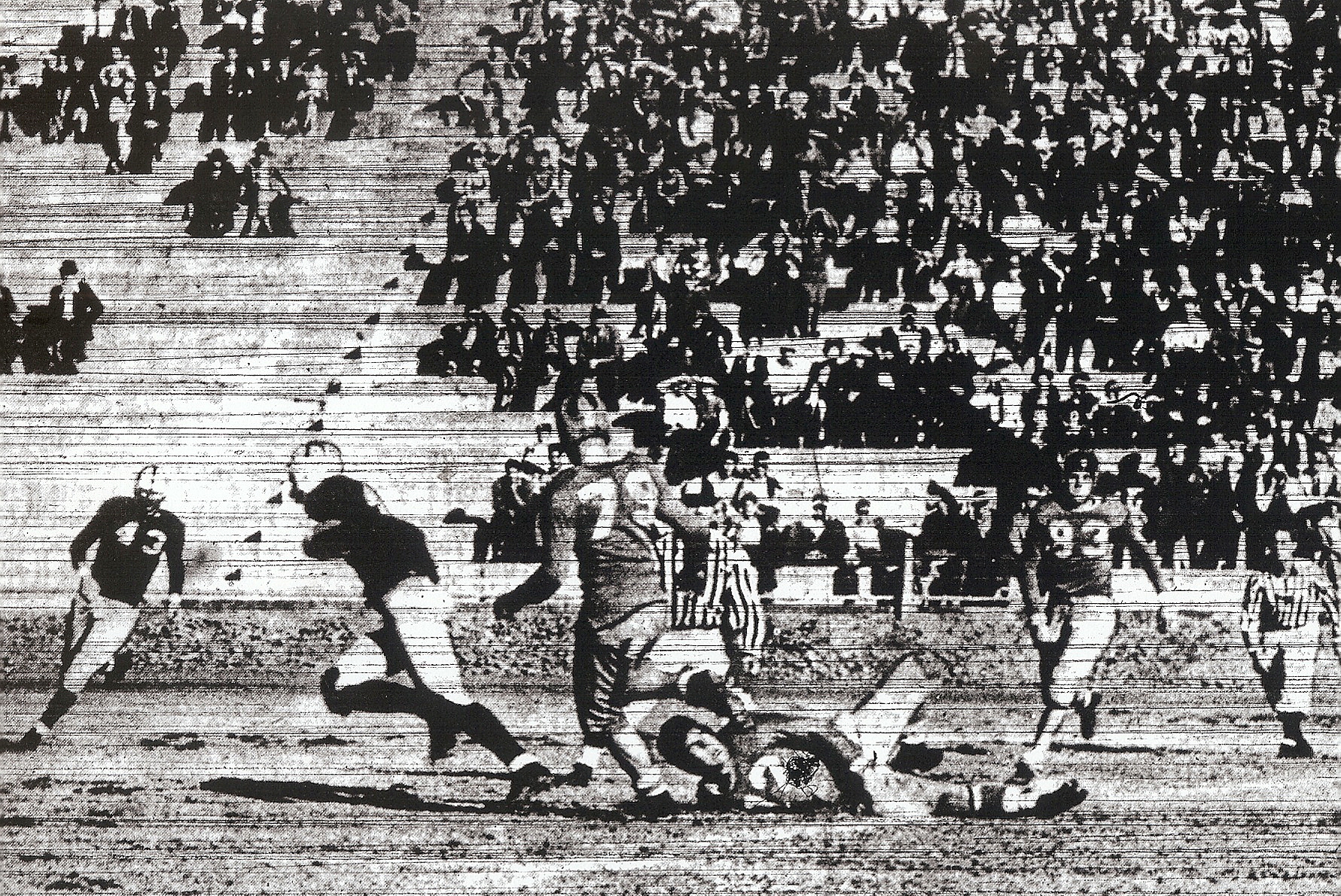
While a San Diego High defender (striped helmet) appears out of the field of play and engaging a game official, Blanchard of Phoenix Union, trailed by teammates, scored touchdown for 13-7 lead. San Diego came back to win, 19-18.
NO PLAYOFFS URGED
Rivalries, partisanship and potential charges of bias were noted by commissioner Seth Van Patten when opponents were to be selected.
Van Patten named an executive committee that was charged with drawing up schedules. Members of the select group did not have any connection to the schools involved.
Another recommendation that was not passed at a subsequent meeting called for the elimination of all playoffs. The postseason apparently was not profitable and therefore not popular, but they would continue.
SIGNS OF THE TIMES
Seventeen bomber planes, from Navy Patrol Squadron 4, flying in formation all night, set a record for air time from San Diego to Honolulu on Sept. 7.
The planes covered the 2,150 miles in 17 hours, 17 minutes.
The trip, described politely as a “routine transfer of patrol bombers,” was made at an average speed of 145 knots, according to officials. Converted, 145 knots was equal to 167 miles per hour.
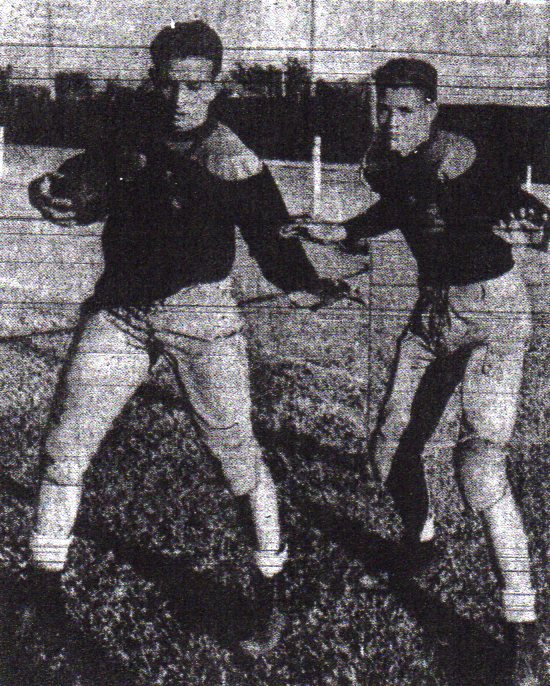
Escondido was only 3-6 under first-year coach Charlie McEuen but Frank Thames (left) and Howard (Bob) White made the all-Metropolitan League second team. White coached Escondido to a 6-3 record in 1952.
CLIMATE CHANGE?
The San Diego temperature of 94 degrees on Oct. 2 broke the record of 88, set in 1893. Six weeks later, on Nov. 12, the temperature dropped to 18 in Descanso, 25 in El Cajon, and 30 in Escondido.
Tomatoes suffered in El Cajon and water froze on Palomar Mountain.
WHO’S GOING TO PAY?
The San Diego State Aztecs attended the USC-Notre Dame game in Los Angeles and then spent the night in a downtown L.A. hotel.
The next morning, after a team breakfast, graduate manager Al Morrison prepared to pay.
Morrison discovered that his wallet had been emptied of its contents. A further check revealed that currency had been removed from the billfolds of head coach Leo Calland and athletic director Morris Gross.
One other hotel guest reported that he, too, had been robbed. The Aztecs made good on the breakfast tab after returning home.
MR. TOUCHDOWN
Bobby Cifers, a triple-threat halfback from Kingsport, Tennessee, set a national high school record with 233 points in 12 games. Cifers scored 34 touchdowns and 29 PAT to break the mark of 211 set by Chicago prep Bill DeCorrevont in 1937.
WHO ARE THESE GUYS?
They were mostly former San Diego High players and they represented the Golden Hill Gophers, who defeated the Hilltoppers’ junior varsity, 12-0.
COOVER OF HOOVER
Coover was on San Diego prep scene as player and coach.COOVER OF HOOVER
Chuck Coover was a 140-pound, second-team all-Coast League end and one of many future coaches mentored by Hoover’s John Perry.
Coover coached many years in San Diego, taking on almost impossible tasks at football-barren St. Augustine (1947), Mar Vista (1952-53), and Mission Bay (1959-61), before moving to Morse.
The school South of Encanto in the city’s Skyline District opened in 1962 and Coover built the program from the ground up. He retired after a 9-2 season in 1968.
ADVERTISING FOR PLAYERS
Joe Beerkle was desperate for backfield help and placed a faux help-wanted ad in the morning newspaper.
“Any halfback, quarterback, or fullback not regularly employed at present kindly report to the San Diego High practice field at 2:30 this afternoon for a tryout.”
Beerkle was elated when Dempsey Holder, a 180-pound halfback, transferred in from a school in the Phoenix area in Arizona.
Like some Hollywood marriages, the relationship was brief and ended unhappily for Beerkle.
Holder, who stepped in at right halfback against Long Beach Poly, was gone three weeks later, moving back to Arizona.
EVENING TO REMEMBER
The first night game at Coronado turned into a frenetic last quarter.
Coronado scored two touchdowns in the last five minutes to overcome St. Augustine, 13-6, after the Saints took a fourth-quarter lead on Les Duffy’s 100-yard punt return.
MOVIES
Film study still was in its development stage, but San Diego coach Joe Beerkle took up most of one practice day by showing the squad “slow motion pictures” of the California-UCLA game from the previous week.
Beerkle hoped the film would aid Cavers backs blocking for Red Isom.
HONORS
Guards Bill Seixas of San Diego (first team) and Dave Cobb of Point Loma (third team), and halfback Al Walden of La Jolla (fourth team), earned all-Southern California honors.
San Diego’s Hank Newman caught pass from Red Isom and scored on 15-yard play for first touchdown against Hoover.
TRUE GRID
A fight almost started at midfield over possession of the game ball after San Diego defeated Hoover, 14-0, before 16,000 in City Stadium…the ball finally was delivered to San Diego coach Joe Beerkle…San Dieguito spoiled dedication of Escondido’s new field, edging the Cougars, 7-6, in the season opener for both teams…Fallbrook, in its third season of football, welcomed a turf playing surface; so did San Dieguito…Ramona won its inaugural game, 7-0 over Fallbrook…Metropolitan League rivals Oceanside and Escondido played a Thanksgiving Day nonleague game with proceeds setting up a fund for injured players…Escondido made it two in a row over the Pirates, 20-0…Hoover and Tucson drew 5,000 spectators in the Arizona city the day after Thanksgiving…the Badgers beat the visitors, 14-6…Point Loma’s ace blocking back and defensive star Jack Farrell turned 20 in the middle of the season and had to leave the team, having exceeded the CIF age limit…
2014: Mac’s fleet 1,500 propels Ducks to title
Happy Father’s Day!
Oregon’s Mac Fleet defended his national collegiate 1,500-meter run championship with a time of 3:39.09 yesterday, helping the Ducks win their first men’s championship since 1984.
Nosing out Arizona’s Lawi Lalang, who was seeking a ninth NCAA individual championship, Fleet made a powerful stretch run in front of his parents, Dale and Jana Fleet, and a crowd of more than 10,000 at Hayward Field in Eugene, Oregon.
Fleet is a name that has resonated many years in San Diego track and field circles.
Dale Fleet was the 1971 state champion for Clairemont High with a time of 8:53.8 in the two-mile run at Drake Stadium on the UCLA campus in Westwood.*
Fleet is among the state’s and San Diego’s all-time runners.
Dale’s time, converted to meters, is 8:50.84, fourth all-time in San Diego County.
Mac ran 4:05.33 to win the state 1,600 meters as a senior at University City in the 95-degree heat at Buchanan High in Clovis in 2009.
The younger Fleet’s 1,600 meters is No. 2 all-time among area runners and his 1:50.31 for 800 meters is fourth.
Mac also is sixth in the all-time California prep rankings with a 4:02.9 mile that converted to 4:01.29 for 1,600 meters. His 3:39.09 1,500 meters in the NCAA event converts to a 3:56.55 mile.
Fleet also won the 1,500 in 3:50.25 in 2013 at Eugene and ran a personal best 3:38.35 last season.
*That meet still ranks among the best ever in California. Competition, before a crowd of more than 12,000, was so intense and marks so outstanding that Lincoln’s Donald Tyler, for example, ran a :47.3 440 and finished eighth in a field of nine.
Tyler’s :47.3, converted to :47.14, has been bettered by only three San Diego runners, led by the :46.85 of Morse’s Lydell Burston in 1996.
Dale Fleet, a San Diego school teacher, still is involved in the sport, helping out with the cross-country program at University City.