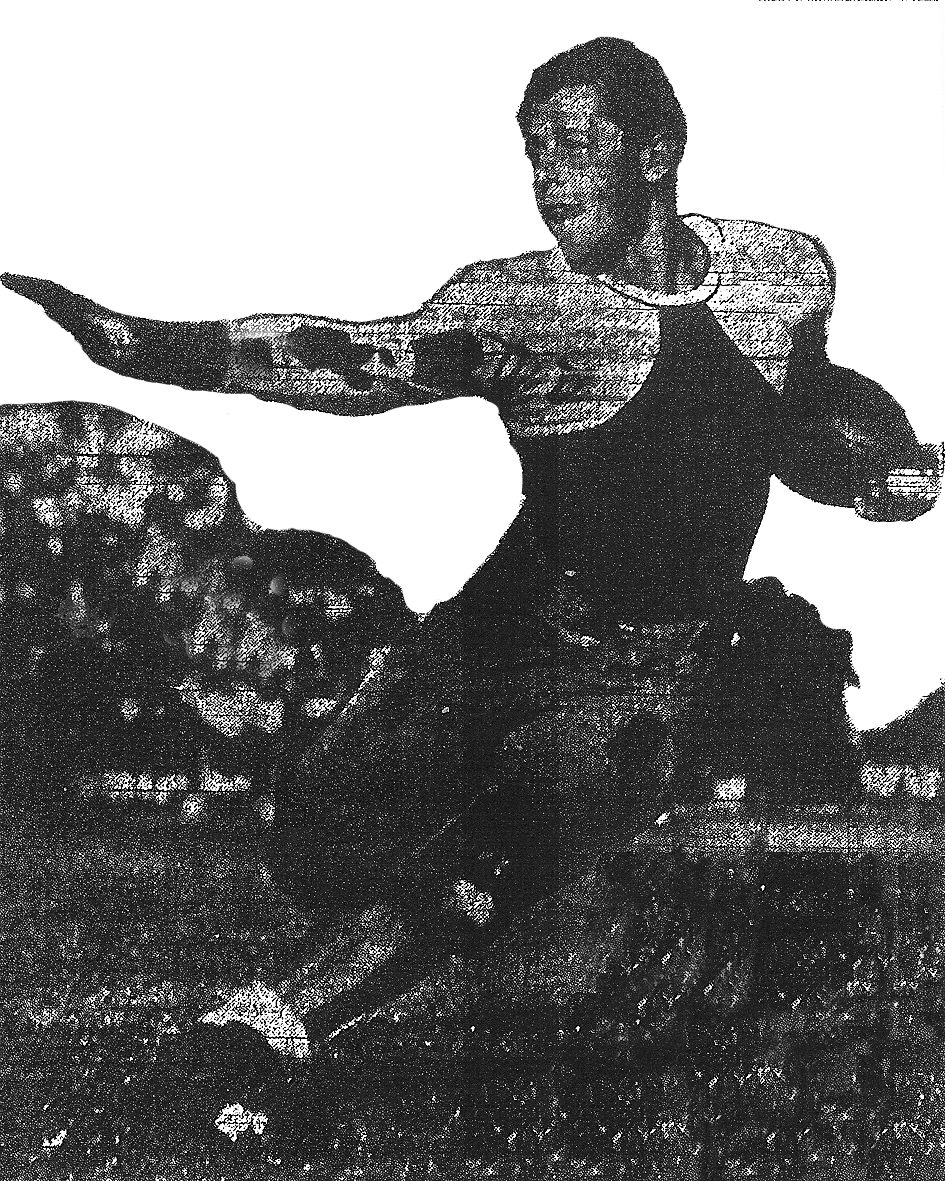
Chants of “We’re number one!” followed by “Why aren’t we number one?” will be heard in a few days when UT-San Diego’s first football Top 10 will signal that games are just days away.
With a little help from UT-San Diego’s John Maffei, who emailed his annual request with some brief team rundowns a few weeks ago, here goes:
(2012 records in parenthesis)
2013
Team
2012
1
Mission Hills (7-4-1)
5
2
Oceanside (12-1)
1
3
Cathedral (0-11)*
9
4
St. Augustine (10-3)
8
5
Helix (10-2)
6
6
Poway (10-3)
2
7
Madison (14-1)
4
8
San Pasqual (7-5)
nr
9
Ramona (8-5)
nr
10
Del Norte (6-6)
nr
*8-3 without forfeits.
WHY THE GRIZZLIES?
Coach Chris Hauser’s San Marcos-based team struggled early last year with a killer schedule but it brings back 10 starters, including veteran presence at quarterback, running back, wide receiver, and placekicker.
The Grizzlies won the summer’s North County passing tournament, defeating Oceanside, and believe they have at least four Division-I prospects.
EARLY DELIGHTS
Some teams have lined up impressive, outside opposition, led by Oceanside’s monster nonleague schedule: @St. Augustine (Mesa College), Gardena Serra, Temecula Chaparral, Poway, and @Mission Hills.
Cathedral will be host school to four other San Diego teams as part of the Under Armour “Brothers in Arms” classic involving more than 40 teams nationally, with games in California, Maryland, and Louisiana.
Play begins Aug. 29 and extends through the weekend.
Games at Cathedral:
Eastlake versus Chandler Hamilton of Arizona.
Mission Hills versus Phoenix Desert Vista.
Helix versus Honolulu Punahou.
Vista versus Whittier La Serna.
Cathedral versus Sandy of Jordan, Utah.
Gardena Serra versus Corona Centennial.
Helix takes on the legendary Buff ‘n Blue of Honolulu Punahou, one of the country’s top teams and one with a legendary history. Punahou already owns a 24-14 victory over Honolulu Mililani.
The two Arizona schools are among the best in that football-fertile state. Cathedral will play a team that was No. 1 in Utah with a 12-1 record in 2012 and Vista, hoping to rebound from a 2-8 record that was the Panthers’ worst since 1988, meets the defending Del Rio League champion from the Southern Section.
QUICK KICKS–Del Norte may be ready to make a run in its fourth season, having improved from 2-8 in 2010, to 4-7 and 6-6…the Nighthawks return 16 starters, including their quarterback and a 1,200-yard rusher…Del Norte is in its third season under coach Leigh Cole…Helix should be very good but pundits in the foothills say the Highlanders are a year away from doing big things…Cathedral returns nine starters and newcomers from a 10-0 junior varsity squad…Madison’s defending state Division III champions will be one of the most watched clubs…the Warhawks lost a lot but 11 starters are back and so is quarterback Kareem Coles…Brawley will get contributions from a 10-0 JV team and 11 starting veterans…
2005: A Double What? Forfeit (Both Teams!)
Game officials came under fire.
A brawl between Helix and Mount Miguel resulted in a referee’s suspension and “double forfeit”.
Playoff divisions increased.
At least two programs were rocked by ineligibility.
WEAK SHALL INHERIT
The San Diego Section playoffs became five divisions, marking the first expansion of the postseason since a fourth division was added in 1979.
Lousy teams with no chance of winning prevailed again.
In 1959, the last year San Diego was in the CIF Southern Section, there were playoff brackets of 16 teams each in the upper and lower divisions and eight teams in the Small Schools.
Five of the of the 29 schools in San Diego County, including San Diego, Chula Vista, Mar Vista, Kearny, and Ramona, comprised 14.5 per cent of the Southern Section’s 40 postseason spots. There were about 300 schools from Atascadero south.
You had to earn your way into the playoffs.
San Diego and Ramona won championships, which meant a lot, but so did just making the playoffs.
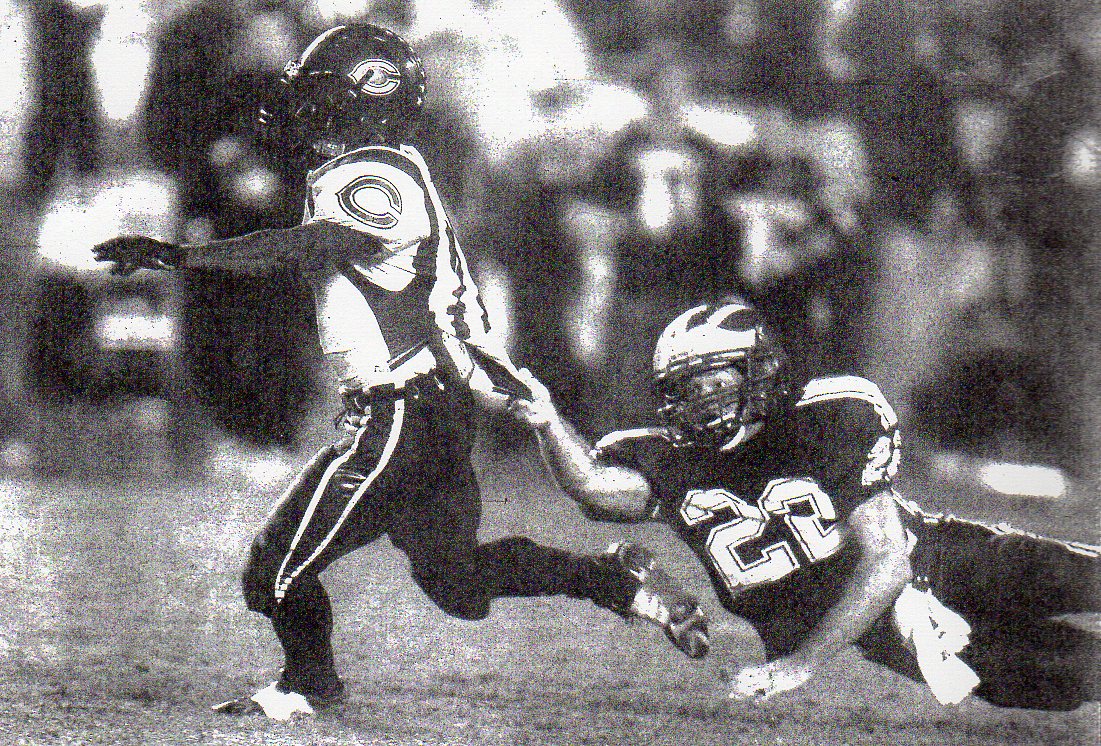
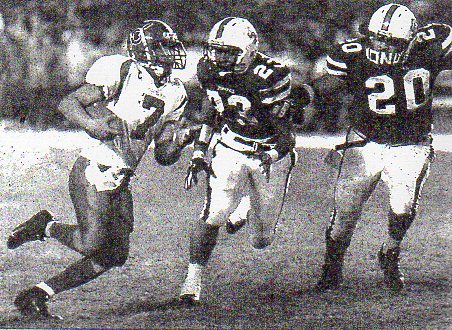
Carlsbad’s Antwan Dawson shook off the shirttail tackle attempt by Torrey Pines’ Robby Collins and completed 90-yard touchdown run in Lancers’ 17-6, Division I championship game victory.
COME ONE, COME ALL
Fifty-seven of 88 San Diego Section teams, almost 65 per cent of schools playing football and not including those in eight-man leagues, were included in the new, five-division alignment.
Eastern bloc countries would approve of this form of socialism.
MEYER’S MANDATE
“Teams could finish 8-1 or 9-1 and if they didn’t win the league, there was no second chance,” remembered El Camino coach Herb Meyer to Steve Brand of The San Diego Union . “That was bad, but so is having teams in with sub-.500 records which lose their first games, fifty to nothing.’
Meyer pointed out that 21 of his 23 El Camino playoff teams won their first playoff games because he wouldn’t consider participating if he didn’t think his teams could at least win one game.
In 1998, when Meyer needed one victory for career number 300 the El Camino coach stunned the playoff committee by announcing he would not submit his 3-7 team for consideration.
Thirteen teams with 3 or fewer victories sought berths at this year’s playoff selection meeting. Six were allowed in.
Playoffs this year included first-round scores of 64-0, 50-14, and 56-26 in Division II, 42-14, in D-I, 47-14 in D-III, and 58-6 in D-IV.
Coronado, a D-IV squad with a 7-3 record, was whacked in the first round in another game that ended with a 58-6 score. There was a 48-0, D-V semifinal round blowout.
Westview, 3-7 in the regular season, made it to the second round and lost in D-III to Brawley 56-14 after trailing, 35-0, at halftime.
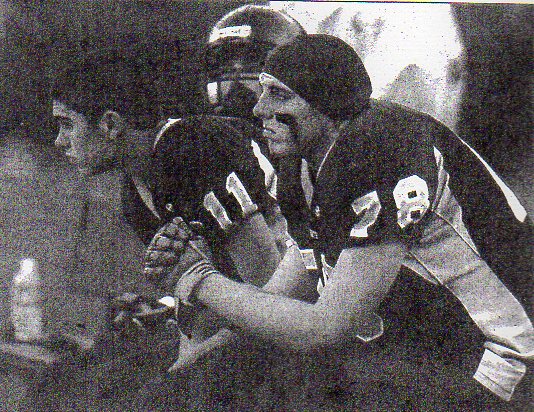
Quarterback Lucas Shaw (11) and lineman Matt Passwaters were glum observers as St. Augustine rolled to 17-7 win in D-III championship game over Point Loma.
WEBB SPINS
Two of the four expansions of playoffs came when Kendall (Spider) Webb was San Diego Section commissioner.
“Those who wanted one true champion didn’t like it, but the majority felt it was an opportunity for more schools to compete,” said Webb, who began running long-distance races after retirement.
Webb said one of the unexpected results of expansion was revenue, but added, “I can honestly say that I don’t remember potential expansion based on revenue.”
Section commissioner Dennis Ackerman pointed out that “as football goes, the budget goes. Because of football we were able to gross $500,000 last year.”
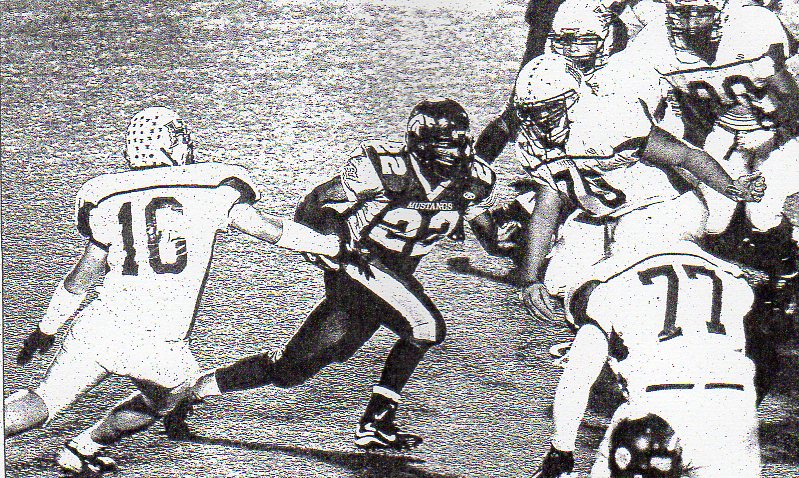
Otay Ranch’s Deraun Deadwiler was surrounded by Hilltop defenders but escaped and raced 83 yards for touchdown in the Mustangs’ 35-14 victory.
DREADED ADMINISTRATIVE GLITCH
Mission Hills, a rising team in only its second season, forfeited four victories for using at least two players who were residentially ineligible.
The San Diego Section passed a rule at the end of the last school year that teams with three forfeits would automatically be disqualified from playoff consideration.
The Mission Hills principal lobbied: “These were extreme, extenuating circumstances and we feel our athletes should not be punished,” he said.
No dice.
The Grizzlies finished with an adjusted, 4-6 record and did not get a playoff invite.
DREADED ADMINISTRATIVE GLITCH, CONT.
Ackerman and Metropolitan Conference commissioner Carlton Hoggard were in agreement that Castle Park had used an ineligible player and would forfeit its Mesa League championship and berth in the playoffs.
If the forfeits held up, Castle Park would go from an 8-2 record to 2-8. The player originally had been at Castle Park, transferred to Sweetwater, then returned to Castle Park.
Sweetwater officials took blame for the paperwork goof and Castle Park thought it was clean, but the CIF found Castle Park at fault for “not uncovering the eligibility concerns” and for allowing the player to participate in six games.
The player’s mother hired a lawyer, who went to court. The issue dragged on the week of the playoffs’ first round before a Superior Court judge ruled in favor of the player.
The Trojans sent Montgomery packing 48-14 in the D-III first round, then were upset by El Cajon Valley 56-32 in the quarterfinals.
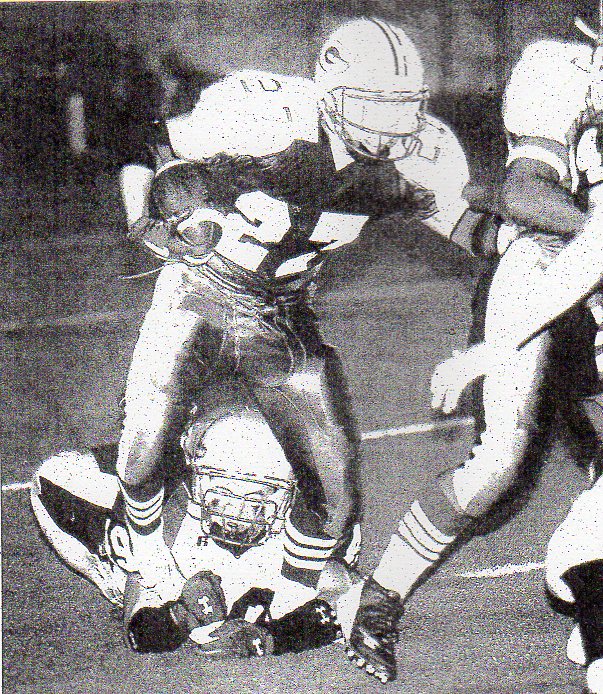
West Hills’ David Hernandez dove, grabbed the shoe tops of Augie Williams in the Grossmont backfield, and made tackle, but Foothillers beat Wolf Pack, 24-14.
HELIX TO CIF: THANKS BUT NO THANKS
A bracket of 14 teams was created for the II playoffs, but only 13 representatives of eligible squads showed for the playoff seeding meeting at the San Diego Section office.
Helixinformed commissioner Dennis Ackermanthat it was not interested in being in the postseason after having been a participant every year but one since 1977.
The Highlanders took the playoffs seriously. They felt unqualified after posting a 2-7-1 record.
Mar Vista (3-7) and El Centro Southwest (3-7) also did not attend the seeding meeting.
FROM THE ASHES
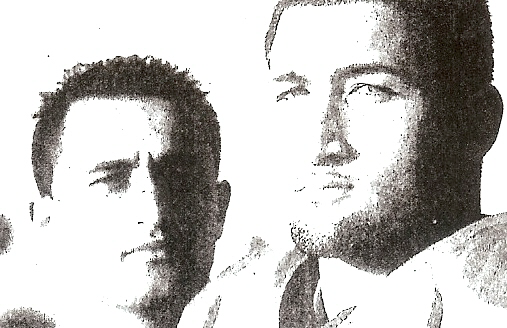
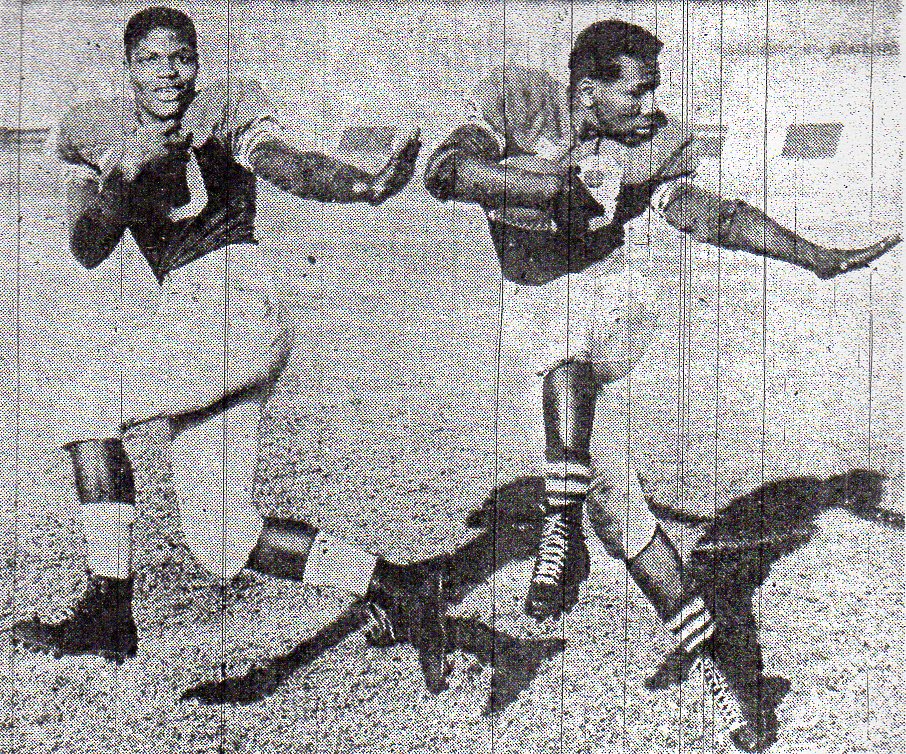
Abraham (right) and Muhammad left their marks at El Cajon Valley.
With Helix on hiatus, El Cajon Valley and Valhalla, two unlikely neighbors from the foothills, each rose like some helmeted phoenix.
El Cajon Valley, with 5 playoff appearances in 51 seasons, beat top-ranked Mira Mesa, 26-21, in the semifinals and a earned a meeting with Oceanside in the D-II championship.
Abraham Muheize, who quarterbacked the Braves from a spread formation and took the snap eight yards behind the center, set a Section passing record with 4,050 yards, a state record for total offense, 5,203 yards (including 1,253 rushing), and a section record with 591 total yards in one game.
The Braves’ 11-2 record entering the finals was best in school history, surpassing the 10-2 of the 1997 team, on which Muheize’s brother Muhammad, now a Braves assistant coach, was a member.
It was a great run, but the Braves fell short, 31-21 to Oceanside. The Pirates’ Mario Gonzales rushed for 188 yards in 28 carries and coach John Carroll’s defense kept Muheize on the run all evening, limiting Abe to 215 yards passing and minus 6 yards rushing in 8 attempts.
Valhalla, three winning seasons in 31, averaged 41 points a game, many furnished by running back Garen Demery, and fashioned a 9-1-2 record.
The Norsemen reached the playoff quarterfinals before losing a thriller to St. Augustine, when the Saints’ Chris Forcier passed for a touchdown on the final play of the game, then passed for a two-point conversion to win, 49-48.
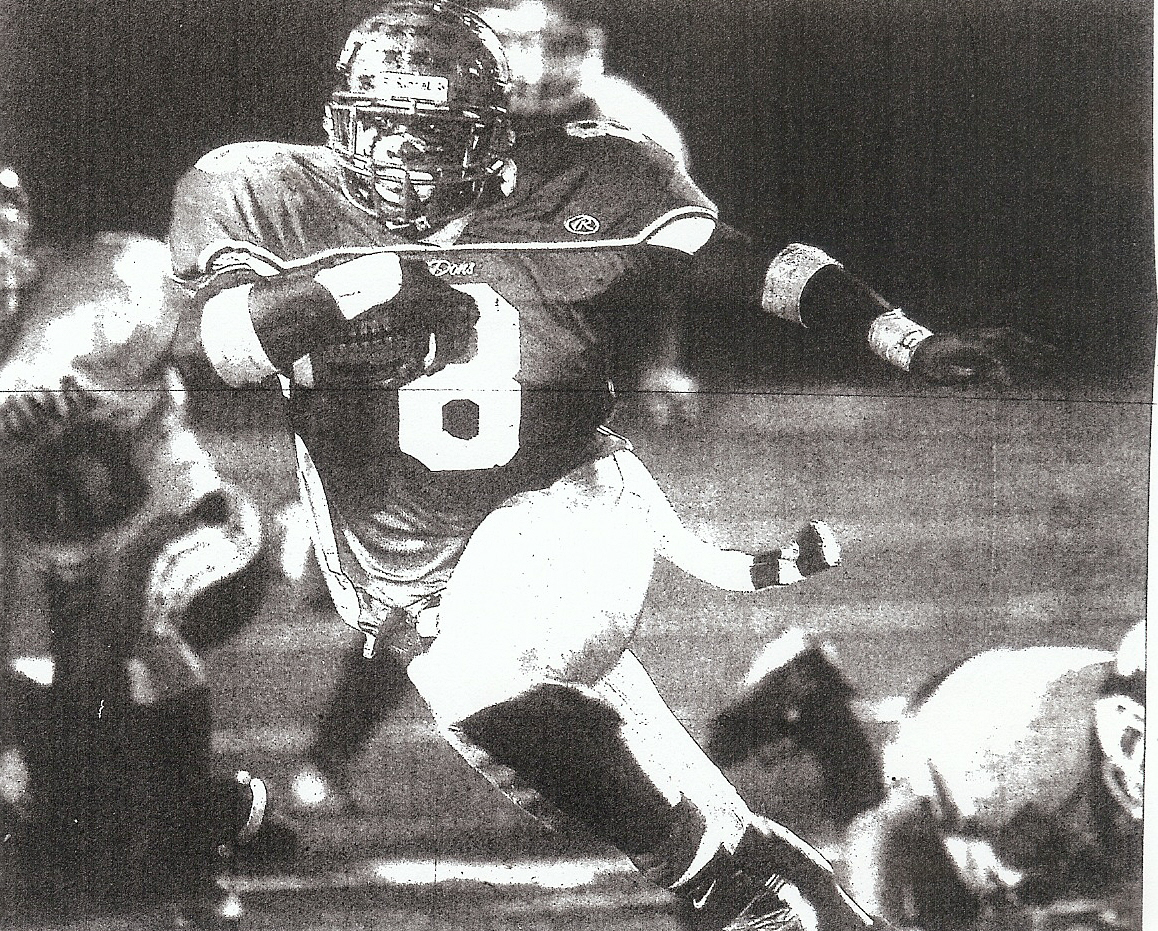
Dons’ Sumler ran for almost a mile in career but was slowed by Saints.
The Saints then won a D-III semifinal battle, 23-6 over arch rival Cathedral, shutting down, for the most part, the Dons’ Demetrius Sumler, who rushed for 81 yards in 17 carries but finished with the all-time San Diego Section career rushing record of 5,630 yards.
The Saints defeated Point Loma, 46-14, in the finals, ending the Pointers’ winning streak at 12 in a row.
LOCK THE DOOR, PLEASE
Carlsbad was in the process of a 17-3 victory over Cathedral when a thief or thieves entered the Lancers’ coaching office and stole a $600 camera.
“I guess they knew we were all on the sideline,” Lancers coach Bob McAllister told Terry Monahan of the North County Times.
The camera included tape from a junior varsity game earlier in the day.
“Maybe one of the doors didn’t lock when someone walked out,” said McAllister. “Someone must have really wanted that JV tape.”
McAllister jested that “somebody took their life in their own hands, because no one touches anything on Rudolph’s desk, not even me.”
The camera disappeared from the working area of assistant coach Dave Rudolph.
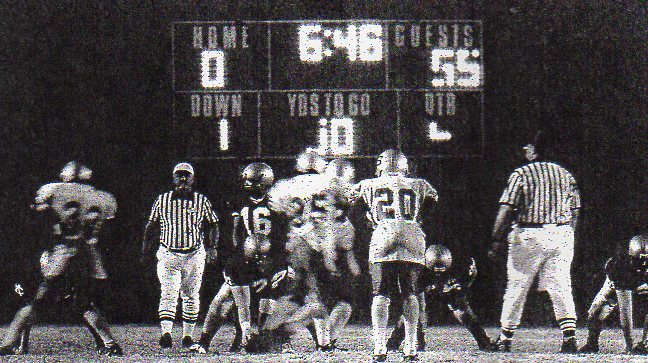
Marian (dark jerseys), two seasons removed from 13-0 record and championship, fell to 0-5 in 55-0 loss to Brawley.
AVOCADO-PALOMAR LEAGUE THUNDER
Knock-down North County football at its best was order of the week when Rancho Bernardo overcame Carlsbad, 24-21, in a battle of Top 10 teams.
Ryan Schmitz of the winning Broncos was involved in a play he’ll never forget. Schmitz struck a 42-yard field goal with six seconds left to deliver the victory for coach Ron Hamamoto’s Broncos.
Rancho Bernardo, remaining undefeated (5-0) and ranked No 1, trailed the Lancers (3-2), 21-0 in the second quarter.
FAST FORWARD
Bonita Vista’s Starr Fuimano felt force of North County power in Carlsbad’s 34-0 win in semifinals.
Rancho Bernardo finished the season with an 8-3 record, eliminated by Vista, 20-0, in the first round of the playoffs. Bob McAllister’s Lancers won their next eight, closing at 11-2 with a 12-6 victory over another North County heavyweight, Torrey Pines, in the D-1 final.
TURNABOUT
The tables moved in another direction for Rancho Bernardo.
Trailing, 13-7, with 30 seconds remaining, Torrey Pines receiver Michael Lambesis lost the ball on the one-yard line when he tried to stretch into the end zone.
Connor Bird of the Falcons recovered Lambesis’ fumble in the endzone for a Torrey Pines touchdown and Bill Bennett toed the extra point for a 14-13 victory, sending ‘Bernardo to its first loss after 5 victories.
“I knew I had to get his back,” Bird said of teammate Lambesis. “I knew I had to get in there and back him up.”
Burke endured many emotions during Torrey Pines’ battle with Rancho Bernardo.
As Falcons coach Ed Burke said to writer Kevin Gemmell: “This was a gutsy win against a great Rancho Bernardo team. They hammered us all night, but in the clutch, clutch players make clutch plays.”
MADISON COACH MIFFED
Mission Bay’s Kenny Mayfield appeared to many observers as having been stopped on the Madison goal line. Officials ruled a touchdown.
Madison coach Rick Jackson got an unsportsmanlike conduct penalty for charging the field. “Tell me I shouldn’t feel that way?” Jackson screamed at an official. “I just want a fair game called. You guys, that was just wrong.”
Jackson was quiet when the officials possibly erred in Madison’s favor in the fourth quarter, when the underdog Buccaneers were hanging in, trailing the Warhawks only 10-7.
ANOTHER BEEF WITH OFFICIALS
Madison’s Brandon Grimsley took a handoff at his 34-yard line on third and eight with about seven minutes remaining in the game.
Grimsley did what he was taught to do.
Grimsley ran laterally to the Mission Bay sideline, where he was met by a host of defenders.
Despite appearing to be tackled, Grimsley did not hear a whistle and didn’t stop, racing untouched for a 66-yard touchdown that pretty much iced the game.
“…one of the strangest plays I’ve ever seen,” Mission Bay coach Willie Matson said to Jon Gold of The San Diego Union. “Running back comes up the sidelines, gets hit and the linebacker wraps his arms around him, but there’s no whistle.”
Matson told the reporter that a Buccaneers defender “hesitated, held up and let him go and there still was no whistle. (Grimsley) took off running, like he should have.”
“Ever since Pop Warner,” said Grimsley, “I’ve been told to keep my feet moving, keep my feet moving.”
POWAY COACH PEEVED
A pass interference penalty against Poway was pivotal in La Costa Canyon’s 27-25 victory, decided on Briton Forester’s 33-yard field goal with eight seconds left.
The infraction placed the ball on Poway’s 16-yard line.
“If there was something outrageous, I didn’t see it,” said Titans coach Damian Gonzalez. “I saw two kids going for the ball. It’s heartbreaking when it comes down to an official and they take the game out of the hands of the kids.”
La Costa Canyon’s Cole Ducey quarterbacked the winning, 10-play, 80-yard drive with 5 pass completions in six attempts.
You can’t see him, but Cathedral’s Demetrious Sumler had just scored a touchdown and was appreciated by his teammates. First game at Dons’ new stadium resulted in 28-17 win over Steele Canyon.
HAVE WE MET?
Calexico defeated San Diego 27-12 in the opening game.
The victory “avenged” a Bulldogs defeat…to San Diego’s 1916 team that went 12-0.
Coach Clarence (Nibs) Price’s Hilltoppers defeated the Imperial Valley entry 55-0 in the Southern California playoffs, 89 years before. The teams had not played since.
ANOTHER RARE INTERSECTIONAL
Point Loma coach Mike Hastings was in need of a game after an opponent pulled out.
Hastings hooked up with Los Angeles Jefferson, which opened in 1916 and for decades boasted one of the country’s premier basketball and track and field programs.
Not football.
The Democrats made their first visit to San Diego and were sent home with a 48-7 defeat by Hastings’ Pointers, who advanced to the D-III finals before losing, 17-7, to St. Augustine and finishing with a 12-1 record.
FAREWELL, UNI!
The University of San Diego High, whose campus across Linda Vista Road from the University of San Diego almost seemed an afterthought for 48 years, was moving to a campus that colleges would envy.
The Dons became Cathedral Catholic High this year on 45 acres (compared to 7 at Uni) in Carmel Valley near Del Mar, with a gorgeous football stadium the focal point.
“It will be nice not having to take a bus ride,” said 11th-season coach Sean Doyle, referring to years of traveling to “home” and away games. The Dons played mostly JV games at their old campus.
“If we want to run laps, we have a track,” said Doyle. “If we want to run stairs, we have a stadium (capacity, 4,000). We’ll leave the locker room and walk seventy yards to the field. The home crowd will really be at home.”
The move didn’t reflect in the won-loss record. The Dons were 10-2 and reached the Division III semifinals in 2004. They were 8-4 this year, again advancing to the semifinal round.
La Jolla Country Day elevated from 8-man to 11-man, aligning in the Pacific League, which numbered the San Diego Section’s five smallest 11-man schools.
The Torreys went from 11-1 in the 8-man Citrus League to 10-2 in the 11-man Pacific, reaching the IV finals before losing to Christian, 35-0.
As an example of their aspirations, the Torreys unveiled an all-weather synthetic turf field. They had installed lights in time for the 2004 seaason.
BIGGER…BUT BETTER?
Savage was headed for UCLA for football and track.
At least 18 players weighed in at 300 pounds or more this season, distinguished by Morse’s 335-pound Darius Savage, an athletic senior who also won the state discus championship the previous spring and who has the County record at 212 feet, 1 inch, and is second with a 66-3 1/2 shot put,
Torrey Pines coach Ed Burke made a cogent observation: “There are 300-pound football players and 300-pound students.
“There is no advantage if the 300-pounder doesn’t have quick feet,” added Burke, citing the most important separator between player and student.
Dustin Sill of Santana taxed the Toledo scale at 420 pounds. Two others were over 340.
DUSTUP RESULTS IN DOUBLE FORFEIT
Helix was leading Mount Miguel 30-6 when a fight broke out and the game was called with 2:15 remaining.
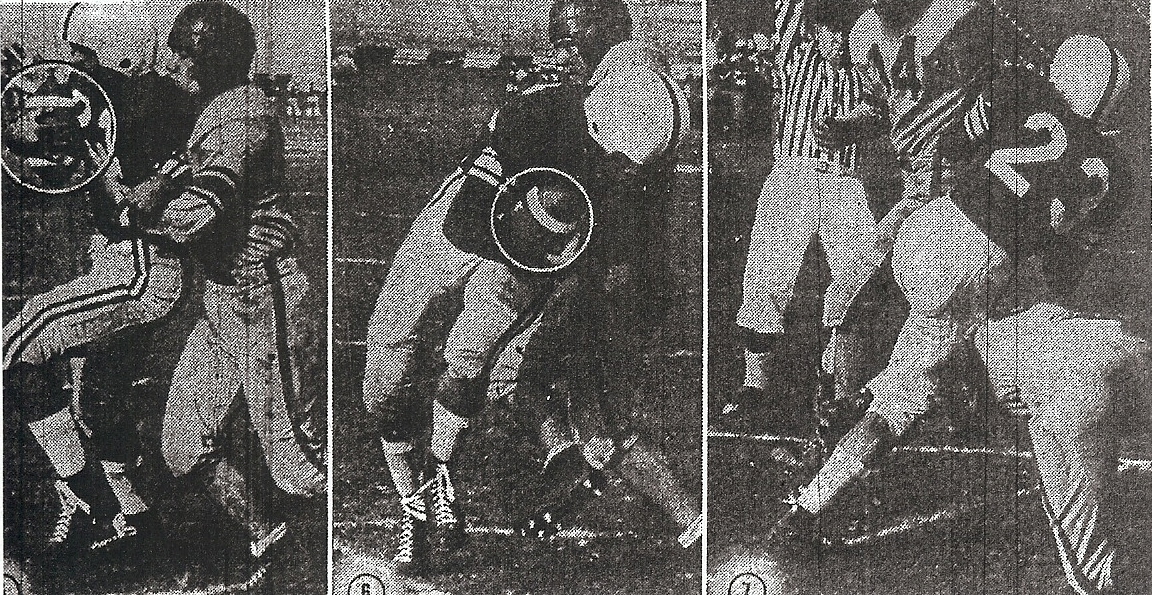
Players from each bench entered the fray. The game referee attempted to restrain a Helix player, who broke free from the grasp of the official, who threw a football that hit another player and a coach.
The referee was suspended for the remainder of the season and expressed regret, saying his action “…was significantly inappropriate.”
The Grossmont League then created outrage at Helix by ruling a double forfeit, probably the first in the history of San Diego County football.
“It’s an atrocity!” shouted Highlanders coach Donnie Van Hook, who said tension began building before the kickoff when a Mount Miguel player jumped on the Helix logo at the 50-yard line.
A total of 18 players from both teams and a Mount Miguel assistant coach were suspended for at least one game.
Three Helix players stayed home when the Highlanders went to Eastlake, where they lost, 24-14. A 17-year-old La Mesa youth was shot during the week and police and school officials decided the players should not attend the game because of possible gang action.
Van Hook stressed that the three players did not have gang affiliations.
TRUE GRID
Fallbrook returned 40 seniors from the 0-11 team of 2004 and improved to 5-6…El Camino returned 15 starters from the 2-8 squad of ’04 and went 2-8 again…an up-and-coming quarterback was Ryan Lindley at El Capitan…Lindley threw for almost 3,000 yards on the Vaqueros’ 8-2 junior varsity team in ‘04…Scripps Ranch’s 3-0 start was the best since the school opened in 1994…the Falcons went to 5-0 before losing…Santana, which started 5-0 in ’04, then flattened out to 6-4, went to 5-0 at the beginning of this season but sagged to 5-6…Brent Arthur, Rancho Buena Vista backup quarterback, sustained a compound fracture of his wrist and the game was called with eight minutes remaining, RBV leading Marian Catholic 42-14…Brawley served up a seventh consecutive shutout, tying a San Diego Section record, when it blanked Blythe Palo Verde Valley, 47-0…Trailing, 7-3, after three quarters, Francis Parker finally wore down Christian and won the D-V title game, 16-7…”We weren’t playing Francis Parker football,” said tackle Tyler Mabry of Parker’s slow going…the Lancers finished 12-1…Hoover snapped a 10-game losing streak to Morse, dating to 1968…the 9-0 victory helped propel Mike Wright’s Cardinals to a 6-5 season, their first above .500 since 2000….
Despite loss to Oceanside, El Cajon Valley’s Abraham Muheize set five San Diego Section passing records and one state record. When not running, Muheize passed for 4,050 years this season.
1954: Bulldogs’ Bite Felt in Foothills
Ramona High, in business since 1894 but sans football until 1938, was emerging.
Nestled at 2,200 feet between Mount Woodson and Iron Mountain in San Diego’s East County, the Bulldogs had quietly plugged along in relative mediocrity for 15 years, save for the 6-1 season of Charlie Snell’s 1940 squad.
Ramona suddenly posted a 7-0 record under new coach Glenn Forsythe this season, steamrollering through a variety of competition that included teams from the Southern Prep League and earning a name among Southland small schools.
The Bulldogs were unscored upon until the final game, when they posted a 26-13 victory over a first-year Mission Bay varsity that had played a mostly junior varsity schedule.
Forsythe was a quiet Midwesterner who didn’t raise his voice.
“He was one of the finest men and finest coaches I have known,” said David Farmer, a 1956 graduate who went on to a long and distinguished career in journalism.
WHAT DID YOU SAY?
Forsythe was “so modest and soft spoken that you had to strain to hear him, whether on the field, in the classroom, or in a school assembly,” Farmer remembered.
Ernie Trumper was Bulldogs standout.
The Bulldogs heard their coach.
Among victories were routs of 51-0, 47-0, and 45-0 over league rivals Brown Military, Army-Navy, and Mountain Empire, respectively.
Statistics were missing from two early-season wins, 13-0 over San Juan Capistrano and 6-0 over Imperial, so the exploits of Ronnie Blakeley and Ernie Trumper are only partially known.
1-2 TOUCHDOWN PUNCH
Blakeley was at least the second highest scorer in the County with 12 touchdowns and 72 points in five games, including 6 touchdowns against Brown Military.
Trumper followed Blakeley with 10 touchdowns and 60 points in five games. Hoover’s John Adams led area runners with 108 points in 10 games.
The Bulldogs qualified for the Southern California small-schools playoffs but did not participate.
The Bulldogs were entering an era that still resonates in the Ramona Valley. They would make even more explosive statements beginning in 1955.
1954: South Bay Dynasty
Chet DeVore was thinking of an earlier, distant journey and a notion called the “Spin T”.
“We expect a tough game from an aggressive, well-coached team,” DeVore said of coach Gus Headington’s 10-1 El Centro Central squad and its uniquely designated offensive formation, “but we took one, long ride home with a beaten team this year and we don‘t plan to do it again.”
The Chula Vista Spartans had dropped their opening game, 13-6, at Torrance.
Now the blue-and-white-clad Spartans would meet the blue and white Spartans of “The High,” the locals’ designation for Imperial Valley’s oldest school.
At stake: championship of the CIF Southern Section Southern division (small schools). Chula Vista was trying to repeat after a 12-6 victory over Brawley in the 1953 finals.
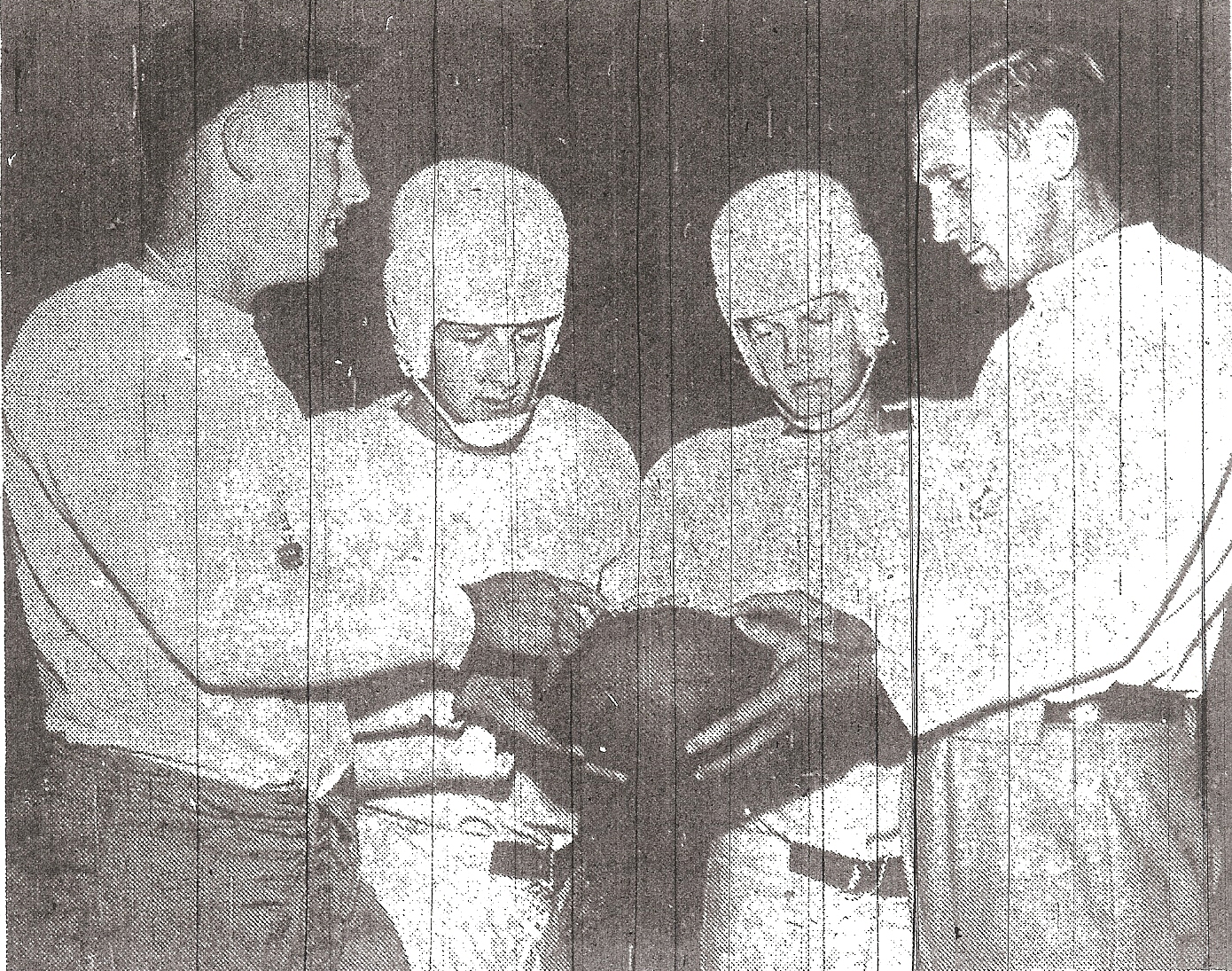
DeVore chalk talked with quarterback Bob Franklin (center) and fullback Billy Lancaster before championship game,
DeVore was prescient.
Although they trailed 6-0 at the end of the first quarter, the visitors rolled to a 34-12, fourth-quarter advantage and cruised to a 34-19 victory.
Spin T or no Spin T.
Defensive end Larry Armbrust kept constant pressure on Central quarterback Larry Shaw, interrupting Shaw’s timing in the formation, which called for the quarterback to take the ball under center, then wheel and effect a spinning move before giving the ball to a predetermined ball carrier.
Shaw faced further grief from Chula Vista defenders Larry Erwin, Wayne Cassity, Carroll Clowers, and Bob Erwin.
The victory was Chula Vista’s 11th in a row since the opener.
Defeats were becoming few and far between at Chula Vista.
The Spartans’ record since the last two games of DeVore’s first season in 1951 was 33-2. They had not lost since the 1952 playoffs.
I DARE YOU
Teams throughout the country had been leaving the single and double wings and installing various T formations in the last few years. Chula Vista ran the ground-chewing Split T favored by college powerhouse Oklahoma and others.
McLean, scoring against St. Augustine, was threat from anywhere on field.
Grossmont coach Phil Morell was so sure Chula Vista would not pass that the Foothillers’ mentor sent his team out with a nine-man defensive line before a crowd of 4,650 at Helix that included a large group of Spartans’ supporters.
Chula Vista’s running game did not suffer.
Jim McLean ran 61 yards for a touchdown on the Spartans’ third play and 91 yards for a score on Chula Vista’s next possession.
McLean’s 180 yards in 7 carries averaged 25.7 per attempt. Jim Damron added 35- and 59-yard touchdowns runs and Don Schmautz raced 58 yards for a score.
Chula Vista ran off with its third straight Metropolitan League championship, 31-14.
SPARTANS OWN THIS AWARD
Larry Armbrust and Larry Erwin were named linemen of the week and fullback Don Schmautz and halfback David Erwin were backs of the week after the Spartans dismissed Sweetwater 41-7 in the final-regular season game.
No surprise there.
Spartans Vernon Sanna, Carroll Clowers, and Bob Lusky had been previous linemen of the week and Dave Erwin, player-of-the-year Bob Franklin, and Jim McLean had won back-of-the-week awards chosen by The San Diego Union.
“We like to think we have eleven good players, not just one or two great ones,” said DeVore.
CAN’T SHAKE THEM
Oceanside couldn’t beat Chula Vista when the Pirates had the great C.R. Roberts and were in the Metropolitan League with their rivals 50 miles down U.S. 101.
Roberts was gone this year, but so was Oceanside. What goes around doesn’t always come around.
The Pirates moved into the new Avocado League this season but were forced to play Chula Vista in a first-round playoff.
Chula Vista eliminated John Simcox’s team, 32-7.
JACK AND THE ARGONAUTS
A semifinal game with Garden Grove proved a pesky challenge, for awhile.
The usual overflow crowd of 5,000 at the Spartans’ stadium sat through 125 yards in penalties, six fumbles and five pass interceptions by both teams.
The Argonauts’ Jack Hart, who played left halfback in a Split T formation, moved to tailback when the visitors went to a spread formation.
Hart was a nettlesome presence when he ran and passed the Orange County squad to a 6-0 lead in the second quarter. The
Quarterback Bob Franklin was Metropolitan League player of the year.
Spartans solved Hart’s code thereafter, intercepting four of his passes.
Chula Vista was leading 19-6 in the third quarter when the visitors’ Jim Dunivin executed a hidden ball play. Dunivin appeared to fake a handoff to Don Hosmun then roll and seemingly look for a pass receiver.
Hosmun kept the ball and ran 50 yards for a score as Spartans defenders pursued Dunivin. The touchdown etched a final score of 19-13 favoring Chula Vista.
COMPETITION UPGRADE
With two straight championships the Spartans would look for a bigger challenge in 1955. They would be moving into the playoffs major division.
1954: Cavemen Come of Age
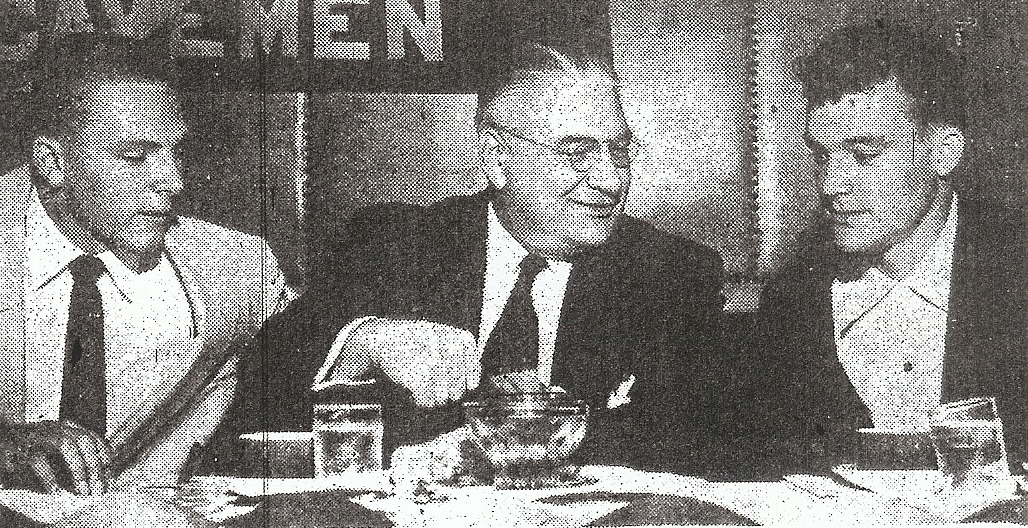
Duane Maley, his voice hoarse and body soaked from an impromptu shower by the coach’s shouting, celebrating players, stood amid the bedlam of the San Diego High sideline in Balboa Stadium.
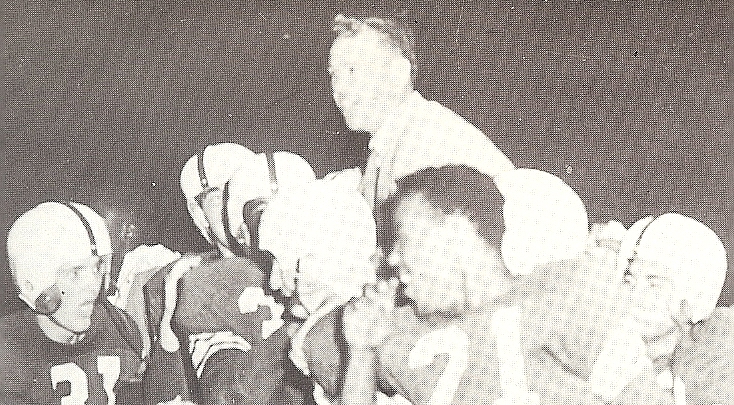
Jubilant Cavemen hoist coach Duane Maley after San Diego’s upset of Hoover.
“My kids played the best football game I’ve ever seen,” said Maley after the gritty, 7-0 victory over the 7-0 Hoover Cardinals in perhaps the biggest regular-season game in the history of either school.
“It was strictly a team job,” Maley told Jerry Brucker of the Evening Tribune. “All our guys played their best ball. We beat Hoover up the gut (151 yards rushing), where they’re toughest.”
Only weeks before the headlines in San Diego newspapers seemed to say it all:
“CAVEMEN, AT LONG LAST, LOSE FAVORITE’S ROLE”
“CAVE FORTUNES AT LOW EBB”
The latter referenced a stunning, 25-0 defeat in the second game of the season against a middling Pasadena squad the Hillers had annually pushed around when the schools were members of the Coast League.
The Bullpups, eventually renamed Bulldogs, who had dropped their opener to Compton, 28-0, scored in every quarter and stunned the visitors from the Border City.
San Diego had won or shared City Prep League titles since the circuit was formed in 1950, but the 7-3 team of 1953 had graduated virtually everyone and that team had made an unexpectedly early departure from the playoffs, spanked by Anaheim, 21-7.
At 1-1 (the opener was a 7-2 victory over visiting Lynwood) Duane Maley’s team appeared ready to be had, especially after Hoover opened with a 34-20 win over Santa Monica, the reigning, two-time Southern California champion, and followed with a 20-0 victory at San Bernardino.
Non-letterman Art Powell made all-Southern California.
The Cavers’ three lettermen were end-linebacker Deron Johnson, who had been promoted from the junior varsity in ’53, halfway through his sophomore season; fullback Joe Banks, and halfback Don Strickland.
POWELL, GUMINA, AND WEST
Maley and his assistant coach, Birt Slater, talked about what needed to be done on the long bus ride back to San Diego after the loss at Pasadena.
They hadn‘t yet proved themselves but junior halfback Willie West and junior quarterback Pete Gumina were going to be stars, as would end Art Powell, Charlie’s younger brother.
Halfbacks James Grady and Leonard Kary, center Henry Wakefield, tackles Tom Collins, A.C. Mills, and Dick Szakacs, guards Wayne Melvin and Don Hiler, fullback Eldridge Cooks, and others till now unknown, also would have to rise.
Maley and Slater spent the weekend looking at their team’s now uncertain future but with their eyes fixed on a destination game against Hoover, six weeks down the road.
MOMENTUM
Essentially routine victories of 39-19 over La Jolla and 32-0 over Lincoln got the Hillers back on track. They moved to 4-1 with a 28-6 win over Point Loma that took on some added cachet considering the Pointers had scared Hoover before bowing, 20-13.
San Diego didn’t put Kearny away until the fourth quarter of a 26-13 exercise but it climbed to 6-1 with a 41-19 victory over old punching bag Grossmont as Gumina passed for three touchdowns and had two others dropped.
CARDINALS SOLID FAVORITES
San Diego had come a long way from 0-25, but oddsmakers probably would have made Hoover at least a seven or eight-point favorite in the rivals’ upcoming title showdown.
The Cavers were ready when Grady signaled their intentions by returning the opening kickoff to his 37-yard line, stopped by John Adams, who made an ankle-top tackle.
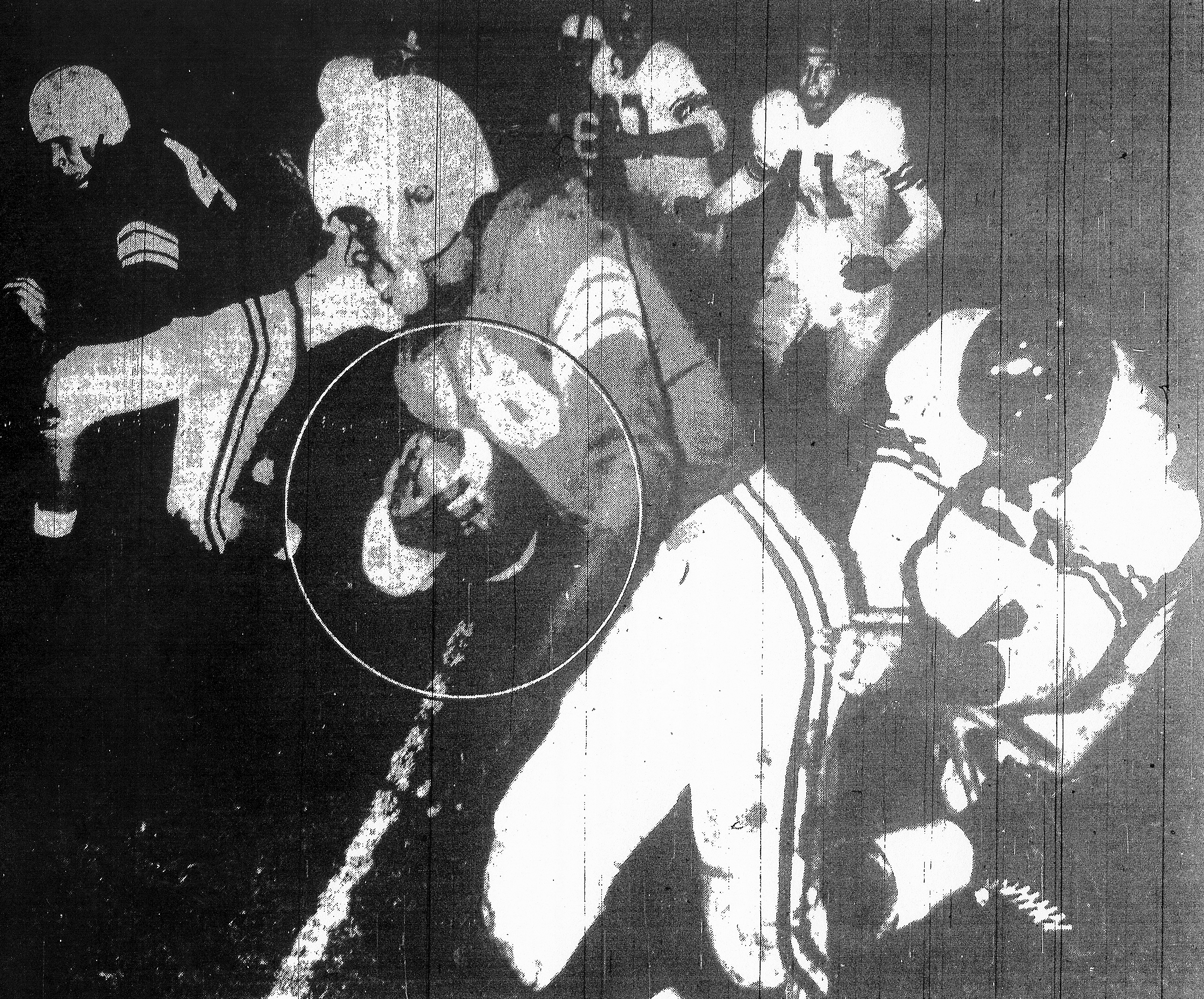
James Grady is halted on opening kickoff by Cardinals’ John Adams.
From there it was a back-and-forth struggle that wasn’t decided until the Cavers’ Joe Banks nudged over for the game’s only touchdown with a little more than six minutes to play.
LAS VEGAS, LONG BEACH WILSON FOLLOW
The victory was challenged by a chorus of Hoover complaints about the game officials, but they were drowned out by the euphoria of San Diego’s victory in this rare role as an underdog.
The Cavers weren’t finished. They went to 8-1 the next week at home with a 26-13 triumph over the 7-2 Las Vegas Wildcats, Nevada’s top team, and then opened the playoffs at home with a 26-13 victory over Long Beach Wilson.
Wilson, which upset the Hillers, 27-13, in the 1945 playoffs and with a 5-3 record this season, led San Diego, 13-7, with just under eight minutes remaining in the game. Touchdowns by West, Cooks, and Kary finally vaulted the Cavers past the pesky Bruins.
Leonard Kary broke free from Wilson’s Ray San Jose to score San Diego’s final touchdown in 26-13 win.
Next would be a quarterfinal test at Santa Monica, which had rebounded from the loss to Hoover and was 7-2, seeking its third straight Southern Section championship.
Trouble loomed.
Deron Johnson sustained a broken hand and Leonard Kary suffered fractured ankle in the third quarter against Wilson. Both were done for the season. Art Powell came down with a broken toe on the last play of the game but would play against the slightly favored Vikings.
Santa Monica, a 13-12 winner over the Hillers in the 1947 championship game, held on to win,14-13, as Vikings supporters flooded the field at the end of the game, more relieved than anything else.
Quarterback Lee Grosscup converted 10 of 15 passing attempts for 148 yards and a touchdown and kept the Cavers on their heels. The Vikings won the yardage battle 344-273, but the visitors rushed for 238 yards and were in position to take the lead in the fourth quarter.
Willie West (left) and James Grady were pivotal in Hillers’ ground game.
HILLERS DENIED
Trailing, 14-13 (a fumbled snap nullified one point-after-touchdown attempt on a field wet from recent rain), the Cavers began from their 20-yard line, where Gumina pitched to Banks, who lateraled to a trailing Willie West.
West weaved 60 yards downfield to the Vikings’ 20, then lateraled to the trailing Gumina, who finally was downed on the 12.
Three plays later the Cavers were back on the 14.
Gumina passed to Alden Kimbrough, Deron Johnson’s replacement. Kimbrough juggled the ball in the end zone, then saw the ball squirt from his hands.
Santa Monica rode out the clock.
Despite the loss, Maley noted that no team of his “had started with so little and come so far.”
The Cavemen already were thinking ahead to 1955.
WHEN AND WHERE?
San Diego had two representatives for the first time in the CIF Southern Section large-school playoffs, the postseason bracket having increased from 10 to 16 teams, the additional six including selected league second-place finishers or deserving free-lance teams.
Despite a crushing loss to San Diego and a struggle the following week in a 14-7 victory over start-up Lincoln, Hoover was in for the first time since winning the Bay League in 1935.
The first-round was scheduled for Friday, Nov. 26, in the middle of the Thanksgiving weekend. Southern Section commissioner Ken Fagans ruled out the possibility of two Friday night games in San Diego and what their effect would have on ticket revenue.
San Diego was booked for a Saturday afternoon contest in Balboa Stadium against Long Beach Wilson, the Coast League runner-up.
Hoover, the San Diego City League’s No. 2 team, would meet Coast league champion Compton.
Six days after the loss to San Diego and before the final regular-season game, Hoover principal Floyd Johnson and head coach Bob Kirchhoff were in Oceanside for a 9 a.m. meeting with Compton coach Gordon Orr and athletics director Keith Lee.
The Cardinals won a coin toss at the meeting and hosted a Wednesday night game the next week. Leading, 12-0, at halftime, the Cardinals fell to the Tarbabes, 20-18.
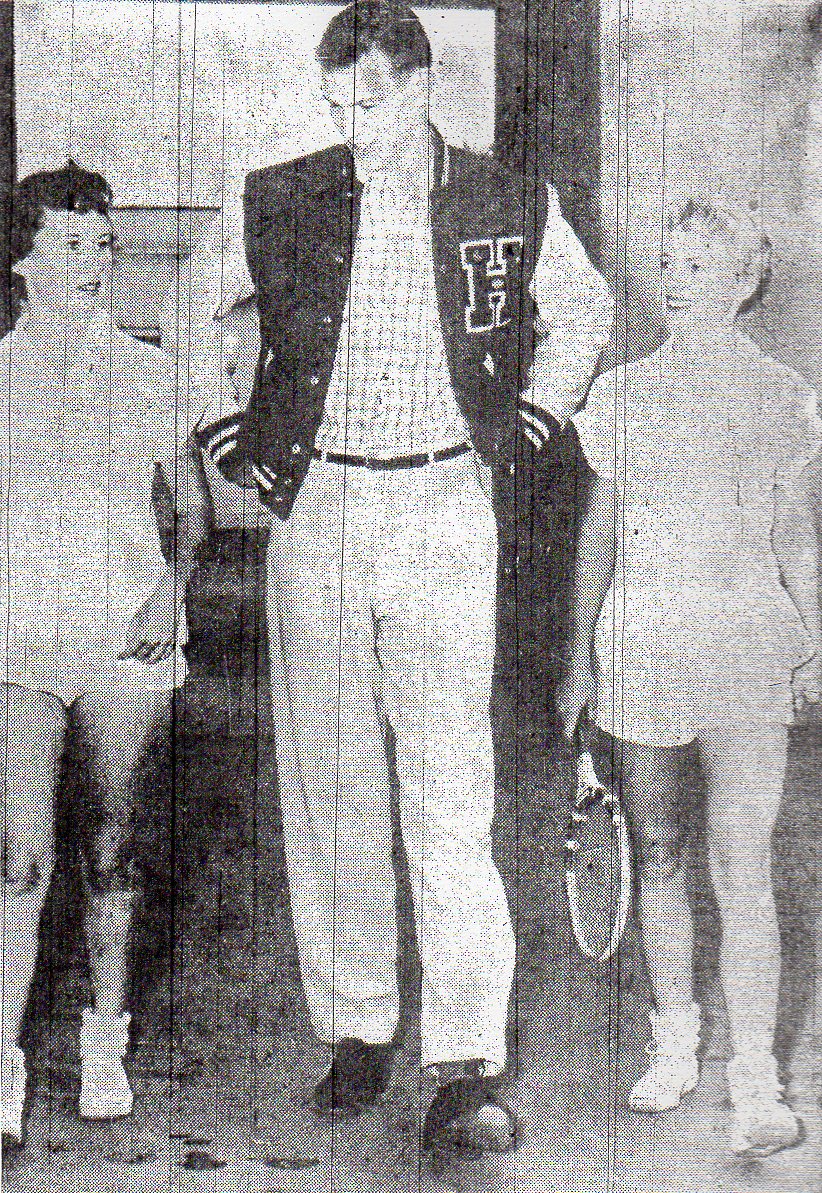
Hoover end Bill Kupiec, 6-feet, 5 1/2 inches, was a big man on campus, towering over coeds Wilma Miller (left) and Carolyn Osburn.
HONORS
Art Powell and John Adams made the all-Southern Section first team. San Diego’s Johnson and Hoover tackle Troy Barbee were on the third team. Another third-team choice was Compton Centennial’s Paul Lowe, later to become one of the San Diego Chargers’ all-time running backs.
Back Bob Erwin of Chula Vista and center Bill Cooper of Hawthorne were co-players of the year in the lower division. Chula Vista end Carroll Clowers was on the second team.
SIGNS OF THE TIME
Halloween rascals were not out in force, according to County sheriffs, but don’t tell that to Escondido principal Guilford (Bud) Quade.
Inventive vandals hurled light bulbs filled with paint, damaging Quade’s automobile, and “grease bombs” were tossed at his home.
This Bud definitely wasn’t for the Cougars’ boss.
HORNETS’ GYM APPROVED
The San Diego Board of Education accepted the low bid on construction of an auditorium-gymnasium at the new Lincoln High after having delayed action when the bid turned out to be $12,409 in excess of the estimate.
Chamco Construction won the bid at $378,669, which reconciled at $13.46 a square foot. The same contractor won a bid for a similar gymnasium-auditorium at Mission Bay for $10.10 per square foot.
Assistant superintendent George Geyer suggested accepting the Lincoln offer because it would take a year to redesign the building and call for new bids.
PIGSKIN OR RUBBER…NO MATTER
Escondido assistant coach Bob (Chick) Embrey, Bill Stewart, Larry Cope, and head coach Walt West (from left) inspect rubber ball.
Oceanside won the inaugural Avocado League championship by virtue of a 0-0 tie with old rival Escondido on a field left sloppy from rains.
The teams had prepared for an off track by introducing an easier-to-grasp rubber football, similar to that used by teams from the Eastern part of the country when bad weather hits in the late fall.
But as Union writer Dave Gallup pointed out, fumbles and intercepted balls were caused by a slick ball.
Escondido had 93 yards total offense, Oceanside 31.
SORRY, WRONG NUMBER!
Lincoln halfback Sam Goldstein was The San Diego Union City Prep League back of the week after he led the Hornets to their first ever victory with two touchdowns in a 19-0, opening-game shutout at Escondido.
Identity theft? Actually, two or three.
As noted in a much smaller story the next day:
Goldstein didn’t score on a 35-yard pass-run play with quarterback “Don” Seeley or on a 75-yard pass play later in the game.
Doyle Seeley was the quarterback in question, but it was Percy Campbell who threw the two touchdown passes.
And it was halfback Charlie Cox who scored the touchdowns.
The Union declared the mistaken identity on Goldstein-Cox was due to a switch in jersey numbers.
But what about Don, er, Doyle Seeley and Percy Campbell? They didn’t change jersey numbers.
California coach Pappy Waldorf broke bread with Hoover’s John Adams (left) and San Diego’s Deron Johnson.
22-POINT LOSS IS IMPROVEMENT
Grossmont’s 41-19 loss to San Diego actually qualified as a moral victory.
–Grossmont was winless in 11 games against Cavers’ varsity dating to 1922, the season which ushered in the series with a 40-7 San Diego victory.
–The teams didn’t meet again until 1943. From that season through 1949, Grossmont was outscored, 128-7, in five losses.
–Grossmont was on the sore end of a 67-0 score in 1953.
–Eight of San Diego’s 11 wins were by shutout.
–The 19 points scored against the Cavemen this season almost equaled the 21 Grossmont had scored in the previous 33.
Grossmont also had a 1-4-1 all-time record against San Diego’s Reserves, B teams, or the split squad of the World War II 1942 season.
FUTURE CHARGERS
First-year Compton Centennial was a surprising winner in the Southern Section playoffs, defeating Glendale Hoover, 12-6. Single-wing tailback Paul Lowe completed a 50-yard touchdown pass on the final play of the game for the victory.
Santa Monica and Compton, teams which eliminated San Diego and Hoover, were themselves beaten in the semifinals. The Cavers and Cardinals still ranked among the best of the 227 schools competing in the CIF Southern Section.
QUICK KICKS
Don Giddings was the veteran Point Loma coach…Don Giddings also was the name of the horse that ran out of the money at Jamaica Racetrack on Long Island, N.Y….Ray Blasingame, who also answered to “Boomer” and “Blaster”, Point Loma’s 1953, all-league end, was an all-league fullback in 1954…21,000 persons were in Balboa Stadium as the East (La Jolla, Hoover, Kearny) topped the West (Lincoln, Point Loma, San Diego), 18-13, in the CPL carnival…6,000 jammed Spartan Stadium in Chula Vista for the Metropolitan League carnival, matching the Grossmont school district league schools against teams from the Sweetwater district…the Avocado League got into the carnival spirit two weeks into the season, when 4,000 filled Escondido’s new, Vallecitos Stadium to watch the inland schools, Escondido, Fallbrook, and Vista, defeat the Coastals, San Dieguito, Oceanside, and Coronado, 21-13…San Diego’s Art Powell wore jersey number 49, same as worn by brother Charlie five seasons before…Mar Vista, enrollment 410, bailed from the Metropolitan League and would go into the Avocado loop in 1955…the Split T formation favored by college powerhouse Oklahoma was en vogue…La Jolla finally gave up the single wing for the Split T under second-year coach Frank Smith….University of California coach Lynn (Pappy) Waldorf was guest of honor and speaker when the North Park Kiwanis honored the Hoover and San Diego squads with a postseason dinner at the Imig Manor Hotel on El Cajon Boulevard….
1954: Coronado’s Fallen Officer
Frank Greene had spent much of his life around a football field or in law enforcement when he was shot and killed at age 43 on Oct. 12, 1954.
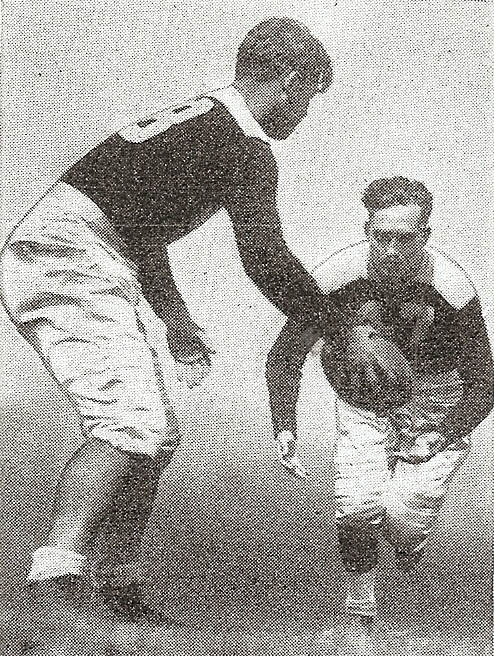
Greene set the standing California high school record of 80 points in one game when he scored 11 touchdowns and 14 points after in a 108-0 Coronado victory over Sweetwater in 1929.
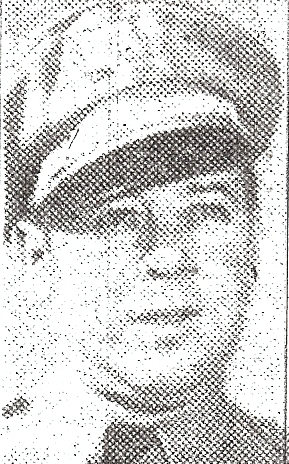
Coronado police Lt. Frank Greene.
Greene, whose death came 25 years and two days after his feat, was a lieutenant on the Coronado police force, working the graveyard shift with Richard Lutsey, a Navy shore patrolman.
Newspaper reports said Greene had received a tip that a robbery was planned to take place at the Mexican Village Restaurant on Orange Avenue.
It was 1:25 a.m. when Greene and his partner noticed with suspicion a 1947 Ford sedan and signaled for the vehicle to pull over as it drove slowly down Coronado’s main thoroughfare.
…”THEN THE SHOT”
Three men were in the vehicle. Greene approached the driver’s side and asked, ‘Where are you going?'” and motioned the occupants to step from the car.
“The fellow sitting next to the driver got out right away,” said Greene’s partner, shore patrolman Lutsey. “The passenger was facing me when the lieutenant made some remark, like he was insisting on identification papers from the driver.”
A moment or two passed. “Then it happened,” said Lutsey. “”I heard a slight scuffle and then the shot.”
Greene fell backward. He probably was dead when he hit the pavement, from a bullet that entered below Greene’s right cheek and lodged in his neck.
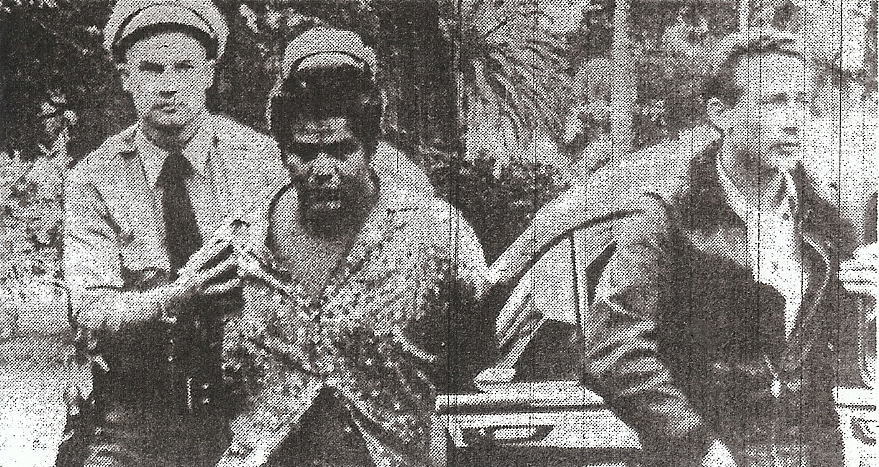
The shooter, Roberto Rodriquez, 27, and Rafael Gruber, 22, a passenger in the backseat, fled. Benjamin Brozowski, 39, who sat next to Rodriguez, was held at the scene by Lutsey.
Captured suspect Rodriguez is taken to Coronado police station.
KITCHEN EMPLOYEES
All three worked in the Hotel del Coronado kitchen as dishwashers, although Brozowski also was described as a “salad man.”
A manhunt involving peace officers from Coronado, San Diego, National City, Chula Vista, the Naval Air Station, and National Guard resulted in arrests of all three within 31 hours.
Officers went house to house, helicopters were deployed along beaches and the Coronado ferry slips were guarded. The community of 12,500 residents was sealed off.
Rodriguez was found days later huddled in the attic of the Hotel del Coronado annex.
Gruber had escaped to Tijuana by traveling on foot 10 miles down the beach on the ocean side of the Silver Strand, Coronado’s only outbound (and blocked) road.
Gruber turned himself in at San Ysidro after reading in a Tijuana newspaper that he was accused of being the shooter.
Rodriguez was tried and sentenced to life in prison for first degree murder and given consecutive sentences for conspiracy to commit robbery and for possession of a gun by a felon. Rodriguez had been in and out of prison since his teenage years.
Brozowski was given a life sentence for murder and five years to life for conspiracy to commit robbery. Gruber received five to life for robbery conspiracy.
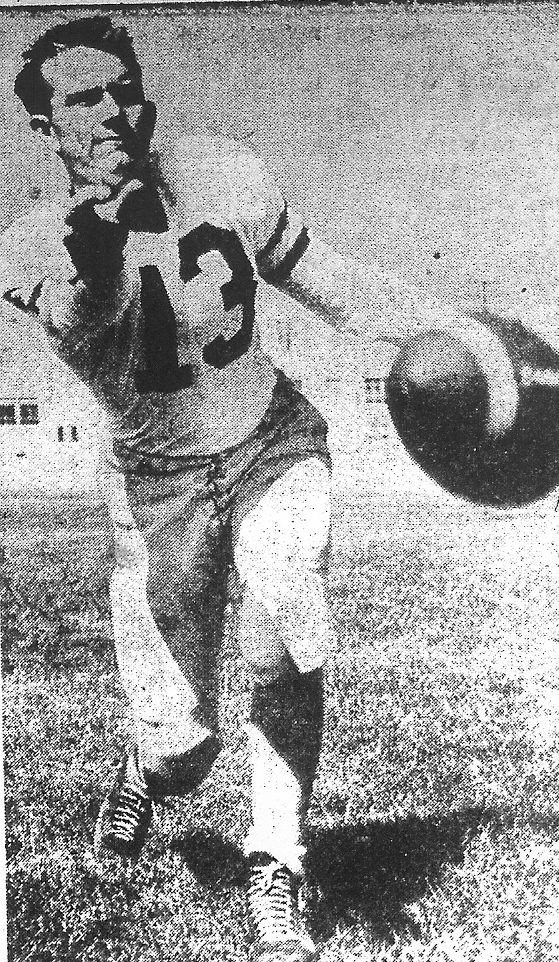
Greene handed off to teammate in 1934 Chicago Cardinals publicity photo.
MOCKS JUDGE’S ADMONITION
Rodriguez smiled and waved when the sentence was pronounced by Superior Court Judge John Hewicker, who criticized the jury’s decision, believing Rodriguez should have gotten the gas chamber. A juror said the jury vote was 11-1 for death.
Gruber, who had testified against the other two defendants, attempted to hang himself while in the San Diego City Jail. He said he feared prison and “friends” who would seek revenge on Rodriguez’ behalf.
Greene is the only Coronado policeman killed in the line of duty. He was active in the community as a founder of Coronado’s Little Theater and as a coach of the semipro Coronado Colts football team.
Greene had been screen tested by the RKO Radio Pictures studio.
Greene was dangerous runner for Coronado’s once-beaten Islanders in 1929.
PLAYED AND COACHED
Greene received all-America honorable mention as a kicker and single wing blocking quarterback under the legendary “Gloomy” Gus Henderson at Tulsa University.
Greene played for the Chicago Cardinals of the NFL in 1934-35 and was a player-coach with the Los Angeles Bulldogs of the American Football League in 1936.
Greene scored 164 points for the 8-1 Coronado Islanders, whose only 1929 loss was to Southern California champion Long Beach Poly, 20-7. He held the school season scoring record for 74 years, until J.R. Roggin bettered the mark in 2003.